
NCERT Textbook Questions & Answers + Important Extra Questions
Section A: In-Text Questions
What is meant by power of accommodation of the eye?
Answer
The ability of the eye lens to adjust its focal length to focus on objects at varying distances is called the power of accommodation. The ciliary muscles can change the shape (curvature) of the lens — they make it thinner (longer focal length) to see distant objects and thicker (shorter focal length) to see nearby objects. This allows us to see objects clearly from about 25 cm (near point) to infinity (far point).
A person with a myopic eye cannot see objects beyond 1.2 m distinctly. What should be the type of the corrective lens used to restore proper vision?
Answer
A concave lens (diverging lens) should be used. The far point of this person is 1.2 m instead of infinity. The concave lens will diverge the incoming parallel rays from distant objects so that they appear to come from 1.2 m, which the eye can then focus on the retina.
Power of lens = 1/f = 1/(–1.2) = –0.83 D
What is the far point and near point of the human eye with normal vision?
Answer
Far point: The farthest point at which the eye can see objects clearly — for a normal eye, this is at infinity (∞).
Near point: The nearest point at which the eye can see objects clearly (without strain) — for a normal eye, this is at 25 cm (called the least distance of distinct vision, denoted as D).
A student has difficulty reading the blackboard while sitting in the last row. What could be the defect of vision? How can it be corrected?
Answer
The student is suffering from myopia (short-sightedness / near-sightedness). In this condition, the person can see nearby objects clearly but cannot see distant objects (like a blackboard from the last row) clearly. This happens because the image forms in front of the retina instead of on it.
Causes: Elongated eyeball or excessive curvature of the eye lens.
Correction: Using a concave lens (diverging lens) of appropriate focal length, which diverges the light rays before they enter the eye, pushing the image back onto the retina.
Section B: NCERT Exercise Questions
The human eye can focus on objects at different distances by adjusting the focal length of the eye lens. This is due to:
Answer
(a) presbyopia (b) accommodation (c) near-sightedness (d) far-sightedness
Ans. (b) Accommodation. The ciliary muscles change the curvature of the eye lens, adjusting its focal length to focus light from objects at various distances onto the retina.
Q2. The human eye forms the image of an object at its
(a) cornea (b) iris (c) pupil (d) retina
Ans. (d) Retina. The eye lens converges light rays to form a real, inverted, and diminished image on the retina, which contains light-sensitive cells (rods and cones) that convert the image into electrical signals for the brain.
The least distance of distinct vision for a young adult with normal vision is about:
Answer
(a) 25 m (b) 2.5 cm (c) 25 cm (d) 2.5 m
Ans. (c) 25 cm. This is the minimum distance at which a normal eye can see an object comfortably and clearly without straining the eye.
The change in focal length of an eye lens is caused by the action of the:
Answer
(a) pupil (b) retina (c) ciliary muscles (d) iris
Ans. (c) Ciliary muscles. When these muscles contract, the lens becomes thicker and its focal length decreases (for near vision). When they relax, the lens becomes thinner and focal length increases (for far vision).
A person needs a lens of power –5.5 D for correcting his distant vision. For correcting his near vision he needs a lens of power +1.5 D. What is the focal length of the lens required for correcting (i) distant vision, and (ii) near vision?
Answer
(i) For distant vision: f = 1/P = 1/(–5.5) = –0.182 m = –18.2 cm (concave lens)
(ii) For near vision: f = 1/P = 1/(+1.5) = +0.667 m = +66.7 cm (convex lens)
The far point of a myopic person is 80 cm in front of the eye. What is the nature and power of the lens required to correct the problem?
Answer
A concave lens is needed. The lens must form a virtual image of distant objects (at infinity) at the far point (80 cm).
u = –∞, v = –80 cm = –0.80 m
1/f = 1/v – 1/u = 1/(–0.80) – 1/(–∞) = –1/0.80 – 0 = –1.25
Power P = 1/f = –1.25 D
Make a diagram to show how hypermetropia is corrected. The near point of a hypermetropic eye is 1 m. What is the power of the lens required to correct this defect? Assume that the near point of the normal eye is 25 cm.
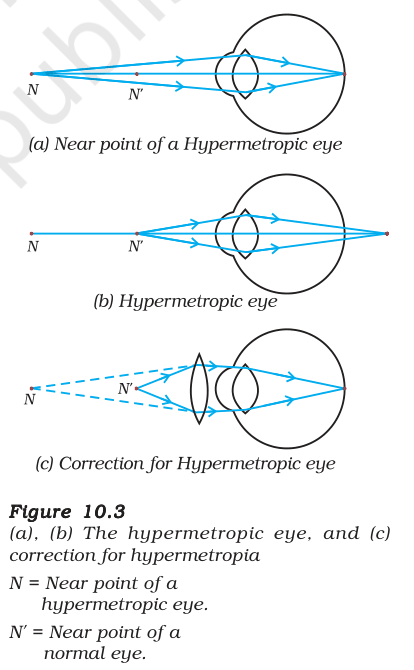
Answer
In hypermetropia, the image of nearby objects forms behind the retina. A convex lens is used for correction.
The lens must form a virtual image of an object at 25 cm (normal near point) at 1 m (person's near point).
u = –25 cm = –0.25 m, v = –1 m = –1.0 m
1/f = 1/v – 1/u = 1/(–1.0) – 1/(–0.25) = –1 + 4 = 3
Power P = +3 D
Why is a normal eye not able to see clearly the objects placed closer than 25 cm?
Answer
When objects are placed closer than 25 cm, the ciliary muscles have to contract excessively to increase the curvature of the lens, and the lens cannot become thick enough to focus light from such close objects onto the retina. The image would form behind the retina. At 25 cm, the ciliary muscles are at their maximum contraction — beyond this, they cannot adjust further. Trying to focus closer causes eye strain and a blurred image.
What happens to the image distance in the eye when we increase the distance of an object from the eye?
Answer
As we move the object farther from the eye, the image distance decreases slightly to maintain focus on the retina. The ciliary muscles relax, making the lens thinner and increasing its focal length. This adjustment keeps the image precisely on the retina. However, since the retina is at a fixed position, the actual change in image distance is very small — it's the lens shape that adjusts to compensate.
Why do stars twinkle?
Answer
Stars twinkle because of atmospheric refraction of starlight. Stars are extremely far away and behave as point sources of light. As starlight enters Earth's atmosphere, it passes through layers of air with varying densities and temperatures that are constantly changing due to air currents. This causes the path and intensity of light reaching our eyes to fluctuate continuously — sometimes more light reaches us, sometimes less. This variation in brightness gives the appearance of twinkling. Planets, being much closer and appearing as extended sources (not point sources), do not twinkle noticeably.
Explain why the planets do not twinkle.
Answer
Planets are much closer to Earth than stars, so they appear as extended sources of light (small discs, not point sources) when seen through telescopes. An extended source can be thought of as a collection of many point sources. The fluctuations in light from individual point sources average out over the visible disc of the planet, resulting in a steady, non-twinkling appearance. Stars, being enormously far away, appear as point sources, making the atmospheric fluctuations visible as twinkling.
Why does the Sun appear reddish early in the morning?
Answer
At sunrise and sunset, sunlight travels through a much thicker layer of Earth's atmosphere compared to when the Sun is overhead. During this longer path, the shorter wavelengths of light (blue and violet) are scattered away in all directions by air molecules (Rayleigh scattering). Only the longer wavelengths (red and orange), which are scattered the least, reach our eyes directly. This is why the Sun and the sky near the horizon appear reddish at dawn and dusk.
Why does the sky appear dark instead of blue to an astronaut?
Answer
The sky appears blue from Earth's surface because air molecules scatter blue light (shorter wavelength) more than other colours, and this scattered blue light reaches our eyes from all directions. In space, there is no atmosphere — no air molecules to scatter light. Without scattering, light travels in straight lines from the Sun, and when we look away from the Sun, there is no scattered light to see. Hence, the sky appears dark/black to astronauts, and stars are visible even during the "daytime."
Section C: Important Extra Questions
What is presbyopia? How is it corrected?
Answer
Presbyopia is a vision defect that occurs with ageing (usually after age 40). The ciliary muscles weaken and the eye lens loses its flexibility, reducing the power of accommodation. The near point gradually recedes beyond 25 cm, making it difficult to read or see nearby objects clearly.
Correction: Bifocal lenses — the upper portion has a concave lens for distance vision, and the lower portion has a convex lens for near vision. Sometimes, a person may need only reading glasses (convex lens) if distance vision is normal.
What is the difference between myopia and hypermetropia?
Answer
Myopia (short-sightedness): Distant objects appear blurred; nearby objects are clear. Image forms in front of the retina. Caused by elongated eyeball or excessive lens curvature. Corrected by concave lens.
Hypermetropia (long-sightedness): Nearby objects appear blurred; distant objects are clear. Image forms behind the retina. Caused by shortened eyeball or weak lens curvature. Corrected by convex lens.
Why does a diamond sparkle so brilliantly?
Answer
Diamond has a very high refractive index (2.42), which gives it a very small critical angle (about 24.4°). When light enters a diamond, most of the light rays strike the internal surfaces at angles greater than the critical angle, undergoing total internal reflection repeatedly. This means light bounces around inside the diamond many times before finally emerging, creating intense brilliance. Diamond cutters specifically cut facets at angles that maximise this effect.
What is a spectrum? How is white light dispersed by a glass prism?
Answer
A spectrum is the band of colours obtained when white light is split into its component colours. When white light enters a glass prism, different colours (wavelengths) are refracted by different amounts because the refractive index of glass varies slightly with wavelength. Violet light (shortest wavelength) is bent the most, while red light (longest wavelength) is bent the least. This separation of white light into its constituent colours — VIBGYOR (Violet, Indigo, Blue, Green, Yellow, Orange, Red) — is called dispersion.
What is Tyndall effect? Give examples.
Answer
The Tyndall effect is the scattering of light by colloidal particles suspended in a medium. When a beam of light passes through a colloid (like smoke, mist, or milk), the suspended particles scatter the light, making the beam visible.
Examples:
(i) Sunlight streaming through a gap in a dark room — dust particles scatter the light, making the beam visible.
(ii) Headlights of a car becoming visible as beams in foggy conditions.
(iii) Blue colour of the sky — air molecules scatter blue light more (similar principle).