
NCERT Textbook Questions & Answers + Important Extra Questions
Section A: In-Text Questions
Why does a compass needle get deflected when brought near a bar magnet?
Answer
A compass needle is a small bar magnet that is free to rotate. The magnetic field of the bar magnet exerts a force on the compass needle, causing it to align along the direction of the field at that point. The north pole of the compass is attracted towards the south pole of the bar magnet, causing deflection.
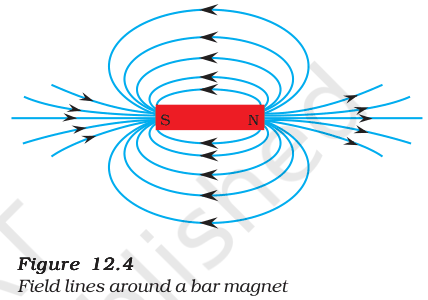
Draw magnetic field lines around a bar magnet.
Answer
Magnetic field lines around a bar magnet form closed curves that emerge from the north pole and enter the south pole outside the magnet, and travel from south to north inside. They are closer near the poles (stronger field) and farther apart away from the magnet. They never cross each other.
List the properties of magnetic field lines.
Answer
(i) They are closed, continuous curves. (ii) They never intersect each other. (iii) Their closeness represents the strength of the field. (iv) The tangent at any point gives the direction of the magnetic field.
Why don't two magnetic field lines intersect each other?
Answer
If two field lines intersected, there would be two different directions of the magnetic field at that point, which is impossible. The magnetic field at any point can have only one unique direction.
Consider a circular loop of wire lying in the plane of the table. Let the current pass through the loop clockwise. Apply the right-hand rule to find the direction of the magnetic field inside and outside the loop.
Answer
Inside the loop: the magnetic field points into the table (downward). Outside the loop: the field comes out of the table (upward). At the centre, field lines are straight and perpendicular to the plane of the loop.
The magnetic field in a given region is uniform. Draw a diagram to represent it.
Answer
A uniform magnetic field is represented by equidistant, parallel straight lines pointing in the same direction. Equal spacing shows same magnitude everywhere; parallel lines show same direction.
The magnetic field inside a long straight solenoid carrying current is: (a) zero (b) decreases towards end (c) increases towards end (d) same at all points
Answer
(d) Is the same at all points. Inside a long solenoid, the field is uniform — parallel, equally spaced lines from south to north end.
Which property of a proton can change while it moves freely in a magnetic field? (a) mass (b) speed (c) velocity (d) momentum
Answer
(c) Velocity and (d) Momentum. The magnetic force is perpendicular to velocity, so it changes direction but not speed or mass.
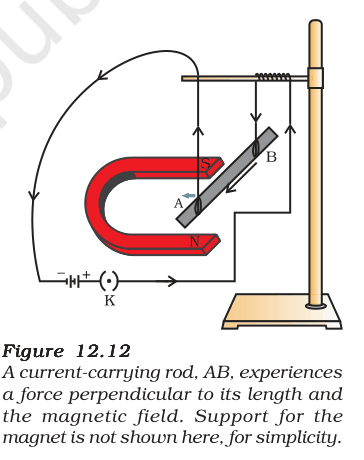
In Activity 13.7, how is displacement of rod AB affected if (i) current is increased; (ii) a stronger magnet is used; (iii) length of rod is increased?
Answer
Force F = BIl. In all three cases, one quantity increases, so force and displacement increase.
A positively-charged particle projected towards west is deflected towards north by a magnetic field. The direction of the field is:
Answer
(d) Upward. Using Fleming's left-hand rule: middle finger (current) west, thumb (force) north, forefinger (field) points upward.
Section B: NCERT Exercise Questions
Which correctly describes the magnetic field near a long straight wire?
Answer
(d) Concentric circles centred on the wire, lying in a plane perpendicular to the wire.
The phenomenon of electromagnetic induction is
Answer
(c) Producing induced current in a coil due to relative motion between a magnet and the coil.
The device used for producing electric current is called a
Answer
(a) Generator — converts mechanical energy into electrical energy via electromagnetic induction.
The essential difference between an AC generator and a DC generator is:
Answer
(d) AC generator has slip rings while DC generator has a commutator (split ring).
At the time of short circuit, the current in the circuit
Answer
(c) Increases heavily. Resistance becomes nearly zero, so I = V/R becomes very large.
Q6. State whether true or false
(a) An electric motor converts mechanical energy into electrical energy — False. Motor converts electrical to mechanical.
(b) An electric generator works on electromagnetic induction — True.
(c) Field at centre of a long circular coil is parallel straight lines — True.
(d) A wire with green insulation is the live wire — False. Green is earth wire; live wire is red/brown.
List two methods of producing magnetic fields.
Answer
(i) Using a permanent magnet. (ii) Passing electric current through a conductor (Oersted's discovery).
How does a solenoid behave like a magnet?
Answer
A solenoid produces a uniform magnetic field inside, with one end acting as north and the other as south pole, just like a bar magnet. To identify poles: bring a bar magnet near — attraction means opposite poles, repulsion means same poles. Or use the right-hand solenoid rule.
When is the force on a current-carrying conductor in a magnetic field the largest?
Answer
When the current direction is perpendicular (90°) to the magnetic field. F = BIl sin θ is maximum when θ = 90°.
An electron beam moving horizontally from back to front wall is deflected to your right by a magnetic field. What is the field direction?
Answer
Downward (vertically downwards). Conventional current is opposite to electron flow (front to back). Using Fleming's left-hand rule: force is right, current is backward, so field points downward.
State the principle of an electric motor.
Answer
A current-carrying conductor in a magnetic field experiences a force. In a motor, a rectangular coil experiences forces in opposite directions on its two sides, creating a torque that rotates the coil continuously, converting electrical energy into mechanical energy.
What is the role of the split ring in an electric motor?
Answer
The split ring acts as a commutator. It reverses the current direction in the coil after every half rotation, ensuring forces always act in the same rotational direction for continuous rotation.
State different ways to induce current in a coil.
Answer
(i) Moving a magnet towards/away from a coil. (ii) Changing current in a nearby coil (mutual induction). (iii) Rotating the coil in a magnetic field. All require a change in magnetic flux.
State the principle of an electric generator.
Answer
Based on electromagnetic induction — when a coil is rotated in a magnetic field, changing magnetic flux induces an emf and current, converting mechanical energy into electrical energy.
Name some sources of direct current.
Answer
Dry cells, DC generators, solar cells, lead-acid batteries, lithium-ion batteries.
Which sources produce alternating current?
Answer
AC generators (alternators). In India, AC frequency is 50 Hz (direction changes 100 times per second). Used in thermal, hydro, and wind power plants.
A rectangular coil rotated in a magnetic field — the direction of induced current changes once in each:
Answer
(c) Half revolution — current reverses every 180° rotation.
Name two safety measures in electric circuits and appliances.
Answer
(i) Electric fuse — melts and breaks circuit during excess current. (ii) Earthing — provides low-resistance path to ground, preventing electric shock.
An electric oven of 2 kW is operated on a 220 V circuit rated at 5 A. What happens?
Answer
Current drawn = 2000/220 = 9.09 A, which exceeds the 5 A rating. The fuse will blow (melt), breaking the circuit. Without a fuse, wires would overheat and could cause fire.
Section C: Important Extra Questions
State Fleming's Left-Hand Rule.
Answer
Stretch the thumb, forefinger, and middle finger of the left hand perpendicular to each other. Forefinger = magnetic field (B), middle finger = current (I), thumb = force/motion on the conductor. Used for electric motors.
State Fleming's Right-Hand Rule.
Answer
Stretch the thumb, forefinger, and middle finger of the right hand perpendicular to each other. Forefinger = magnetic field (B), thumb = motion/velocity of conductor, middle finger = induced current direction. Used for electric generators.
What is the function of an earth wire?
Answer
The earth wire provides a low-resistance path to the ground, connected to the metal body of appliances. During a fault, current flows to the ground instead of through the user, preventing electric shock and blowing the fuse to disconnect supply.
What is the difference between AC and DC?
Answer
AC: Changes direction periodically (50 Hz in India), cannot be stored directly, voltage can be transformed easily. DC: Flows in one direction only, can be stored in batteries, voltage not easily changed. Used in electronic devices.
What is a short circuit?
Answer
Occurs when live and neutral wires directly contact each other, offering nearly zero resistance. Causes extremely large current, excessive heating, and can cause fire. Prevented by fuses, MCBs, proper insulation, and earthing.