
NCERT Textbook Questions & Answers + Important Extra Questions
Section A: In-Text Questions
What is the difference between a reflex action and walking?
Answer
Reflex action: An involuntary, automatic, and extremely rapid response to a stimulus that does not involve conscious thinking. It is controlled by the spinal cord and is inborn (not learned). Examples: pulling hand away from a hot object, blinking when something approaches the eye.
Walking: A voluntary action that is learned and controlled by the brain (cerebellum and cerebrum). It can be started, stopped, or modified at will. Though it becomes somewhat automatic with practice, it still requires conscious coordination.
What happens at the synapse between two neurons?
Answer
At the synapse, there is a tiny gap (synaptic cleft) between the axon terminal of one neuron and the dendrite of the next neuron. When an electrical impulse reaches the axon terminal, it triggers the release of chemical substances called neurotransmitters (like acetylcholine) into the synaptic cleft. These chemicals diffuse across the gap and bind to receptors on the next neuron's dendrite, generating a new electrical impulse. This is how the signal jumps from one neuron to the next. The synapse ensures that nerve impulses travel in one direction only.
Which part of the brain maintains posture and equilibrium of the body?
Answer
The cerebellum (located at the back of the brain, below the cerebrum) is responsible for maintaining body posture, balance, and equilibrium. It coordinates voluntary movements, ensures precision and smooth muscle activity, and helps us perform actions like walking, cycling, or picking up objects accurately.
How do we detect the smell of an agarbatti (incense stick)?
Answer
When an agarbatti burns, it releases volatile aromatic molecules into the air. These molecules enter the nose during breathing and reach the olfactory epithelium in the upper part of the nasal cavity. Here, specialised olfactory receptor cells detect the chemical molecules and generate nerve impulses. These impulses travel along the olfactory nerve to the olfactory area of the cerebrum (forebrain), where the smell is identified and interpreted.
What is the role of the brain in reflex action?
Answer
In most spinal reflex actions, the brain is not directly involved in producing the response — the spinal cord handles it independently for speed. However, the brain still plays an important role:
(i) It receives a copy of the sensory information from the spinal cord, so you become aware of the stimulus (e.g., you feel pain after pulling your hand from a flame).
(ii) For cerebral reflexes (like blinking, pupil contraction), the brain itself processes the reflex.
(iii) The brain can modify future behaviour based on reflex experiences stored in memory.
What are plant hormones?
Answer
Plant hormones (phytohormones) are chemical substances naturally produced in very small quantities by plants that regulate and coordinate growth, development, and responses to environmental stimuli. Major plant hormones include:
(i) Auxins: Promote cell elongation, phototropism, and fruit development
(ii) Gibberellins: Promote stem elongation, seed germination, and flowering
(iii) Cytokinins: Promote cell division, delay ageing of leaves
(iv) Abscisic acid (ABA): Inhibits growth, promotes wilting and dormancy, helps in stress response
(v) Ethylene: Promotes fruit ripening and leaf fall
How is the movement of leaves of the sensitive plant (Mimosa pudica) different from the movement of a shoot towards light?
Answer
Sensitive plant (touch-me-not): This is a nastic movement (thigmonasty) — it is independent of the direction of the stimulus. When touched, the leaf cells rapidly lose water (change in turgor pressure), causing the leaves to fold and droop. This is a quick, reversible, non-growth movement.
Shoot towards light: This is phototropism — a directional, growth-dependent movement. Auxin accumulates on the shaded side of the shoot, causing cells there to elongate more. This differential growth makes the shoot bend toward the light source. It is a slow, permanent (growth-based) movement.
Give an example of a plant hormone that promotes growth.
Answer
Auxin (specifically indole-3-acetic acid / IAA) is a plant hormone that promotes growth. It stimulates cell elongation in shoots, helps in phototropism and gravitropism, and promotes the development of fruits. Gibberellins also promote growth by stimulating stem elongation and seed germination.
How do auxins promote the growth of a tendril around a support?
Answer
When a tendril touches a support, the side in contact with the support receives less auxin, while the side away from the support (free side) accumulates more auxin. Since auxin promotes cell elongation, the cells on the free side grow faster and longer than those on the contact side. This unequal growth causes the tendril to curl around the support, providing a firm grip for the climbing plant.
Design an experiment to demonstrate hydrotropism.
Answer
Take a trough or container and fill it with moist sawdust. Sow some germinating seeds (like peas or beans) in the sawdust near one end. Place the trough at a slight tilt so that any water drains to the lower end. Poke small holes at the lower end. Keep the sawdust moist only at the lower end.
Observation: After a few days, the roots (radicles) of the seedlings will grow toward the moist end, even bending downward against their initial direction if necessary. This bending of roots toward water (moisture) demonstrates hydrotropism — a directional growth response toward water.
How does chemical coordination take place in animals?
Answer
Chemical coordination in animals occurs through hormones — chemical messengers secreted by endocrine glands (ductless glands) directly into the bloodstream. The blood carries these hormones to specific target organs where they produce their effect. This system works through feedback mechanisms:
For example, when blood sugar rises after a meal, the pancreas detects this and releases insulin, which signals body cells to absorb glucose and the liver to store it as glycogen. When blood sugar drops to normal, insulin secretion decreases. This precise regulation ensures that blood sugar levels stay within a narrow range.
Why is the use of iodised salt advisable?
Answer
Iodine is an essential element required by the thyroid gland to produce the hormone thyroxine. Thyroxine regulates the body's metabolic rate, physical and mental development, body temperature, and heart rate. If the diet lacks sufficient iodine, the thyroid gland enlarges in an attempt to produce more thyroxine, leading to a condition called goitre (swelling in the neck). Iodine deficiency can also cause cretinism (impaired growth and mental development) in children. Using iodised salt ensures adequate iodine intake and prevents these disorders.
How does our body respond when adrenaline is secreted into the blood?
Answer
Adrenaline (also called epinephrine) is the "fight or flight" hormone secreted by the adrenal glands during emergencies, fear, anger, or excitement. Its effects include:
(i) Heart rate increases — pumps more blood faster
(ii) Blood supply to skeletal muscles increases — preparing for action
(iii) Blood supply to skin and digestive organs decreases — prioritising essential functions
(iv) Breathing rate increases — more oxygen intake
(v) Blood sugar level rises — liver releases stored glucose for immediate energy
(vi) Pupils dilate — improved vision
All these changes prepare the body to either face the danger or run away from it.
Why are some patients of diabetes treated by giving injections of insulin?
Answer
In diabetes (specifically Type 1 diabetes), the pancreas either produces very little or no insulin. Insulin is the hormone that allows body cells to absorb glucose from the blood and enables the liver and muscles to store excess glucose as glycogen. Without insulin, glucose accumulates in the blood (high blood sugar) while cells starve for energy. Insulin injections provide the missing hormone externally, enabling cells to utilise glucose properly and maintaining blood sugar at healthy levels.
Section B: NCERT Exercise Questions
Which of the following is a plant hormone?
Answer
(a) Insulin (b) Thyroxin (c) Oestrogen (d) Cytokinin
Ans. (d) Cytokinin. It is a plant hormone that promotes cell division and delays leaf senescence. The others — insulin, thyroxin, and oestrogen — are all animal hormones.
Q2. The gap between two neurons is called a
(a) Dendrite (b) Synapse (c) Axon (d) Impulse
Ans. (b) Synapse. It is the small gap (junction) between the axon terminal of one neuron and the dendrite of the next neuron, where chemical transmission of nerve impulses occurs.
Q3. The brain is responsible for
(a) thinking (b) regulating the heartbeat (c) balancing the body (d) all of the above
Ans. (d) All of the above. The cerebrum handles thinking, the medulla oblongata (in the hindbrain) regulates heartbeat and other involuntary functions, and the cerebellum maintains balance and coordination.
What is the function of receptors in our body? Think of situations where receptors do not work properly. What problems are likely to arise?
Answer
Receptors are specialised cells or nerve endings that detect specific stimuli from the environment and convert them into nerve impulses. Types include photoreceptors (light), phonoreceptors (sound), olfactory receptors (smell), gustatory receptors (taste), and thermoreceptors (temperature).
If receptors malfunction:
• Damaged photoreceptors
⇒ blindness or impaired vision
• Damaged phonoreceptors → deafness
• Damaged thermoreceptors
⇒ inability to sense hot/cold, risking burns or frostbite
• Damaged olfactory receptors
⇒ inability to smell (anosmia), which also affects taste perception
Draw the structure of a neuron and explain its function.
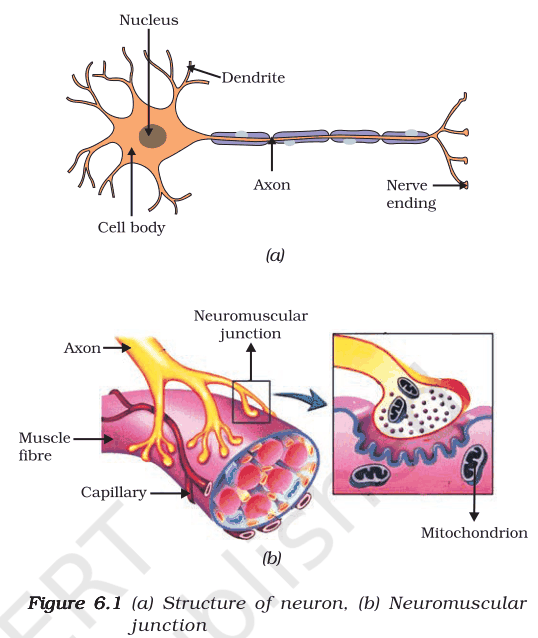
Answer
A neuron (nerve cell) has three main parts:
(i) Cell body (soma): Contains the nucleus and cytoplasm; maintains the cell's metabolic activities.
(ii) Dendrites: Short, branched projections that receive nerve impulses from other neurons or receptors and transmit them to the cell body.
(iii) Axon: A long, slender fibre that carries impulses away from the cell body to other neurons, muscles, or glands. It is covered by a myelin sheath (in myelinated neurons) for faster impulse transmission. The axon ends in axon terminals (synaptic knobs) that release neurotransmitters across the synapse.
Function: Neurons transmit information as electrical impulses throughout the body, enabling rapid communication between the brain/spinal cord and all body parts.
How does phototropism occur in plants?
Answer
Phototropism is the bending of a plant organ toward or away from light. In shoots (positive phototropism):
(i) Light is detected by photoreceptors (phototropins) at the shoot tip.
(ii) The hormone auxin migrates from the lit side to the shaded side of the shoot.
(iii) Higher auxin concentration on the shaded side causes greater cell elongation on that side.
(iv) The uneven growth makes the shoot bend toward the light source.
In roots (negative phototropism), higher auxin concentration inhibits growth, so the root bends away from light.
Which signals will get disrupted in case of a spinal cord injury?
Answer
A spinal cord injury can disrupt:
(i) Sensory signals from the body below the injury site cannot reach the brain — loss of sensation (touch, pain, temperature).
(ii) Motor signals from the brain cannot reach the muscles below the injury — paralysis (inability to move).
(iii) Reflex actions controlled by the injured segment of the spinal cord may be lost or become abnormal.
(iv) Control over involuntary functions like bladder and bowel control may be affected.
The severity depends on where the injury occurs — higher injuries cause more widespread effects.
How does chemical coordination occur in plants?
Answer
Plants lack a nervous system but achieve coordination through plant hormones (phytohormones). These hormones are produced in one part of the plant and transported to other parts where they exert their effects:
• Auxin (produced in shoot tips) promotes cell elongation and directional growth responses
• Gibberellins promote stem growth and seed germination
• Cytokinins promote cell division
• Abscisic acid inhibits growth and promotes dormancy during stress
Coordination is achieved through the balance between growth-promoting hormones (auxin, gibberellins, cytokinins) and growth-inhibiting hormones (abscisic acid). Environmental stimuli (light, gravity, water) influence hormone distribution, leading to appropriate plant responses.
What is the need for a system of control and coordination in an organism?
Answer
Multicellular organisms have many specialised organs and tissues that must work together in a coordinated manner. A control and coordination system is needed to:
(i) Respond to environmental changes — detecting and reacting to stimuli like light, heat, danger
(ii) Coordinate body functions — ensuring organs work in harmony (e.g., during eating, digestion, movement all need to be synchronised)
(iii) Maintain homeostasis — keeping internal conditions (temperature, blood sugar, water balance) stable
(iv) Enable complex activities — like thinking, learning, and performing skilled tasks
Without such a system, the different parts of the body would function independently and chaotically.
How are involuntary actions and reflex actions different from each other?
Answer
Involuntary actions: Actions not under conscious control that maintain essential body functions continuously. They are controlled by the medulla oblongata (hindbrain). Examples: heartbeat, breathing, peristalsis, blood pressure regulation. These are ongoing, rhythmic activities.
Reflex actions: Sudden, automatic, extremely rapid responses to specific stimuli, primarily controlled by the spinal cord. They are protective in nature and occur only when triggered by a stimulus. Examples: pulling hand from fire, knee-jerk response, sneezing.
Key difference: Reflex actions are emergency responses to specific stimuli, while involuntary actions are continuous processes essential for survival.
Compare and contrast nervous and hormonal mechanisms for control and coordination in animals.
Answer
Nervous system
• Uses electrical impulses along nerve fibres
• Response is very fast (milliseconds)
• Effect is short-lived and precise (targets specific muscles/glands)
• Impulse travels along a definite pathway (neuron to neuron)
Hormonal system
• Uses chemical messengers (hormones) via the bloodstream
• Response is slower (seconds to hours)
• Effect is long-lasting and widespread (affects all target cells throughout the body)
• Hormones travel through blood and reach all parts, not just specific pathways
Both systems work together — for example, in stress, the nervous system triggers the adrenal gland (endocrine system) to release adrenaline.
What is the difference between the manner in which movement takes place in a sensitive plant and the movement in our legs?
Answer
Sensitive plant (Mimosa pudica)
• Movement caused by changes in water pressure (turgor) in specialised cells at the base of leaves (pulvinus)
• No muscles or nervous system involved
• Response to touch stimulus — nastic movement
• Not growth-related; the plant returns to original position when stimulus is removed
Movement of our legs
• Caused by contraction and relaxation of muscles attached to bones
• Controlled by the nervous system (brain sends signals through motor neurons)
• Voluntary action (conscious decision to walk/run)
• Requires specialised proteins (actin and myosin) that convert chemical energy (ATP) into mechanical movement
Section C: Important Extra Questions
What is a reflex arc? Draw a labelled diagram.
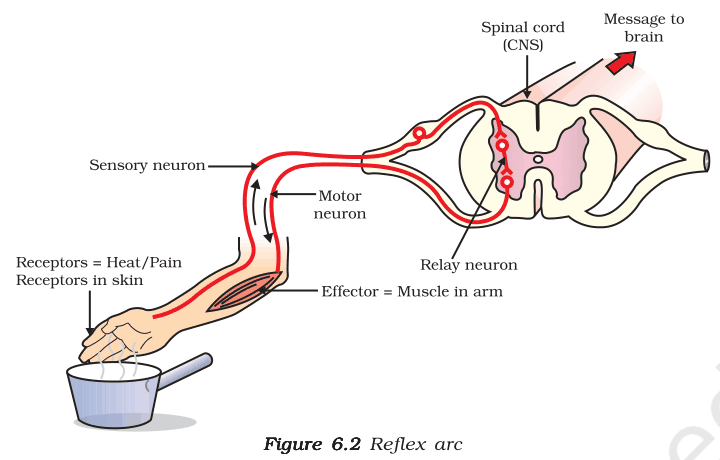
Answer
A reflex arc is the pathway taken by nerve impulses during a reflex action. It consists of five components in sequence:
(i) Receptor: Detects the stimulus (e.g., pain receptors in skin)
(ii) Sensory (afferent) neuron: Carries impulse from receptor to the spinal cord
(iii) Relay (interneuron): Present in the spinal cord; connects sensory and motor neurons
(iv) Motor (efferent) neuron: Carries impulse from spinal cord to the effector
(v) Effector: Muscle or gland that carries out the response
Example: Touching a hot object
⇒ pain receptor
⇒ sensory neuron
⇒ spinal cord
⇒ motor neuron
⇒ hand muscles contract
⇒ hand pulls away.
Name the hormones secreted by the following glands and state their functions:
Answer
(a) Thyroid (b) Pituitary (c) Pancreas (d) Adrenal
Ans.
(a) Thyroid
⇒ Thyroxine: Regulates metabolism, body temperature, heart rate, physical and mental development. Requires iodine for synthesis.
(b) Pituitary
⇒ Growth hormone: Controls growth of bones and body; deficiency causes dwarfism, excess causes gigantism. (Also secretes many other hormones controlling other glands.)
(c) Pancreas
⇒ Insulin and Glucagon: Insulin lowers blood sugar by promoting glucose uptake; glucagon raises blood sugar by promoting glycogen breakdown. Together they regulate blood sugar levels.
(d) Adrenal
⇒ Adrenaline: Prepares the body for emergency "fight or flight" response — increases heart rate, breathing, blood pressure, and blood sugar.
What are tropic and nastic movements in plants? Give examples.
Answer
Tropic movements: Directional growth movements in response to a stimulus — the direction of movement depends on the direction of the stimulus.
• Phototropism — toward/away from light
• Geotropism — toward/away from gravity
• Hydrotropism — toward water
• Chemotropism — toward/away from chemicals (e.g., pollen tube toward ovule)
Nastic movements: Non-directional movements that do not depend on the direction of the stimulus, only on its presence.
• Thigmonasty — Mimosa leaves folding on touch
• Nyctinasty — Flowers opening/closing with day/night cycle