
Circle of Learning • New NCERT textbook "Ganita Manjari" (2026-27) • Exercise Sets, Think and Reflect, End-of-Chapter Exercises – step-by-step solutions
In-text Question
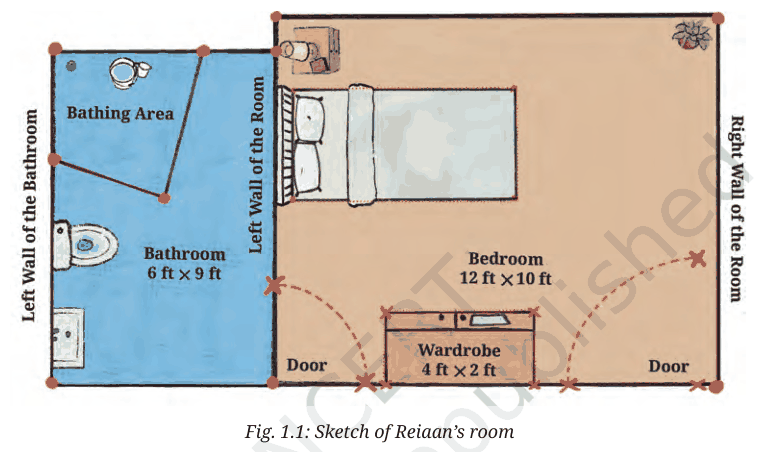
Do you see why the position of the windows cannot be marked on the map in Fig. 1.1?
Answer
The sketch shows only the floor of the room, which is two-dimensional (length and width). Windows are on the walls, at some height above the floor. Height is a third dimension, so a 2-D floor map cannot show where the windows are.
Exercise Set 1.1
(Based on Fig. 1.3: room OABC with O (0, 0), A (12, 0), B (12, 10), C (0, 10); scale 1 unit = 1 ft. The door D1R1 lies on the x-axis, with D1 at the 8 mark.)
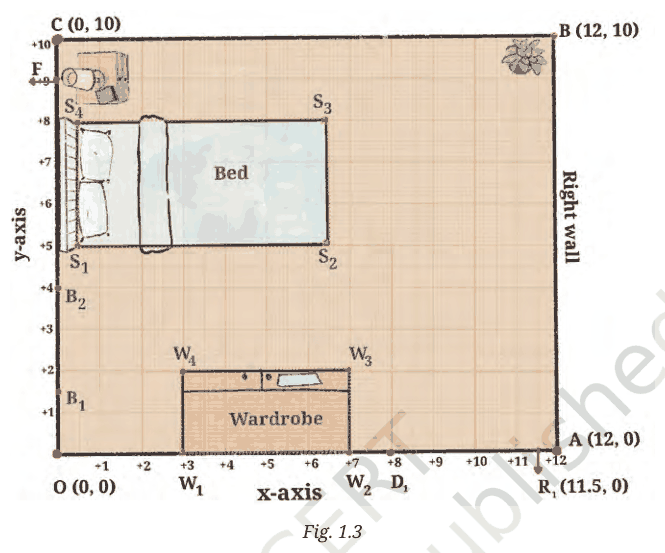
(i) If D1R1 represents the door to Reiaan's room, how far is the door from the left wall (the y-axis)? How far is the door from the x-axis?
D1 is at the 8 mark on the x-axis, so the door is 8 ft from the left wall (y-axis). The door lies on the x-axis (the bottom wall), so its distance from the x-axis is 0 ft.
(ii) What are the coordinates of D1?
D1 = (8, 0)
(iii) If R1 is the point (11.5, 0), how wide is the door? Is this a comfortable width? Can a person in a wheelchair enter easily?
Width = 11.5 − 8 = 3.5 ft (about 107 cm).
Yes, this is a comfortable width. A wheelchair is usually about 2–2.5 ft wide and needs a clear opening of about 3 ft (about 90 cm), so a person in a wheelchair can enter easily.
(iv) If B1 (0, 1.5) and B2 (0, 4) represent the ends of the bathroom door, is the bathroom door narrower or wider than the room door?
Bathroom door width = 4 − 1.5 = 2.5 ft. Since 2.5 ft < 3.5 ft, the bathroom door is narrower (by 1 ft).
Think and Reflect
What are the standard widths for a room door?
Answer
Room doors in homes are usually about 2.5 ft to 3 ft (75–90 cm) wide; bathroom doors are often narrower (about 2–2.5 ft); main doors and school classroom doors are often 3–4 ft wide. (Measure doors at home and in school to compare.)
Are the doors in your school suitable for people in wheelchairs?
Answer
A door needs a clear width of at least about 3 ft (90 cm), no step or a ramp at the entrance, and enough space to turn. Check your school's doors against these points. Doors narrower than about 2.5 ft or with steps are not suitable.
Think and Reflect (Quadrants)
What is the x-coordinate of a point on the y-axis?
Answer
It is always 0. Such a point has the form (0, y).
Is there a similar generalisation for a point on the x-axis?
Answer
Yes – its y-coordinate is always 0; the point has the form (x, 0).
Does point Q (y, x) ever coincide with point P (x, y)? Justify.
Answer
Only when x = y. Two points coincide only if their x-coordinates are equal and their y-coordinates are equal, i.e. y = x and x = y. Example: (3, 3) and (3, 3). But (2, 5) and (5, 2) are different points.
If x ≠ y, then (x, y) ≠ (y, x); and (x, y) = (y, x) if and only if x = y. Is this claim true?
Answer
Yes, it is true, for the reason given in Q3 – the order of coordinates matters, which is why they are called ordered pairs.
Activity: Points in Quadrant I have the form (+, +), e.g. P (2, 3); points in Quadrant III have the form (−, −), e.g. R (−4, −2).
Exercise Set 1.2
(Based on Fig. 1.5, which adds the bathroom to the left of the y-axis: bathroom corners O, F, R, P with P at (−6, 0); scale 1 unit = 1 ft. Wardrobe from W1 (3, 0) to W2 (7, 0). Answers involving placement can vary.)
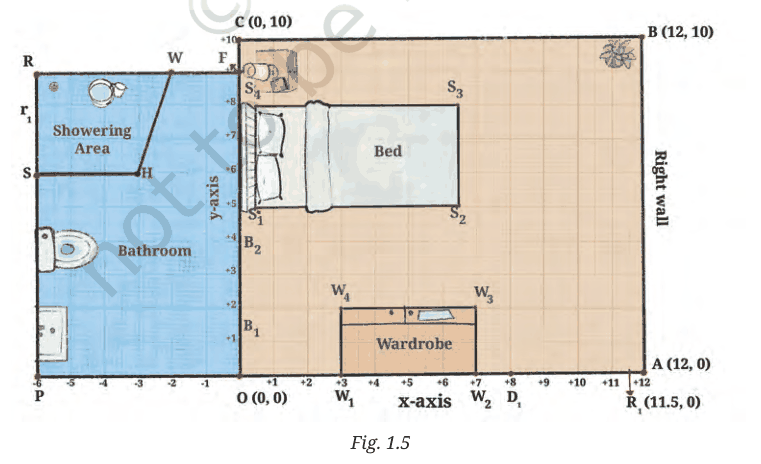
Place Reiaan's rectangular study table with three of its feet at (8, 9), (11, 9) and (11, 7). (i) Where will the fourth foot be? (ii) Is this a good spot? (iii) What is the width, length and height of the table?
Answer
(i) In a rectangle, opposite sides are parallel to the axes here. The fourth foot is (8, 7).
(ii) Yes, it is a good spot. It lies in the empty top-right part of the room, clear of the bed (which ends at about x = 6.5), the wardrobe and the door, so it does not block movement. It is also near the right wall, where a window can give light.
(iii) Length = 11 − 8 = 3 ft; width = 9 − 7 = 2 ft. The height cannot be found from the floor plan, because a 2-D map shows only length and width.
If the bathroom door has a hinge at B1 and opens into the bedroom, will it hit the wardrobe? Are there any changes you would suggest if the door is made wider?
Answer
The door is 2.5 ft wide (from B1 (0, 1.5) to B2 (0, 4)). When it opens, its free edge moves on a quarter circle of radius 2.5 ft with centre B1, so it reaches at most x = 2.5. The wardrobe starts at x = 3 (W1). Since 2.5 < 3, the door will not hit the wardrobe (there is a gap of 0.5 ft).
If the door is made wider than 3 ft, it would hit the wardrobe. Suggestions: make the door open into the bathroom, use a sliding door, put the hinge at B2 instead, or shift the wardrobe a little to the right.
Look at Reiaan's bathroom. (i) Coordinates of the four corners O, F, R and P. (ii) Shape and corners of the showering area SHWR. (iii) Mark a 3 ft × 2 ft space for the washbasin and a 2 ft × 3 ft space for the toilet.
Answer
(i) O (0, 0), F (0, 9), R (−6, 9), P (−6, 0). The bathroom is 6 ft × 9 ft.
(ii) The showering area is a trapezium (one pair of sides, SH and RW, is parallel to the x-axis; the side SR is along the wall and HW is slanting). Reading from the figure: S (−6, 6), H (−3, 6), W (−2, 9), R (−6, 9) (approximately).
(iii) One possible arrangement along the left wall (answers may vary):
Washbasin (3 ft along the wall, 2 ft deep): (−6, 0), (−4, 0), (−4, 3), (−6, 3).
Toilet (2 ft along the wall, 3 ft deep): (−6, 3.5), (−3, 3.5), (−3, 5.5), (−6, 5.5).
Neither overlaps the shower area (which starts at y = 6) or the door (on x = 0, from y = 1.5 to 4).
(i) Reiaan's room door leads from the dining room (length 18 ft, width 15 ft). Its length extends from P to A. Sketch it and mark the coordinates of its corners. (ii) Place a 5 ft × 3 ft dining table precisely in the centre. Write the coordinates of its feet.
Answer
(i) P = (−6, 0) and A = (12, 0), so PA = 18 ft – this is the length along the x-axis. The dining room lies below the x-axis (the room door D1R1 opens into it). Corners: (−6, 0), (12, 0), (12, −15), (−6, −15).
(ii) Centre of the dining room = ((−6 + 12)/2, (0 − 15)/2) = (3, −7.5).
Table 5 ft along x and 3 ft along y: x from 3 − 2.5 = 0.5 to 3 + 2.5 = 5.5; y from −7.5 − 1.5 = −9 to −7.5 + 1.5 = −6.
Feet: (0.5, −6), (5.5, −6), (5.5, −9), (0.5, −9).
Think and Reflect (Distance Between Two Points)
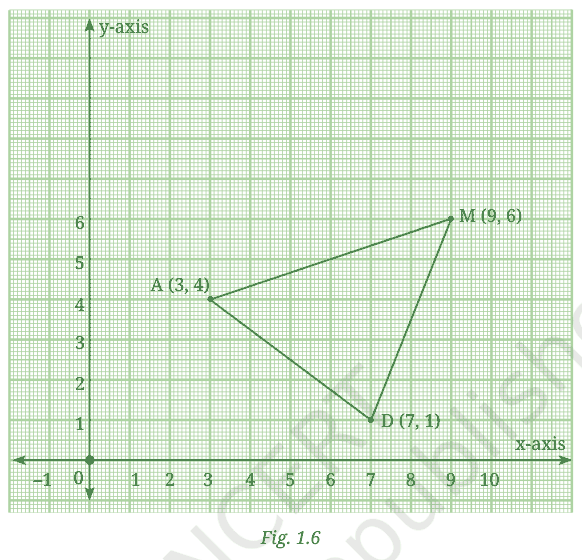
In moving from A (3, 4) to D (7, 1), what distance is covered along the x-axis? Along the y-axis?
Answer
Along x: 7 − 3 = 4 units. Along y: 4 − 1 = 3 units (downward).
Can these distances help you find AD?
Answer
Yes. They are the two perpendicular sides of a right triangle with AD as hypotenuse. By the Baudhāyana–Pythagoras theorem, AD = √(4² + 3²) = √25 = 5 units.
Think and Reflect (Reflection)
What has remained the same and what has changed with the reflection of ΔADM in the y-axis?
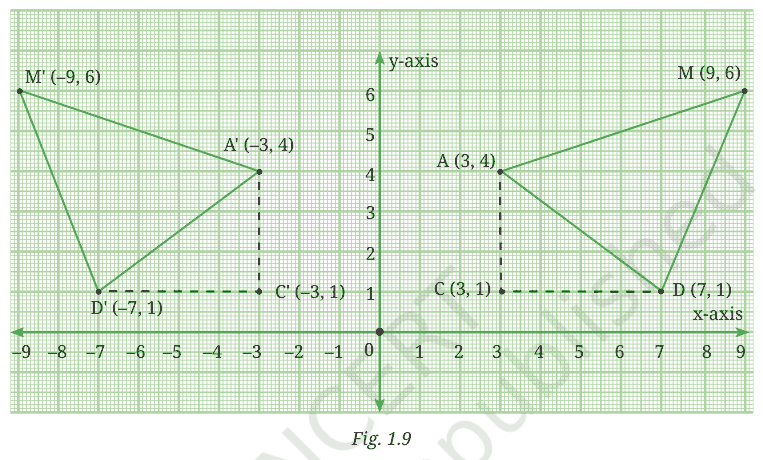
Answer
Same: the lengths of the sides (AD = 5, DM = √29, MA = √40), the angles, the shape and size of the triangle, and the y-coordinates of the points. Changed: the x-coordinates change sign (A (3, 4)
⇒ A′ (−3, 4)), the triangle moves to Quadrant II and its orientation is reversed (like a mirror image).
Would these observations be the same if ΔADM were reflected in the x-axis?
Answer
Yes, side lengths, angles, shape and size would again be preserved. This time the y-coordinates would change sign and the x-coordinates would stay the same, e.g. A (3, 4)
⇒ (3, −4); the triangle would move to Quadrant IV.
End-of-Chapter Exercises
What are the x-coordinate and y-coordinate of the point of intersection of the two axes?
Answer
The axes meet at the origin, (0, 0): x-coordinate 0 and y-coordinate 0.
Point W has x-coordinate −5. Predict the coordinates of point H on the line through W parallel to the y-axis. Which quadrants can H lie in?
Answer
Every point on a line parallel to the y-axis has the same x-coordinate. So H = (−5, y) for some number y.
If y > 0, H is in Quadrant II; if y < 0, H is in Quadrant III; if y = 0, H is on the x-axis at (−5, 0).
Consider R (3, 0), A (0, −2), M (−5, −2) and P (−5, 2), joined in order. Predict: (i) two perpendicular sides, (ii) a side parallel to an axis, (iii) two points that are mirror images in an axis.
Answer
(i) AM and MP: AM joins (0, −2) and (−5, −2) – same y, so it is horizontal; MP joins (−5, −2) and (−5, 2) – same x, so it is vertical. A horizontal and a vertical line are perpendicular.
(ii) AM is parallel to the x-axis (and MP is parallel to the y-axis).
(iii) M (−5, −2) and P (−5, 2) are mirror images in the x-axis (same x, opposite y).
Plotting the points confirms these predictions.
Plot Z (5, −6). Construct a right-angled triangle IZN and find the lengths of its sides.
Answer
One possible answer: take N = (0, 0) and I = (5, 0), so the right angle is at I (NI is horizontal and IZ is vertical).
NI = 5 − 0 = 5 units; IZ = 0 − (−6) = 6 units; NZ = √(5² + 6²) = √61 ≈ 7.81 units.
(Other choices of I and N give different, equally correct answers.)
What would a system of coordinates be like if we did not have negative numbers? Would it allow us to locate all points on a 2-D plane?
Answer
Without negative numbers we could use only the half-lines to the right of and above the origin, i.e. only Quadrant I and the positive axes. Points to the left of or below the origin could not be named. So it would not locate all points of the plane. (We could manage only a limited region, such as a room, by placing the origin at its bottom-left corner – as is done on a computer screen – but not the whole infinite plane.)
Are M (−3, −4), A (0, 0) and G (6, 8) on the same straight line? Suggest a method to check without plotting.
Answer
Method 1 (distances): Three points are collinear if the sum of two distances equals the third.
MA = √(3² + 4²) = 5; AG = √(6² + 8²) = 10; MG = √(9² + 12²) = √225 = 15.
MA + AG = 5 + 10 = 15 = MG, so the points are collinear.
Method 2 (steps/ratio): From M to A, x increases by 3 and y by 4 (ratio 4 : 3). From A to G, x increases by 6 and y by 8 (ratio 8 : 6 = 4 : 3). Equal ratios of rise to run mean the same direction, so the points lie on one line.
Use your method to check whether R (−5, −1), B (−2, −5) and C (4, −12) are on the same straight line.
Answer
R
⇒ B: x changes by +3, y by −4 (ratio −4 : 3 = −1.33).
B
⇒ C: x changes by +6, y by −7 (ratio −7 : 6 = −1.17).
The ratios are different, so the points are not collinear.
Check with distances: RB = √(9 + 16) = 5; BC = √(36 + 49) = √85 ≈ 9.220; RC = √(81 + 121) = √202 ≈ 14.213. RB + BC ≈ 14.220 ≠ 14.213. They are very nearly in a line, which is why a plot may look straight – but they are not exactly collinear.
Using the origin as one vertex, plot the vertices of (i) a right-angled isosceles triangle, (ii) an isosceles triangle with one vertex in Quadrant III and the other in Quadrant IV.
(i) O (0, 0), A (4, 0), B (0, 4). OA = OB = 4 and the angle at O is 90°.
(ii) O (0, 0), A (−3, −4), B (3, −4). OA = OB = √(9 + 16) = 5, so the triangle is isosceles; A is in Quadrant III and B in Quadrant IV.
Answer
(Many other answers are possible.)
State whether M is the midpoint of ST in each case. Justify.
Answer
S | M | T | Is M the midpoint? | Reason |
(−3, 0) | (0, 0) | (3, 0) | Yes | ((−3 + 3)/2, (0 + 0)/2) = (0, 0); also SM = MT = 3 on a straight line |
(2, 3) | (3, 4) | (4, 5) | Yes | ((2 + 4)/2, (3 + 5)/2) = (3, 4) |
(0, 0) | (0, 5) | (0, −10) | No | Midpoint is (0, −5); SM = 5 but MT = 15 |
(−8, 7) | (0, −2) | (6, −3) | No | Midpoint is (−1, 2) |
Connection: If M is the midpoint of S (x1, y1) and T (x2, y2), then M = ((x1 + x2)/2, (y1 + y2)/2) – each coordinate of M is the average of the corresponding coordinates of S and T.
Find B (x, y) given that M (−7, 1) is the midpoint of A (3, −4) and B.
Answer
(3 + x)/2 = −7 ⇒ 3 + x = −14 ⇒ x = −17
(−4 + y)/2 = 1 ⇒ −4 + y = 2 ⇒ y = 6
B = (−17, 6)
P and Q trisect AB (P closer to A). Using midpoints, how would you find P and Q? Do this for A (4, 7) and B (16, −2).
Answer
Idea: Since AP = PQ = QB, P is the midpoint of A and Q, and Q is the midpoint of P and B.
Let P = (p1, p2) and Q = (q1, q2).
x-coordinates: p1 = (4 + q1)/2 and q1 = (p1 + 16)/2.
Substituting: 2p1 = 4 + (p1 + 16)/2
⇒ 4p1 = 8 + p1 + 16
⇒ 3p1 = 24
⇒ p1 = 8, and q1 = (8 + 16)/2 = 12.
y-coordinates: 2p2 = 7 + (p2 − 2)/2
⇒ 4p2 = 14 + p2 − 2
⇒ 3p2 = 12
⇒ p2 = 4, and q2 = (4 − 2)/2 = 1.
P = (8, 4) and Q = (12, 1).
(Shortcut: P = ((2·4 + 16)/3, (2·7 − 2)/3) and Q = ((4 + 2·16)/3, (7 − 2·2)/3).)
(i) Show that A (1, −8), B (−4, 7) and C (−7, −4) lie on a circle K with centre O (0, 0). Find its radius. (ii) Check whether D (−5, 6) and E (0, 9) lie inside, on or outside K.
(i) OA = √(1 + 64) = √65; OB = √(16 + 49) = √65; OC = √(49 + 16) = √65.
Answer
All three are at the same distance from O, so they lie on a circle with centre O and radius √65 ≈ 8.06 units.
(ii) OD = √(25 + 36) = √61 < √65
⇒ D lies inside K.
OE = √(0 + 81) = 9 = √81 > √65
⇒ E lies outside K.
The midpoints of the sides of triangle ABC are D (5, 1), E (6, 5) and F (0, 3). Find A, B and C.
Answer
Take D as the midpoint of BC, E of CA and F of AB. Then
B + C = 2D = (10, 2), C + A = 2E = (12, 10), A + B = 2F = (0, 6) (adding coordinates).
Adding all three: 2(A + B + C) = (22, 18)
⇒ A + B + C = (11, 9).
A = (A + B + C) − (B + C) = (11 − 10, 9 − 2) = (1, 7)
B = (A + B + C) − (C + A) = (11 − 12, 9 − 10) = (−1, −1)
C = (A + B + C) − (A + B) = (11 − 0, 9 − 6) = (11, 3)
Check: midpoint of BC = (5, 1) ✓, of CA = (6, 5) ✓, of AB = (0, 3) ✓.
A city has two main roads crossing at the centre (N–S and E–W). Other streets are parallel to them, 200 m apart, 10 streets in each direction. (i) Draw a model using 1 cm = 200 m. (ii) An intersection of the 2nd N–S street and the 5th E–W street is called (2, 5). Find (a) how many intersections can be called (4, 3), (b) how many can be called (3, 4).
(i) Draw 10 vertical lines (N–S streets) and 10 horizontal lines (E–W streets), each 1 cm apart, forming a square grid. Mark the two main roads through the centre.
(ii) (a) Only one intersection – where the 4th N–S street meets the 3rd E–W street.
(b) Only one intersection – where the 3rd N–S street meets the 4th E–W street.
Answer
(4, 3) and (3, 4) are different intersections, which shows why the order in an ordered pair matters.
A screen is 800 pixels wide and 600 pixels high, origin at the bottom-left. Circle 1 has radius 80 and centre A (100, 150); circle 2 has radius 100 and centre B (250, 230). Determine (i) whether any part of either circle lies outside the screen, (ii) whether the circles intersect.
Answer
(i) Circle 1 spans x from 100 − 80 = 20 to 180 and y from 150 − 80 = 70 to 230 – all within 0–800 and 0–600.
Circle 2 spans x from 150 to 350 and y from 130 to 330 – also within the screen.
So no part of either circle lies outside the screen.
(ii) Distance between centres AB = √((250 − 100)² + (230 − 150)²) = √(150² + 80²) = √(22500 + 6400) = √28900 = 170 pixels.
Sum of radii = 80 + 100 = 180. Since 170 < 180, the circles overlap (intersect).
Plot A (2, 1), B (−1, 2), C (−2, −1) and D (1, −2). Is ABCD a square? Explain. What is its area?
Answer
Sides: AB = √(3² + 1²) = √10; BC = √(1² + 3²) = √10; CD = √(3² + 1²) = √10; DA = √(1² + 3²) = √10.
Diagonals: AC = √(4² + 2²) = √20; BD = √(2² + 4²) = √20.
All four sides are equal and the diagonals are equal, so ABCD is a square. (Also, AB² + BC² = 10 + 10 = 20 = AC², so angle B is 90°.)
Area = side² = (√10)² = 10 square units.
Extra Practice Questions
1. In which quadrant does (−4, 7) lie? Quadrant II.
2. Find the distance between (−1, 3) and (5, −5). √(6² + 8²) = √100 = 10 units.
3. Find the midpoint of (−2, 6) and (8, −4). ((−2 + 8)/2, (6 − 4)/2) = (3, 1).
4. Find the point on the x-axis equidistant from (2, 3) and (6, 1). Let it be (x, 0). (x − 2)² + 9 = (x − 6)² + 1 ⇒ −4x + 13 = −12x + 37 ⇒ 8x = 24 ⇒ x = 3. The point is (3, 0).