
NCERT Textbook Questions & Answers + Important Extra Questions
Section A: In-Text Questions
What would be the electron dot structure of carbon dioxide (CO₂)?
Answer
In CO₂, carbon forms double bonds with each of the two oxygen atoms. Carbon shares two pairs of electrons with each oxygen atom. Both carbon and oxygen atoms achieve a complete octet through this sharing. The structure is: O=C=O, where each line represents a shared pair of electrons.
What would be the electron dot structure of a molecule of sulphur (S₈)?
Answer
Sulphur exists as S₈ molecules in which eight sulphur atoms are linked together in a ring (crown-shaped). Each sulphur atom forms two single covalent bonds with its neighbouring sulphur atoms and has two lone pairs of electrons, completing its octet.
How many structural isomers can you draw for pentane?
Answer
Pentane (C₅H₁₂) has three structural isomers:
(i) n-Pentane (straight chain): CH₃–CH₂–CH₂–CH₂–CH₃
(ii) Isopentane (one branch): CH₃–CH(CH₃)–CH₂–CH₃
(iii) Neopentane (two branches): C(CH₃)₄
What are the two properties of carbon which lead to the huge number of carbon compounds we see around us?
Answer
(i) Catenation: Carbon atoms have the unique ability to link with other carbon atoms to form long chains, branched chains, and ring structures. The C–C bond is very strong because of carbon's small size, allowing stable catenation.
(ii) Tetravalency: Carbon has a valency of 4, meaning it can form bonds with four other atoms simultaneously. This allows it to bond with hydrogen, oxygen, nitrogen, sulphur, chlorine, and other carbon atoms, creating an enormous variety of compounds.
What will be the formula and electron dot structure of cyclopentane?
Answer
The molecular formula of cyclopentane is C₅H₁₀. It consists of five carbon atoms arranged in a ring, with each carbon bonded to two hydrogen atoms and two adjacent carbon atoms. The general formula for cycloalkanes is CₙH₂ₙ.
Q6. Draw the structures for the following compounds
(i) Ethanoic acid (ii) Bromopentane (iii) Butanone (iv) Hexanal
Are structural isomers possible for bromopentane?
Ans.
(i) Ethanoic acid: CH₃–COOH (methyl group attached to a carboxyl group)
(ii) Bromopentane: CH₃–CH₂–CH₂–CH₂–CH₂Br (bromine at the end of a 5-carbon chain)
(iii) Butanone: CH₃–CO–CH₂–CH₃ (ketone group on carbon-2 of a 4-carbon chain)
(iv) Hexanal: CH₃–CH₂–CH₂–CH₂–CH₂–CHO (aldehyde group at the end of 6-carbon chain)
Yes, structural isomers are possible for bromopentane — the bromine atom can be attached to carbon-1, carbon-2, or carbon-3, giving position isomers. Chain isomers (branched chains) are also possible.
How would you name the following compounds?
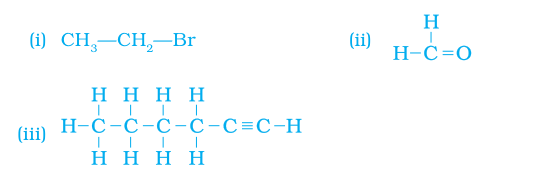
Answer
(i) CH₃–CH₂–Br → Bromoethane
(ii) A 6-carbon chain with a triple bond at position 1
⇒ Hex-1-yne
(iii) H–CHO → Methanal (formaldehyde)
Why is the conversion of ethanol to ethanoic acid considered an oxidation reaction?
Answer
When ethanol (CH₃CH₂OH) is converted to ethanoic acid (CH₃COOH), the molecule gains an oxygen atom and loses two hydrogen atoms. Both the addition of oxygen and removal of hydrogen are hallmarks of oxidation. An oxidising agent like alkaline KMnO₄ or acidified K₂Cr₂O₇ is used to carry out this conversion:
CH₃CH₂OH →[O] CH₃COOH
A mixture of oxygen and ethyne is burnt for welding. Can you tell why a mixture of ethyne and air is not used?
Answer
When ethyne (acetylene) burns in air, it produces a sooty and less hot flame because air contains only about 21% oxygen along with 78% nitrogen and other gases. Nitrogen does not support combustion and dilutes the flame. When ethyne is burnt with pure oxygen, the flame temperature reaches about 3000°C — hot enough to melt and weld metals. This extremely hot, clean flame is called an oxy-acetylene flame.
How would you distinguish experimentally between an alcohol and a carboxylic acid?
Answer
Two simple tests:
(i) Litmus test: Carboxylic acid turns blue litmus paper red; alcohol has no effect on litmus paper.
(ii) Sodium hydrogen carbonate test: Add NaHCO₃ to each sample. Carboxylic acid produces brisk effervescence (CO₂ gas is released with fizzing). Alcohol shows no reaction with NaHCO₃.
CH₃COOH + NaHCO₃
⇒ CH₃COONa + H₂O + CO₂↑
What are oxidising agents?
Answer
Oxidising agents are substances that supply oxygen to another substance or remove hydrogen from it during a chemical reaction. They bring about the oxidation of other substances while getting reduced themselves. Common examples include alkaline potassium permanganate (KMnO₄) and acidified potassium dichromate (K₂Cr₂O₇).
Would you be able to check if water is hard by using a detergent?
Answer
No, you cannot check water hardness using a detergent. Detergents produce lather equally well in both hard and soft water because they do not form insoluble compounds with calcium and magnesium ions. Only soap can distinguish between hard and soft water — soap forms scum (insoluble precipitate) in hard water but lathers freely in soft water.
People use a variety of methods to wash clothes. Usually after adding the soap, they 'beat' the clothes on a stone, or beat it with a paddle, scrub with a brush or use a washing machine to agitate them. Why is agitation necessary to get clean clothes?
Answer
Soap molecules form micelles around the dirt and grease particles trapped in the fabric. However, these micelles need mechanical force to detach from the cloth fibres. Beating, scrubbing, or machine agitation provides this force — it loosens the micelles carrying trapped dirt from the surface of the fabric and suspends them in the wash water. The dirty water is then rinsed away, leaving the clothes clean.
Section B: NCERT Exercise Questions
Q1. Ethane, with the molecular formula C₂H₆, has
(a) 6 covalent bonds (b) 7 covalent bonds (c) 8 covalent bonds (d) 9 covalent bonds
Ans. (b) 7 covalent bonds. Ethane has one C–C bond and six C–H bonds (three on each carbon), totalling 7 covalent bonds.
Q2. Butanone is a four-carbon compound with the functional group
(a) Carboxylic acid (b) Aldehyde (c) Ketone (d) Alcohol
Ans. (c) Ketone. Butanone (CH₃COCH₂CH₃) has a carbonyl group (>C=O) attached to two carbon groups, which is the characteristic feature of a ketone.
While cooking, if the bottom of the vessel is getting blackened on the outside, it means that:
Answer
(a) the food is not cooked completely (b) the fuel is not burning completely (c) the fuel is wet (d) the fuel is burning completely
Ans. (b) The fuel is not burning completely. Incomplete combustion produces soot (unburnt carbon particles) which deposits as a black layer on the vessel bottom. This usually happens when the air holes of the burner are partially blocked, reducing oxygen supply.
Explain the nature of the covalent bond using the bond formation in CH₃Cl.
Answer
In CH₃Cl (chloromethane), carbon has 4 valence electrons and needs 4 more to complete its octet. It shares one electron each with three hydrogen atoms (3 C–H bonds) and one electron with one chlorine atom (1 C–Cl bond). Each shared pair of electrons constitutes a covalent bond. Hydrogen achieves its duplet, chlorine completes its octet, and carbon completes its octet — all through mutual sharing of electrons, not transfer.
Q5. Draw the electron dot structures for
(a) Ethanoic acid (b) H₂S (c) Propanone (d) F₂
Ans.
(a) Ethanoic acid (CH₃COOH): Carbon-1 shares electrons with 3H; Carbon-2 shares double bond with O and single bond with OH group.
(b) H₂S: Sulphur shares one electron each with two hydrogen atoms, retaining two lone pairs.
(c) Propanone (CH₃COCH₃): Central carbon has a double bond with oxygen and single bonds with two CH₃ groups.
(d) F₂: Two fluorine atoms share one pair of electrons between them; each has three lone pairs.
What is a homologous series? Explain with an example.
Answer
A homologous series is a group of organic compounds that have the same general formula, similar chemical properties, and the same functional group. Successive members differ by a –CH₂– unit (14 atomic mass units).
Example — the alkane series (general formula CₙH₂ₙ₊₂):
Methane (CH₄), Ethane (C₂H₆), Propane (C₃H₈), Butane (C₄H₁₀)...
Each member differs from the next by one CH₂ group. All undergo similar reactions like combustion and substitution. Physical properties (boiling point, melting point) change gradually as molecular size increases.
How can ethanol and ethanoic acid be differentiated on the basis of their physical and chemical properties?
Answer
Physical differences
• Ethanol has a pleasant smell; ethanoic acid has a pungent vinegar-like smell.
• Ethanol's boiling point is 78°C; ethanoic acid's is 118°C.
• Ethanol has no effect on litmus; ethanoic acid turns blue litmus red.
Chemical differences
• NaHCO₃ test: Ethanoic acid reacts with sodium bicarbonate to produce brisk effervescence (CO₂ gas). Ethanol does not react.
• Sodium metal test: Both react with sodium, but ethanol reacts slowly while ethanoic acid reacts more readily.
• Ester formation: Ethanoic acid reacts with ethanol in the presence of acid catalyst to form a sweet-smelling ester (ethyl ethanoate).
Why does micelle formation take place when soap is added to water? Will a micelle be formed in other solvents such as ethanol?
Answer
A soap molecule has two distinct parts: a long hydrophobic (water-repelling) hydrocarbon tail and a short hydrophilic (water-attracting) ionic head. When soap is dissolved in water, the molecules arrange themselves with the hydrophobic tails pointing inward (away from water) and the hydrophilic heads facing outward (toward water). This spherical arrangement is called a micelle.
Micelles will not form in ethanol or other non-polar/organic solvents because both parts of the soap molecule dissolve freely in such solvents. The driving force for micelle formation — the incompatibility between the hydrocarbon tail and the polar solvent — does not exist.
Why are carbon and its compounds used as fuels for most applications?
Answer
Carbon compounds are excellent fuels because:
(i) They undergo combustion (burning in oxygen) to release a large amount of heat energy, along with CO₂ and H₂O.
(ii) They have high calorific values — for example, methane gives 55.5 kJ/g, LPG gives about 50 kJ/g.
(iii) Most carbon fuels have controllable combustion rates, making them practical for cooking, transportation, and industry.
Common carbon fuels include wood, coal, petroleum, LPG, CNG, and biogas.
Explain the formation of scum when hard water is treated with soap.
Answer
Hard water contains dissolved salts of calcium (Ca²⁺) and magnesium (Mg²⁺) ions. When soap (sodium stearate, for example) is added to hard water, these ions react with the soap molecules to form an insoluble precipitate — this white, sticky substance is called scum:
2C₁₇H₃₅COONa + CaCl₂
⇒ (C₁₇H₃₅COO)₂Ca↓ + 2NaCl
Scum sticks to fabrics and vessel surfaces, making cleaning difficult. A large amount of soap is wasted in forming scum before lather can finally be produced.
What change will you observe if you test soap with litmus paper (red and blue)?
Answer
Soap solution is basic in nature (alkaline). Therefore:
• Red litmus paper turns blue when dipped in soap solution.
• Blue litmus paper remains blue (no change).
This is because soaps are sodium or potassium salts of long-chain fatty acids, and when dissolved in water, they produce NaOH/KOH, making the solution alkaline.
What is hydrogenation? What is its industrial application?
Answer
Hydrogenation is the chemical process of adding hydrogen (H₂) to unsaturated hydrocarbons (compounds with C=C double bonds) in the presence of a catalyst (usually nickel or palladium) to convert them into saturated hydrocarbons.
Industrial application: Hydrogenation of vegetable oils (unsaturated fats, liquid) converts them into vegetable ghee or margarine (saturated fats, solid). This process is widely used in the food industry.
Vegetable oil + H₂
⇒ Ni catalyst Vegetable ghee (vanaspati)
Which of the following hydrocarbons undergo addition reactions?
Answer
C₂H₆, C₃H₈, C₃H₆, C₂H₂, CH₄
Ans. C₃H₆ (propene) and C₂H₂ (ethyne/acetylene) undergo addition reactions because they are unsaturated hydrocarbons — propene has a C=C double bond and ethyne has a C≡C triple bond. These multiple bonds can break to allow additional atoms (like H₂, Br₂, HBr) to add across them. The others (C₂H₆, C₃H₈, CH₄) are saturated alkanes and only undergo substitution reactions.
Give a test that can be used to differentiate chemically between butter and cooking oil.
Answer
Add a few drops of bromine water (or dissolved bromine in CCl₄) to samples of butter and cooking oil separately.
• Cooking oil (unsaturated fat) will decolourise the yellow/orange bromine water — the colour disappears as bromine adds across the C=C double bonds.
• Butter (mostly saturated fat) will not decolourise bromine water significantly, as it lacks sufficient C=C bonds for addition.
Explain the mechanism of the cleansing action of soaps.
Answer
Soap molecules have a dual nature — a hydrophobic hydrocarbon tail (water-hating, oil-loving) and a hydrophilic ionic head (water-loving).
When soap is applied to a dirty cloth:
(i) The hydrophobic tails penetrate into the oil/grease layer on the fabric and dissolve in it.
(ii) The hydrophilic heads remain in contact with the surrounding water.
(iii) This forms a spherical structure called a micelle, where the oil/dirt is trapped inside and the ionic heads face outward toward the water.
(iv) Since the outer surface of the micelle is ionic and soluble in water, the entire micelle (with the trapped dirt) gets pulled into the water.
(v) Mechanical agitation (scrubbing, beating) helps dislodge these micelles from the fabric. Rinsing with water carries away the micelles, leaving the fabric clean.
Section C: Important Extra Questions
What are saturated and unsaturated hydrocarbons? Give examples.
Answer
Saturated hydrocarbons: Carbon compounds in which all carbon atoms are linked by single bonds only. They contain the maximum possible number of hydrogen atoms. Also called alkanes. General formula: CₙH₂ₙ₊₂.
Examples: Methane (CH₄), Ethane (C₂H₆), Propane (C₃H₈)
Unsaturated hydrocarbons: Carbon compounds that contain at least one double bond (C=C) or triple bond (C≡C) between carbon atoms. They can accommodate additional atoms.
Examples: Ethene (C₂H₄ — alkene), Ethyne (C₂H₂ — alkyne)
What happens when ethanol is heated with excess concentrated sulphuric acid at 170°C?
Answer
Ethanol undergoes dehydration — it loses a molecule of water to form ethene (ethylene):
C₂H₅OH
⇒ conc. H₂SO₄, 170°C CH₂=CH₂ + H₂O
Concentrated sulphuric acid acts as a dehydrating agent. This is an elimination reaction.
What is an esterification reaction? Write the equation.
Answer
Esterification is a chemical reaction in which a carboxylic acid reacts with an alcohol in the presence of an acid catalyst (like conc. H₂SO₄) to form a sweet-smelling compound called an ester and water.
CH₃COOH + C₂H₅OH
⇒ conc. H₂SO₄ CH₃COOC₂H₅ + H₂O
(Ethanoic acid + Ethanol
⇒ Ethyl ethanoate + Water)
The reverse of this reaction (ester + water/NaOH
⇒ acid + alcohol) is called saponification when done with a base.
What is the difference between soap and detergent?
Answer
Soap: Sodium or potassium salt of a long-chain fatty acid (e.g., sodium stearate). Forms scum in hard water. Biodegradable and environmentally friendly.
Detergent: Sodium salt of a long-chain sulphonic acid or alkyl sulphate. Works equally well in hard and soft water (does not form scum). Some detergents are non-biodegradable and can cause water pollution.
What are functional groups? Name the functional groups present in:
Answer
(i) CH₃OH (ii) CH₃COOH (iii) CH₃CHO (iv) CH₃COCH₃
Ans. A functional group is an atom or group of atoms that determines the chemical properties of an organic compound. It is the reactive part of the molecule.
(i) CH₃OH — Alcohol (–OH) — hydroxyl group
(ii) CH₃COOH — Carboxylic acid (–COOH) — carboxyl group
(iii) CH₃CHO — Aldehyde (–CHO) — aldehyde group
(iv) CH₃COCH₃ — Ketone (>C=O) — ketone/carbonyl group