
NCERT Exercise Questions & Answers + Important Extra Questions
Exercise 2.1
The graphs of y = p(x) are given below, for some polynomials p(x). Find the number of zeroes of p(x), in each case.
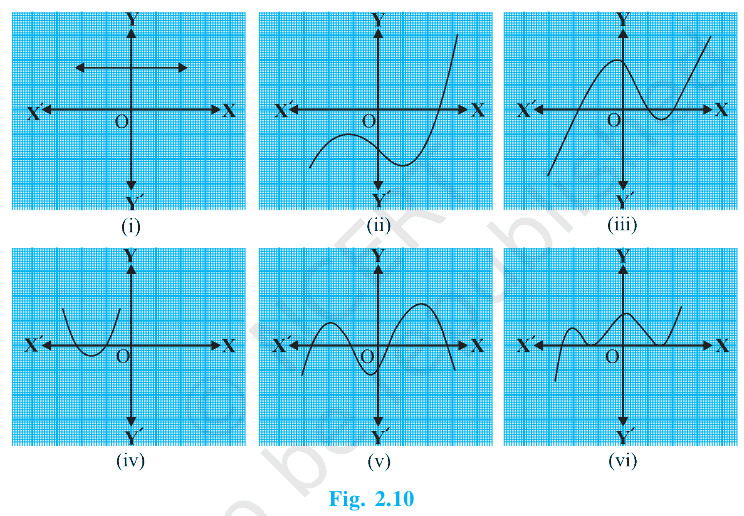
Answer
The number of zeroes of p(x) equals the number of points where the graph of y = p(x) meets (cuts or touches) the x-axis.
(i) The graph is a line parallel to the x-axis and does not meet it
⇒ number of zeroes = 0
(ii) The graph cuts the x-axis at exactly one point
⇒ number of zeroes = 1
(iii) The graph cuts the x-axis at three points
⇒ number of zeroes = 3
(iv) The graph cuts the x-axis at two points
⇒ number of zeroes = 2
(v) The graph cuts the x-axis at four points
⇒ number of zeroes = 4
(vi) The graph cuts the x-axis at one point (on the left) and touches it at two more points
⇒ it meets the x-axis at three points
⇒ number of zeroes = 3
Exercise 2.2
Find the zeroes of the following quadratic polynomials and verify the relationship between the zeroes and the coefficients: (i) x² – 2x – 8 (ii) 4s² – 4s + 1 (iii) 6x² – 3 – 7x (iv) 4u² + 8u (v) t² – 15 (vi) 3x² – x – 4
Answer
For ax² + bx + c with zeroes α and β: α + β = –b/a and αβ = c/a.
(i) x² – 2x – 8
x² – 2x – 8 = x² – 4x + 2x – 8
⇒ x(x – 4) + 2(x – 4)
⇒ (x – 4)(x + 2). Zeroes: 4 and –2
Sum of zeroes = 4 + (–2) = 2, and –b/a = –(–2)/1 = 2 ✓
Product of zeroes = 4 × (–2) = –8, and c/a = –8/1 = –8 ✓
(ii) 4s² – 4s + 1
4s² – 4s + 1 = (2s – 1)². Zeroes: 1/2 and 1/2
Sum of zeroes = 1/2 + 1/2 = 1, and –b/a = –(–4)/4 = 1 ✓
Product of zeroes = 1/2 × 1/2 = 1/4, and c/a = 1/4 ✓
(iii) 6x² – 3 – 7x
Standard form: 6x² – 7x – 3 = 6x² – 9x + 2x – 3
⇒ 3x(2x – 3) + 1(2x – 3)
⇒ (2x – 3)(3x + 1). Zeroes: 3/2 and –1/3
Sum of zeroes = 3/2 – 1/3 = 9/6 – 2/6 = 7/6, and –b/a = –(–7)/6 = 7/6 ✓
Product of zeroes = 3/2 × (–1/3) = –1/2, and c/a = –3/6 = –1/2 ✓
(iv) 4u² + 8u
4u² + 8u = 4u(u + 2). Zeroes: 0 and –2
Sum of zeroes = 0 + (–2) = –2, and –b/a = –8/4 = –2 ✓
Product of zeroes = 0 × (–2) = 0, and c/a = 0/4 = 0 ✓ (here c = 0)
(v) t² – 15
t² – 15 = (t – √15)(t + √15). Zeroes: √15 and –√15
Sum of zeroes = √15 + (–√15) = 0, and –b/a = –0/1 = 0 ✓ (here b = 0)
Product of zeroes = √15 × (–√15) = –15, and c/a = –15/1 = –15 ✓
(vi) 3x² – x – 4
3x² – x – 4 = 3x² – 4x + 3x – 4
⇒ x(3x – 4) + 1(3x – 4)
⇒ (3x – 4)(x + 1). Zeroes: 4/3 and –1
Sum of zeroes = 4/3 – 1 = 1/3, and –b/a = –(–1)/3 = 1/3 ✓
Product of zeroes = 4/3 × (–1) = –4/3, and c/a = –4/3 ✓
Find a quadratic polynomial each with the given numbers as the sum and product of its zeroes respectively: (i) 1/4, –1 (ii) √2, 1/3 (iii) 0, √5 (iv) 1, 1 (v) –1/4, 1/4 (vi) 4, 1
Answer
A quadratic polynomial with sum of zeroes S and product P is k[x² – Sx + P], where k is any non-zero constant.
(i) S = 1/4, P = –1
⇒ x² – (1/4)x – 1
⇒ multiplying by k = 4: 4x² – x – 4
(ii) S = √2, P = 1/3
⇒ x² – √2x + 1/3
⇒ multiplying by k = 3: 3x² – 3√2x + 1
(iii) S = 0, P = √5
⇒ x² – 0·x + √5
⇒ x² + √5
(iv) S = 1, P = 1 → x² – x + 1
(v) S = –1/4, P = 1/4
⇒ x² + (1/4)x + 1/4
⇒ multiplying by k = 4: 4x² + x + 1
(vi) S = 4, P = 1 → x² – 4x + 1
Important Extra Questions
If α and β are the zeroes of the polynomial p(x) = 2x² + 5x + k and α² + β² + αβ = 21/4, find the value of k.
Answer
α + β = –b/a = –5/2 and αβ = c/a = k/2.
α² + β² + αβ = (α + β)² – 2αβ + αβ = (α + β)² – αβ
So 25/4 – k/2 = 21/4
⇒ k/2 = 25/4 – 21/4 = 1
⇒ k = 2
If the zeroes of the polynomial x³ – 3x² + x + 1 are a – b, a, a + b, find a and b.
Answer
For ax³ + bx² + cx + d, sum of zeroes = –b/a and product of zeroes = –d/a. Here the coefficients are 1, –3, 1, 1.
Sum of zeroes: (a – b) + a + (a + b) = 3a = –(–3)/1 = 3
⇒ a = 1
Product of zeroes: (a – b) · a · (a + b) = a(a² – b²) = –1/1 = –1
⇒ 1 × (1 – b²) = –1
⇒ b² = 2
⇒ b = ±√2
What is the relationship between zeroes and coefficients of a quadratic polynomial?
Answer
For a quadratic polynomial ax² + bx + c (a ≠ 0) with zeroes α and β:
Sum of zeroes: α + β = –b/a = –(coefficient of x)/(coefficient of x²)
Product of zeroes: αβ = c/a = (constant term)/(coefficient of x²)
Hence the polynomial can be written as k[x² – (α + β)x + αβ], where k is any non-zero constant.