
NCERT Exercise Questions & Answers + Important Extra Questions
Exercise 6.1
Fill in the blanks using the correct word given in brackets: (i) All circles are ______. (congruent, similar) (ii) All squares are ______. (similar, congruent) (iii) All ______ triangles are similar. (isosceles, equilateral) (iv) Two polygons of the same number of sides are similar, if (a) their corresponding angles are ______ and (b) their corresponding sides are ______. (equal, proportional)
Answer
(i) All circles are similar.
(ii) All squares are similar.
(iii) All equilateral triangles are similar.
(iv) Two polygons of the same number of sides are similar, if (a) their corresponding angles are equal and (b) their corresponding sides are proportional.
Give two different examples of pair of (i) similar figures (ii) non-similar figures.
Answer
(i) Similar figures: (a) any two circles of different radii; (b) any two squares of different side lengths (or any two equilateral triangles).
(ii) Non-similar figures: (a) a square and a rhombus that is not a square (sides proportional but angles not equal); (b) a square and a rectangle that is not a square (angles equal but sides not proportional). A triangle and a quadrilateral are also non-similar.
State whether the following quadrilaterals are similar or not
Answer
In the figure, PQRS is a rhombus with each side 1.5 cm and ABCD is a square with each side 3 cm.
Ratio of corresponding sides: PQ/AB = QR/BC = RS/CD = SP/DA = 1.5/3 = 1/2, so the sides are proportional.
But every angle of the square ABCD is 90°, while the angles of the rhombus PQRS are not 90° (it is slanted). So the corresponding angles are not equal.
Since both conditions are not satisfied, the quadrilaterals are not similar.
Exercise 6.2
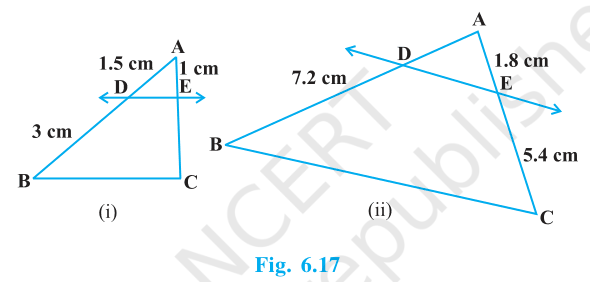
In figures (i) and (ii), DE ∥ BC. Find EC in (i) and AD in (ii).
Answer
(i) Given AD = 1.5 cm, DB = 3 cm, AE = 1 cm. Since DE ∥ BC, by the Basic Proportionality Theorem (BPT): AD/DB = AE/EC
⇒ 1.5/3 = 1/EC
⇒ EC = 3/1.5 = 2 cm
(ii) Given DB = 7.2 cm, AE = 1.8 cm, EC = 5.4 cm. By BPT: AD/DB = AE/EC
⇒ AD/7.2 = 1.8/5.4 = 1/3
⇒ AD = 7.2/3 = 2.4 cm
E and F are points on the sides PQ and PR respectively of a ΔPQR. For each of the following cases, state whether EF ∥ QR: (i) PE = 3.9 cm, EQ = 3 cm, PF = 3.6 cm and FR = 2.4 cm (ii) PE = 4 cm, QE = 4.5 cm, PF = 8 cm and RF = 9 cm (iii) PQ = 1.28 cm, PR = 2.56 cm, PE = 0.18 cm and PF = 0.36 cm
Answer
By the converse of BPT, EF ∥ QR if and only if PE/EQ = PF/FR.
(i) PE/EQ = 3.9/3 = 1.3 and PF/FR = 3.6/2.4 = 1.5. Since 1.3 ≠ 1.5, EF is not parallel to QR.
(ii) PE/QE = 4/4.5 = 8/9 and PF/RF = 8/9. Since the ratios are equal, EF ∥ QR.
(iii) EQ = PQ – PE = 1.28 – 0.18 = 1.10 cm and FR = PR – PF = 2.56 – 0.36 = 2.20 cm.
PE/EQ = 0.18/1.10 = 9/55 and PF/FR = 0.36/2.20 = 9/55. Since the ratios are equal, EF ∥ QR.
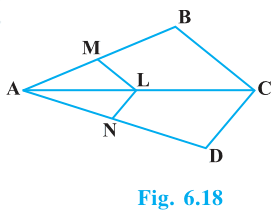
In the figure, if LM ∥ CB and LN ∥ CD, prove that AM/AB = AN/AD.
Answer
In ΔABC, LM ∥ CB. By BPT: AM/MB = AL/LC
⇒ MB/AM = LC/AL
⇒ adding 1 to both sides: (AM + MB)/AM = (AL + LC)/AL
⇒ AB/AM = AC/AL
⇒ AM/AB = AL/AC ... (1)
In ΔADC, LN ∥ CD. In the same way, by BPT: AN/ND = AL/LC
⇒ AN/AD = AL/AC ... (2)
From (1) and (2): AM/AB = AN/AD. Hence proved.
Exercise 6.3
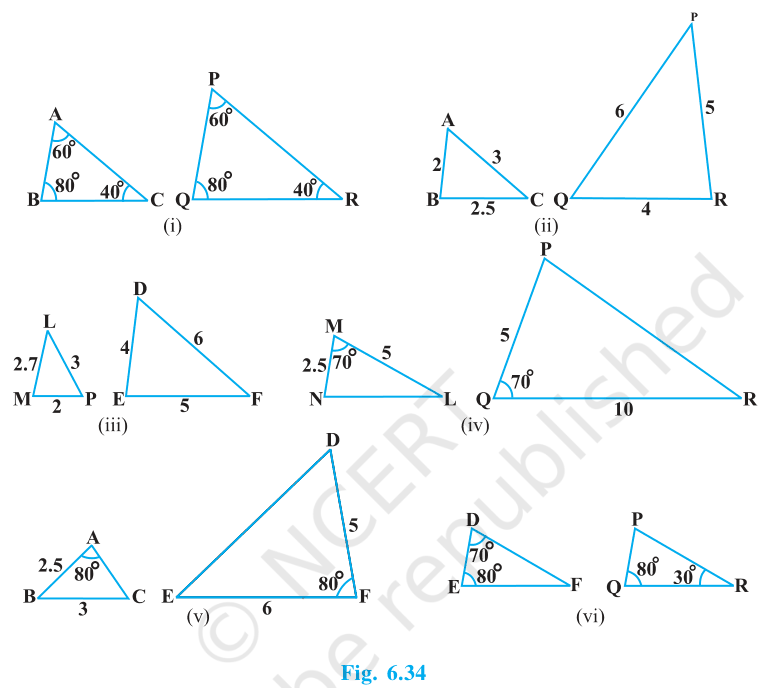
State which pairs of triangles are similar. Write the similarity criterion used and also write the pairs of similar triangles in the symbolic form:
Answer
(i) In ΔABC and ΔPQR: ∠A = ∠P = 60°, ∠B = ∠Q = 80°, ∠C = ∠R = 40°. All corresponding angles are equal
⇒ ΔABC ~ ΔPQR (AAA similarity criterion)
(ii) In ΔABC: AB = 2, BC = 2.5, CA = 3. In ΔPQR: QR = 4, PR = 5, PQ = 6. AB/QR = 2/4 = 1/2, BC/RP = 2.5/5 = 1/2, CA/PQ = 3/6 = 1/2
⇒ all three ratios are equal
⇒ ΔABC ~ ΔQRP (SSS similarity criterion)
(iii) In ΔLMP: MP = 2, LP = 3, LM = 2.7. In ΔDEF: DE = 4, EF = 5, DF = 6. MP/DE = 2/4 = 0.5, LP/DF = 3/6 = 0.5, but LM/EF = 2.7/5 = 0.54. The ratios are not all equal
⇒ not similar.
(iv) In ΔMNL and ΔQPR: ∠M = ∠Q = 70°, MN/QP = 2.5/5 = 1/2 and ML/QR = 5/10 = 1/2. One angle is equal and the sides including it are proportional
⇒ ΔNML ~ ΔPQR (SAS similarity criterion)
(v) In ΔABC: AB = 2.5, BC = 3, ∠A = 80°. In ΔDEF: DF = 5, EF = 6, ∠F = 80°. Here AB/DF = BC/EF = 1/2, but the 80° angle in ΔABC is ∠A, which is not the angle included between AB and BC (that is ∠B). So the SAS condition is not met
⇒ not similar (cannot be concluded similar from the given data).
(vi) In ΔDEF: ∠D = 70°, ∠E = 80°
⇒ ∠F = 180° – 70° – 80° = 30°. In ΔPQR: ∠Q = 80°, ∠R = 30°
⇒ ∠P = 180° – 80° – 30° = 70°. So ∠D = ∠P, ∠E = ∠Q, ∠F = ∠R
⇒ ΔDEF ~ ΔPQR (AAA similarity criterion)
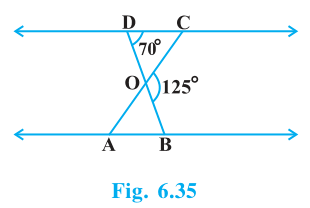
In the figure, ΔODC ~ ΔOBA, ∠BOC = 125° and ∠CDO = 70°. Find ∠DOC, ∠DCO, and ∠OAB.
Answer
DB is a straight line, so ∠DOC and ∠BOC form a linear pair
⇒ ∠DOC = 180° – 125° = 55°
In ΔDOC: ∠DCO = 180° – ∠CDO – ∠DOC = 180° – 70° – 55° = 55°
Since ΔODC ~ ΔOBA, the corresponding angles are equal (O ↔ O, D ↔ B, C ↔ A)
⇒ ∠OAB = ∠OCD = 55°
Sides AB and AC and median AD of a triangle ABC are respectively proportional to sides PQ and PR and median PM of another triangle PQR. Show that ΔABC ~ ΔPQR.
Answer
Given: AB/PQ = AC/PR = AD/PM, where AD and PM are medians.
Construction: Produce AD to E so that DE = AD, and produce PM to N so that MN = PM. Join BE, CE, QN and RN.
In quadrilateral ABEC, the diagonals AE and BC bisect each other at D
⇒ ABEC is a parallelogram
⇒ BE = AC and CE = AB. Similarly PQNR is a parallelogram
⇒ QN = PR and RN = PQ.
Also AE = 2AD and PN = 2PM
⇒ AE/PN = AD/PM.
In ΔABE and ΔPQN: AB/PQ = BE/QN (since BE = AC, QN = PR) = AE/PN
⇒ ΔABE ~ ΔPQN (SSS)
⇒ ∠BAE = ∠QPN ... (1)
In ΔACE and ΔPRN: AC/PR = CE/RN (since CE = AB, RN = PQ) = AE/PN
⇒ ΔACE ~ ΔPRN (SSS)
⇒ ∠CAE = ∠RPN ... (2)
Adding (1) and (2): ∠BAE + ∠CAE = ∠QPN + ∠RPN
⇒ ∠BAC = ∠QPR.
Now in ΔABC and ΔPQR: AB/PQ = AC/PR and the included angles ∠BAC = ∠QPR
⇒ ΔABC ~ ΔPQR (SAS similarity). Hence proved.
Important Extra Questions
State and prove the Basic Proportionality Theorem (Thales Theorem).
Answer
Statement: If a line is drawn parallel to one side of a triangle to intersect the other two sides in distinct points, the other two sides are divided in the same ratio.
Given: In ΔABC, a line parallel to BC meets AB at D and AC at E (DE ∥ BC). To prove: AD/DB = AE/EC.
Construction: Join BE and CD. Draw EN ⊥ AB and DM ⊥ AC.
Proof: ar(ADE) = ½ × AD × EN and ar(BDE) = ½ × DB × EN
⇒ ar(ADE)/ar(BDE) = AD/DB ... (1)
ar(ADE) = ½ × AE × DM and ar(DEC) = ½ × EC × DM
⇒ ar(ADE)/ar(DEC) = AE/EC ... (2)
ΔBDE and ΔDEC are on the same base DE and between the same parallels DE and BC
⇒ ar(BDE) = ar(DEC) ... (3)
From (1), (2) and (3): AD/DB = AE/EC. Hence proved.
State the criteria for similarity of triangles.
Answer
(i) AAA (Angle-Angle-Angle): If in two triangles the corresponding angles are equal, their corresponding sides are in the same ratio and the triangles are similar.
(ii) AA (Angle-Angle): If two angles of one triangle are respectively equal to two angles of another triangle, the triangles are similar (the third angles are then automatically equal).
(iii) SSS (Side-Side-Side): If the corresponding sides of two triangles are in the same ratio, their corresponding angles are equal and the triangles are similar.
(iv) SAS (Side-Angle-Side): If one angle of a triangle is equal to one angle of another triangle and the sides including these angles are proportional, the triangles are similar.
State and prove Pythagoras Theorem.
Answer
Statement: In a right triangle, the square of the hypotenuse is equal to the sum of the squares of the other two sides.
Given: ΔABC right-angled at B. To prove: AC² = AB² + BC².
Construction: Draw BD ⊥ AC.
Proof: In ΔADB and ΔABC: ∠A is common and ∠ADB = ∠ABC = 90°
⇒ ΔADB ~ ΔABC (AA)
⇒ AD/AB = AB/AC
⇒ AB² = AD × AC ... (1)
In ΔBDC and ΔABC: ∠C is common and ∠BDC = ∠ABC = 90°
⇒ ΔBDC ~ ΔABC (AA)
⇒ CD/BC = BC/AC
⇒ BC² = CD × AC ... (2)
Adding (1) and (2): AB² + BC² = AC × (AD + CD) = AC × AC = AC². Hence proved.