
NCERT Exercise Questions & Answers + Important Extra Questions
Exercise 8.1
In ΔABC, right-angled at B, AB = 24 cm, BC = 7 cm. Find (i) sin A, cos A (ii) sin C, cos C
Answer
AC = √(24² + 7²) = √(576+49) = √625 = 25 cm
(i) sin A = BC/AC = 7/25, cos A = AB/AC = 24/25
(ii) sin C = AB/AC = 24/25, cos C = BC/AC = 7/25
In the figure, find tan P – cot R.
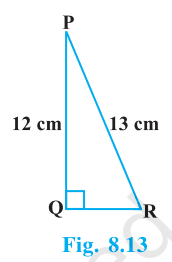
Answer
In ΔPQR right-angled at Q: PQ = 12, PR = 13, QR = √(169–144) = 5.
tan P = QR/PQ = 5/12. cot R = QR/PQ = 5/12.
tan P – cot R = 5/12 – 5/12 = 0
If sin A = 3/4, calculate cos A and tan A.
Answer
sin A = 3/4
⇒ opposite = 3k, hypotenuse = 4k. Adjacent = √(16k²–9k²) = k√7.
cos A = k√7/4k = √7/4. tan A = 3k/k√7 = 3/√7 = 3√7/7
Given 15 cot A = 8, find sin A and sec A.
Answer
cot A = 8/15
⇒ adjacent = 8, opposite = 15, hypotenuse = √(64+225) = √289 = 17.
sin A = 15/17, sec A = 17/8
Given sec θ = 13/12, calculate all other trigonometric ratios.
Answer
Hypotenuse = 13, adjacent = 12, opposite = √(169–144) = 5.
sin θ = 5/13, cos θ = 12/13, tan θ = 5/12, cosec θ = 13/5, sec θ = 13/12, cot θ = 12/5
If ∠A and ∠B are acute angles such that cos A = cos B, then show that ∠A = ∠B.
Answer
In ΔABC, cos A = AC/hypotenuse, cos B = BC/hypotenuse. If cos A = cos B, then the sides adjacent to A and B are equal. In a right triangle, if two sides are equal, the angles opposite to them are equal. Hence ∠A = ∠B.
If cot θ = 7/8, evaluate: (i) (1+sin θ)(1–sin θ)/(1+cos θ)(1–cos θ) (ii) cot²θ
Answer
cot θ = 7/8
⇒ adjacent = 7, opposite = 8, hyp = √(49+64) = √113.
sin θ = 8/√113, cos θ = 7/√113.
(i) = (1–sin²θ)/(1–cos²θ) = cos²θ/sin²θ = cot²θ = 49/64
(ii) cot²θ = 49/64
If 3 cot A = 4, check whether (1–tan²A)/(1+tan²A) = cos²A – sin²A or not.
Answer
cot A = 4/3
⇒ tan A = 3/4, sin A = 3/5, cos A = 4/5.
LHS = (1–9/16)/(1+9/16) = (7/16)/(25/16) = 7/25
RHS = 16/25 – 9/25 = 7/25. LHS = RHS ✓
Q11. State whether the following are true or false
(i) tan A is not defined for A = 90° → True
(ii) sec A = 12/5 for some value of ∠A → True (sec A can be > 1)
(iii) cos A is the abbreviation of cosecant A → False (cos = cosine, cosec = cosecant)
(iv) cot A is the product of cot and A → False (cot A is a function of angle A)
(v) sin θ = 4/3 for some angle θ → False (sin θ cannot exceed 1)
Exercise 8.2
Q1. Evaluate the following
(i) sin 60° cos 30° + sin 30° cos 60° = (√3/2)(√3/2) + (1/2)(1/2) = 3/4 + 1/4 = 1
(ii) 2 tan²45° + cos²30° – sin²60° = 2(1)² + (√3/2)² – (√3/2)² = 2 + 3/4 – 3/4 = 2
(iii) cos 45°/(sec 30° + cosec 30°): (1/√2)/(2/√3 + 2) = (1/√2)/((2+2√3)/√3) = √3/(√2(2+2√3)) = (√3(√3–1))/4... simplified = (3√2 – √6)/8
Q2. Choose the correct option
(i) 2 tan 30°/(1 + tan²30°) = 2(1/√3)/(1+1/3) = (2/√3)/(4/3) = 6/(4√3) = 3/(2√3) = √3/2 = sin 60°
(ii) (1 – tan²45°)/(1 + tan²45°) = (1–1)/(1+1) = 0 = cos 90°
(iii) sin 2A = 2 sin A cos A. If 2A = A... wait: checking if sin 2A = 2 sin A is true. Only if cos A = 1, i.e., A = 0. → Answer depends on specific option.
If tan(A+B) = √3 and tan(A–B) = 1/√3, find A and B (0° < A+B ≤ 90°).
Answer
A + B = 60° (since tan 60° = √3), A – B = 30° (since tan 30° = 1/√3).
Adding: 2A = 90°
⇒ A = 45°. B = 60° – 45° = 15°. A = 45°, B = 15°
Q4. State whether true or false
(i) sin(A+B) = sin A + sin B → False
(ii) The value of sin θ increases as θ increases → True (for 0° ≤ θ ≤ 90°)
(iii) The value of cos θ increases as θ increases → False (cos θ decreases from 0° to 90°)
(iv) sin θ = cos θ for all values of θ → False (only true for θ = 45°)
(v) cot A is not defined for A = 0° → True (cot 0° = cos 0°/sin 0° = 1/0 = undefined)
Exercise 8.3
Q1. Evaluate: (i) sin 18°/cos 72°
sin 18° = cos(90°–18°) = cos 72°. So sin 18°/cos 72° = 1
(ii) tan 26°/cot 64°
tan 26° = cot(90°–26°) = cot 64°. So tan 26°/cot 64° = 1
(iii) cos 48° – sin 42°
cos 48° = sin(90°–48°) = sin 42°. So cos 48° – sin 42° = 0
(iv) cosec 31° – sec 59°
cosec 31° = sec(90°–31°) = sec 59°. So cosec 31° – sec 59° = 0
Show that: tan 48° tan 23° tan 42° tan 67° = 1
Answer
tan 48° = cot 42°, tan 23° = cot 67°.
LHS = cot 42° × cot 67° × tan 42° × tan 67° = (cot 42° × tan 42°)(cot 67° × tan 67°) = 1 × 1 = 1
If tan 2A = cot(A – 18°), find the value of A (where 2A is an acute angle).
Answer
tan 2A = cot(90° – 2A). So cot(90° – 2A) = cot(A – 18°)
⇒ 90° – 2A = A – 18°
⇒ 108° = 3A
⇒ A = 36°
If tan A = cot B, prove that A + B = 90°.
Answer
tan A = cot B = tan(90° – B). Since both are acute: A = 90° – B
⇒ A + B = 90°
Express sin 67° + cos 75° in terms of trigonometric ratios of angles between 0° and 45°.
Answer
sin 67° = cos(90°–67°) = cos 23°. cos 75° = sin(90°–75°) = sin 15°.
= cos 23° + sin 15°
Exercise 8.4
Express the trigonometric ratios sin A, sec A and tan A in terms of cot A.
Answer
cosec²A = 1 + cot²A
⇒ sin A = 1/√(1 + cot²A)
sec²A = 1 + tan²A = 1 + 1/cot²A = (cot²A + 1)/cot²A
⇒ sec A = √(1 + cot²A)/cot A
tan A = 1/cot A
Write all the other trigonometric ratios of ∠A in terms of sec A.
Answer
cos A = 1/sec A. sin A = √(sec²A – 1)/sec A. tan A = √(sec²A – 1).
cosec A = sec A/√(sec²A – 1). cot A = 1/√(sec²A – 1).
Q3. Evaluate: (i) (sin²63° + sin²27°)/(cos²17° + cos²73°)
sin 63° = cos 27°, cos 17° = sin 73°. Numerator = cos²27° + sin²27° = 1. Denominator = sin²73° + cos²73° = 1.
Answer = 1
Prove that (sin θ – cos θ + 1)/(sin θ + cos θ – 1) = 1/(sec θ – tan θ)
Answer
Divide numerator and denominator by cos θ:
(tan θ – 1 + sec θ)/(tan θ + 1 – sec θ)
Using identity sec²θ – tan²θ = 1
⇒ (sec θ – tan θ)(sec θ + tan θ) = 1
Multiply numerator and denominator by (sec θ – tan θ):
= (sec θ + tan θ – 1)(sec θ – tan θ)/((tan θ + 1 – sec θ)(sec θ – tan θ))
After simplification = 1/(sec θ – tan θ). Proved.
Important Extra Questions
Write the standard trigonometric table for 0°, 30°, 45°, 60°, 90°.
Answer
sin: 0, 1/2, 1/√2, √3/2, 1
cos: 1, √3/2, 1/√2, 1/2, 0
tan: 0, 1/√3, 1, √3, undefined
cosec: undefined, 2, √2, 2/√3, 1
sec: 1, 2/√3, √2, 2, undefined
cot: undefined, √3, 1, 1/√3, 0
Prove that (1 + tan²A)/(1 + cot²A) = tan²A.
Answer
LHS = sec²A / cosec²A = (1/cos²A) / (1/sin²A) = sin²A/cos²A = tan²A = RHS. Proved.
Prove: (cosec θ – cot θ)² = (1 – cos θ)/(1 + cos θ).
Answer
LHS = (1/sin θ – cos θ/sin θ)² = ((1–cos θ)/sin θ)² = (1–cos θ)²/sin²θ = (1–cos θ)²/(1–cos²θ) = (1–cos θ)²/((1–cos θ)(1+cos θ)) = (1–cos θ)/(1+cos θ) = RHS. Proved.