
Circle of Learning • New NCERT textbook "Exploration" (2026-27) • Pause and Ponder + Revise, Reflect, Refine (all questions) + extra important questions
Pause and Ponder (In-text Questions)
Explore various ways of producing sound.
Answer
- Plucking a string (guitar, sitar, a stretched rubber band)
- Striking/beating (drum, tabla, bell, tuning fork, clapping)
- Blowing air through a tube or over an opening (flute, whistle, shehnai, blowing across a bottle top)
- Bowing/rubbing (violin, sarangi, rubbing a wet finger on the rim of a glass)
- Shaking/scraping (rattle, ghungroo, maracas)
- Vibration of our vocal cords when we speak or sing
In every case, something is made to vibrate.
Make a list of different types of musical instruments and identify their vibrating parts which produce sound.
Answer
Instrument | Vibrating part |
Sitar, guitar, veena, violin, sarangi | Stretched strings |
Tabla, dholak, mridangam, drum | Stretched membrane (skin) |
Flute, bansuri, shehnai, trumpet | Air column inside the tube |
Harmonium, mouth organ | Metal reeds (and air) |
Ghatam, jal tarang, bells, manjira | The body of the pot/bowl/metal |
Assertion (A): We cannot hear the sound of a bell ringing in a closed jar after most of the air is pumped out. Reason (R): Sound requires a medium to travel.
Answer
(ii) Both A and R are true, and R is the correct explanation of A.
Assertion (A): Compressions and rarefactions move through the medium. Reason (R): Individual particles of the medium continuously move forward with the wave.
Answer
(iii) A is true, but R is false. The particles only vibrate back and forth about their mean positions; only the disturbance (and energy) moves forward.
When sound travels from a tuning fork to your ear, which of the following actually reaches your ear?
Answer
(ii) Energy carried by sound waves.
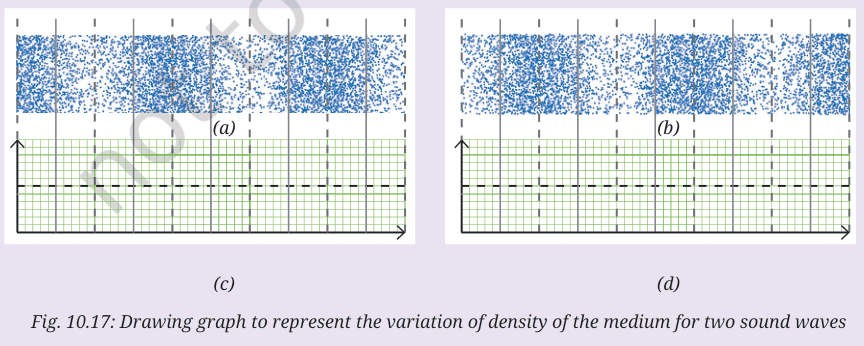
The variation of density of the medium for two sound waves is shown in Fig. 10.17 (a) and (b). Label compression and rarefaction by C and R. In the graphs in Fig. 10.17 (c) and (d), label the axes and draw the curves corresponding to (a) and (b).
Answer
- In (a) and (b), mark C at the regions where the dots are crowded together (high density) and R where they are spread apart (low density).
- In (c) and (d), label the x-axis "Distance" and the y-axis "Density", and draw a dashed horizontal line for the average density.
- Draw a smooth wave whose crests lie directly below each C and troughs directly below each R. The distance between two crests should equal the distance between two compressions in the picture above it.
Conduct Activity 10.1 again with a thick and a thin rubber band. Does the thin rubber band vibrate faster? If yes, how do the frequency and time period of the sound produced by it differ from that of the thick band?
Answer
Yes, the thin rubber band vibrates faster. So its sound has a higher frequency (higher pitch) and a shorter time period (T = 1/f) than the thick band's sound.
If the frequency of a sound wave produced by an oscillating piston in a long air-filled tube is 20 Hz, how many oscillations does the piston complete per minute?
Answer
20 oscillations per second × 60 s = 1200 oscillations per minute
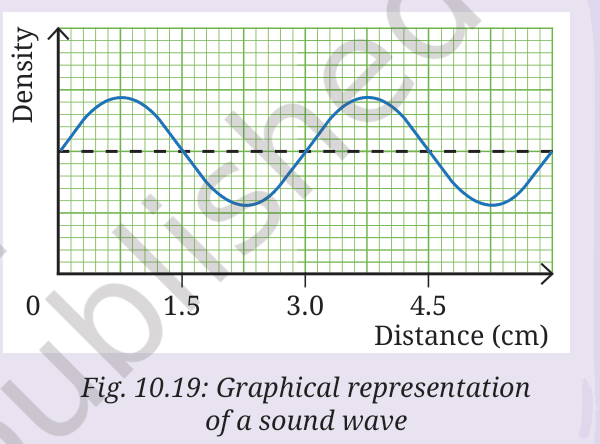
For the sound wave represented by the graph in Fig. 10.19, what is half of its wavelength?
Answer
From the graph, one complete wave (crest to next crest) spans 3.0 cm, so the wavelength is 3.0 cm and half of the wavelength is 1.5 cm (the distance between a compression and the next rarefaction).
Using Table 10.1 (steel 5000 m s−1, water 1500 m s−1, air 340 m s−1), find the ratio of (i) the speed of sound in water to that in air, (ii) the speed of sound in steel to that in water.
(i) 1500 : 340 ≈ 4.4 : 1 (sound is about 4.4 times faster in water than in air)
(ii) 5000 : 1500 ≈ 3.3 : 1 (about 3.3 times faster in steel than in water)
Answer
Two friends stand along a steel fence 340 m apart. Gunjan places her ear on the fence and her friend knocks it. Calculate the time difference between the sound reaching her through air and through steel. Could she distinguish the two sounds? (They must be at least 0.1 s apart.)
Answer
Time through air = 340/340 = 1 s
Time through steel = 340/5000 = 0.068 s
Time difference = 1 − 0.068 = 0.932 s
Since 0.932 s is much more than 0.1 s, yes, she would hear two separate sounds – first through the steel, then through the air.
An experiment requires echoes to arrive at least 0.2 s after the emission of sound. What minimum distance should a reflecting surface be placed at? (speed of sound = 343 m s−1)
Answer
Sound travels to the surface and back: 2d = v × t = 343 × 0.2 = 68.6 m
d = 34.3 m
A sonar signal sent to find the depth of the ocean takes 4 s to return. What is the depth if the speed of sound in seawater is 1500 m s−1?
Answer
2d = 1500 × 4 = 6000 m
⇒ depth d = 3000 m
Revise, Reflect, Refine (Textbook Exercise)
Which observation best supports the idea that sound is a mechanical wave?
Answer
(ii) Sound needs a medium to propagate.
For a sound wave propagating in a medium, increasing its frequency will increase its:
Answer
(iii) number of compressions per second. (In the same medium the speed stays the same, so the wavelength and time period decrease.)
If 20 compressions pass a point in 4 seconds, the frequency is
Answer
(ii) 5 Hz (20 ÷ 4 = 5 per second)
In a room, the reflected sound reaches the ear 0.05 s after its production. Will it produce an echo or reverberation? Justify.
Answer
It will produce reverberation, not an echo. A distinct echo is heard only when the reflected sound arrives at least 0.1 s after the original sound (the sensation of sound persists in our ear for about 0.1 s). Here the reflected sound arrives so soon that it merges with the original sound and makes it seem to persist – this is reverberation.
Graphs of two sound waves are given in Fig. 10.30 (same scales). Which has (i) greater wavelength, (ii) smaller amplitude?
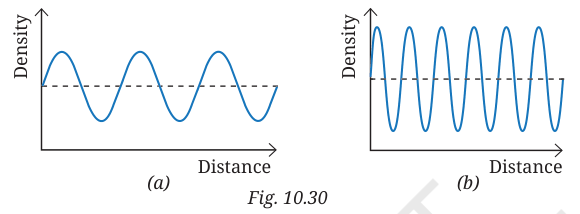
(i) Wave (a) has the greater wavelength – its crests are farther apart (fewer waves in the same distance).
(ii) Wave (a) also has the smaller amplitude – its curve rises and falls less from the average-density line than wave (b).
Answer
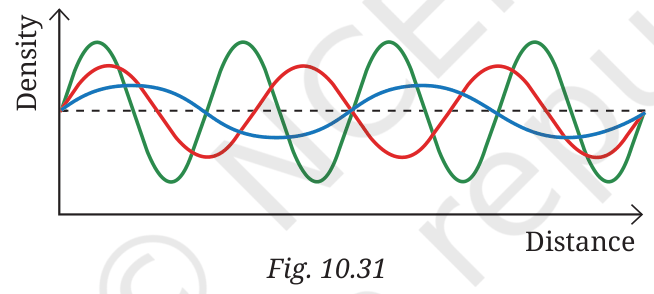
Sound waves from sources A, B and C are shown in Fig. 10.31. The frequency of A is maximum and C is minimum. Identify and mark the curves.
Answer
In the same distance, the wave with the most oscillations (shortest wavelength) has the highest frequency (same speed in air).
- Green curve (most oscillations) – A
- Red curve (medium number) – B
- Blue curve (fewest oscillations, longest wavelength) – C
Draw a graph to represent a sound wave for which the density amplitude is 3 units and wavelength is 4 cm.
Answer
Take distance (cm) on the x-axis and density on the y-axis. Draw a dashed line for the average density. Draw a smooth wave that rises 3 units above and falls 3 units below this line. Place crests at 1 cm, 5 cm, 9 cm… and troughs at 3 cm, 7 cm, 11 cm…, so that the distance between two consecutive crests is 4 cm. Show at least two complete waves (0 to 8 cm).
In a movie, an explosion of a spacecraft in space is shown with a flash of light and sound at the same time. What are the errors in this depiction?
Answer
Space is almost a vacuum. Sound is a mechanical wave and needs a medium, so no sound of the explosion can be heard in space. Light can travel through vacuum, so only the flash would be seen. (Even on Earth, the sound would arrive after the flash, because sound is much slower than light – so showing them at the same time for a distant explosion is also wrong.)
A source produces a sound wave of wavelength 3.44 m. If the wave travels at 344 m s−1, find its time period.
Answer
f = v/λ = 344/3.44 = 100 Hz
T = 1/f = 0.01 s
A ship sent a sonar signal and detected an echo after 5 s. If ultrasonic waves travel at 1525 m s−1 in seawater, how far down is the wreckage?
Answer
2d = 1525 × 5 = 7625 m
⇒ d = 3812.5 m (about 3.8 km)
A parking sensor's warning beep starts at 1.2 m from the obstacle. How much time is taken by the ultrasonic wave to travel to the obstacle and back? (speed = 345 m s−1)
Answer
Total distance = 2 × 1.2 = 2.4 m
t = 2.4/345 ≈ 0.007 s (about 7 milliseconds)
The speed of sound in air is about 331 m s−1 at 0 °C and 344 m s−1 at 22 °C. How much extra time will thunder take to travel 1720 m if the temperature drops from 22 °C to 0 °C?
Answer
At 22 °C: t = 1720/344 = 5.0 s
At 0 °C: t = 1720/331 ≈ 5.2 s
Extra time ≈ 0.2 s
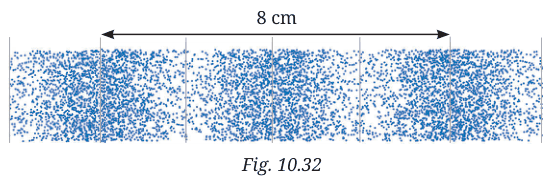
The variation of density for a sound wave travelling at 340 m s−1 is shown in Fig. 10.32. Calculate the wavelength and frequency.
Answer
The 8 cm marked in the figure stretches from the centre of the first compression to the centre of the third compression, i.e. it covers two wavelengths.
λ = 8/2 = 4 cm = 0.04 m
f = v/λ = 340/0.04 = 8500 Hz
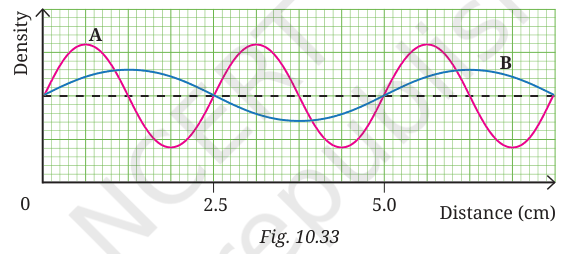
Two sound waves A and B travel at 345 m s−1 (Fig. 10.33). Find the wavelength and frequency of each.
Answer
From the graph:
Wave A repeats every 2.5 cm
⇒ λA = 0.025 m; fA = 345/0.025 = 13,800 Hz
Wave B repeats every 5.0 cm
⇒ λB = 0.05 m; fB = 345/0.05 = 6,900 Hz
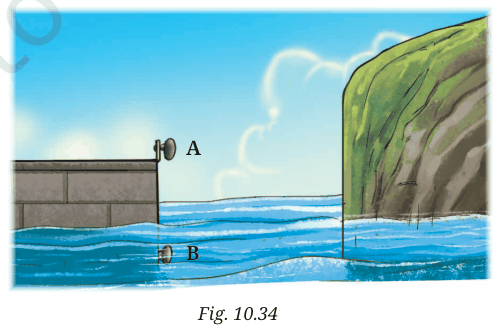
Two identical sources at A (in air) and B (in water) produce sound that travels to a cliff and back. If the time taken to return to A is 4.5 times that of B, what is the ratio of the speeds of sound in air and water?
Answer
Both cover the same distance, so speed ∝ 1/time.
vair : vwater = tB : tA = 1 : 4.5 = 2 : 9
Extra Important Questions
Multiple Choice Questions (1 mark)
1. The audible range of the human ear is
(a) 2 Hz–2000 Hz (b) 20 Hz–20,000 Hz (c) 200 Hz–200,000 Hz (d) above 20 kHz
Answer: (b)
2. Sound waves in air are
(a) transverse (b) longitudinal (c) electromagnetic (d) none
Answer: (b) longitudinal
3. Pitch of a sound depends on its
(a) amplitude (b) frequency (c) speed (d) intensity
Answer: (b) frequency
4. Bats locate prey using
(a) infrasound (b) ultrasound (c) light (d) heat
Answer: (b) ultrasound
Short Answer Questions
Write the relation between speed, frequency and wavelength.
Answer
v = f × λ, where v is the speed, f the frequency and λ the wavelength of the wave.
Give two uses of ultrasound.
Answer
Ultrasonography (imaging internal organs and the foetus), SONAR (measuring ocean depth), detecting cracks in metal blocks, cleaning delicate parts (any two).
How can reverberation in a hall be reduced?
Answer
By covering walls and ceilings with sound-absorbing materials such as curtains, fibreboard, rough plaster and by using upholstered seats and carpets.