
Circle of Learning • New NCERT textbook "Exploration" (2026-27) • Activity + Pause and Ponder + Revise, Reflect, Refine (all questions) + extra important questions
Activity 4.1 – Let Us Analyse
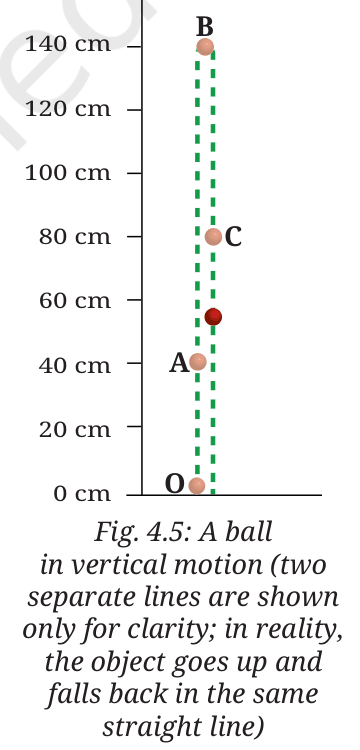
A ball is thrown vertically upwards from O. It moves up straight till B and then falls back to O (Fig. 4.5: A at 40 cm, B at 140 cm, C at 80 cm). (1) Can this be considered a motion in a straight line? (2) Fill up Table 4.1. (3) Choose which is true for displacement.
Answer
(1) Yes. The ball moves up and down along the same vertical line, so it is motion in a straight line (only the direction reverses).
(2)
Position | Total distance travelled from O | Displacement from O |
O | 0 cm | 0 cm |
A | 40 cm | 40 cm upward |
B | 140 cm | 140 cm upward |
C (on the way down) | 140 + 60 = 200 cm | 80 cm upward |
O (back) | 280 cm | 0 cm |
(3) (iii) Its magnitude is less than or equal to the total distance travelled.
Pause and Ponder (In-text Questions)
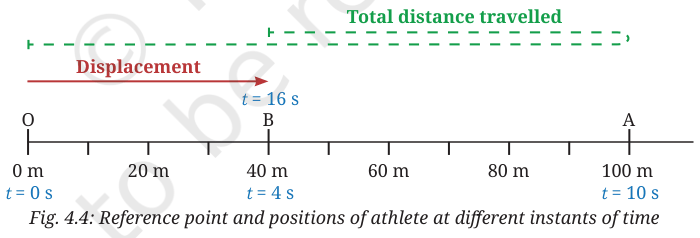
In the example of an athlete running back and forth on a straight track (Fig. 4.4), when will the displacement of the athlete be zero? What will be the total distance travelled in that case?
Answer
The displacement will be zero at the instant the athlete comes back to her starting point, because displacement depends only on the initial and final positions. The total distance at that moment is the full length of the path she has run – for example, if she ran 100 m forward and then 100 m back, the distance is 200 m. So distance can be large even when displacement is zero.
Fuel used up in a vehicle depends on which of the following? Justify your answer. (i) Total distance travelled (ii) Displacement
Answer
(i) Total distance travelled. The engine burns fuel for every metre the vehicle actually moves, whatever the direction. A car that goes 10 km and returns home has zero displacement but has used fuel for 20 km.
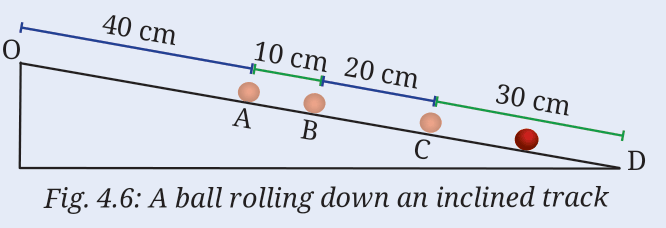
A ball rolls down an inclined track (Fig. 4.6: OA = 40 cm, AB = 10 cm, BC = 20 cm, CD = 30 cm). Is its motion a straight line motion? Assuming the starting point O as origin, can its motion from O to D be depicted using a horizontal line? Are the values of total distance travelled and magnitude of displacement from O equal or different at positions A, B, C and D?
Answer
Yes, it is straight line motion – the ball moves along the straight inclined track in one direction. A straight line need not be horizontal; we can simply take the track itself as our number line (tilt the horizontal line along the track) with O as the origin.
Since the ball moves in one direction without turning back, distance = magnitude of displacement at every point:
Position | Distance from O | Displacement from O |
A | 40 cm | 40 cm |
B | 50 cm | 50 cm |
C | 70 cm | 70 cm |
D | 100 cm | 100 cm |
During a family road trip, you drive 200 km north in three hours. Afterwards, you drive 200 km south in two hours. Find the average speed and average velocity for your entire trip.
Answer
Total distance = 200 + 200 = 400 km; total time = 3 + 2 = 5 h
Average speed = 400/5 = 80 km/h
You return to the starting point, so displacement = 0.
Average velocity = 0/5 = 0 km/h
Under what condition(s) is the (i) magnitude of average velocity of an object equal to its average speed? (ii) magnitude of average velocity of an object zero while its average speed is not zero?
(i) When the object moves in a straight line in one direction only (it never turns back), so distance = magnitude of displacement.
(ii) When the object moves and returns to its starting point – displacement is zero, but distance is not zero. Example: a runner completing one round of a track.
Answer
Revise, Reflect, Refine (Textbook Exercise)
My father went to a shop 250 m away on a straight road. He came home to take a cloth bag, went to the shop again, bought provisions and came back home. How much was the total distance travelled? What was his displacement from home?
Answer
He covered 250 m four times (home
⇒ shop
⇒ home
⇒ shop
⇒ home).
Total distance = 4 × 250 = 1000 m (1 km)
He ends at home, so displacement = 0 m.
A student runs from the ground floor to the fourth floor to collect a book and then comes down to the classroom on the second floor. If the height of each floor is 3 m, find (i) the total vertical distance travelled, and (ii) their displacement from the starting point.
Answer
Ground to 4th floor = 4 × 3 = 12 m up; 4th to 2nd floor = 2 × 3 = 6 m down.
(i) Total vertical distance = 12 + 6 = 18 m
(ii) Final position is the 2nd floor = 2 × 3 = 6 m vertically upward from the start.
A girl is riding her scooter and finds that its speedometer reading is constant. Is it possible for her scooter to be accelerating and if so, how?
Answer
Yes. Acceleration is the rate of change of velocity, and velocity has both magnitude and direction. If she is going around a curve or a roundabout at constant speed, the direction of motion keeps changing, so the velocity changes and the scooter is accelerating even though the speedometer shows a constant reading.
A car starts from rest and its velocity reaches 24 m s−1 in 6 s. Find the average acceleration and the distance travelled in these 6 s.
Answer
a = (v − u)/t = (24 − 0)/6 = 4 m s−2
s = ut + ½at² = 0 + ½ × 4 × 36 = 72 m
A motorbike moving with initial velocity 28 m s−1 and constant acceleration stops after travelling 98 m. Find the acceleration of the motorbike and the time taken to come to a stop.
Answer
v² = u² + 2as
⇒ 0 = 28² + 2a(98)
⇒ 0 = 784 + 196a
⇒ a = −4 m s−2
v = u + at ⇒ 0 = 28 − 4t ⇒ t = 7 s
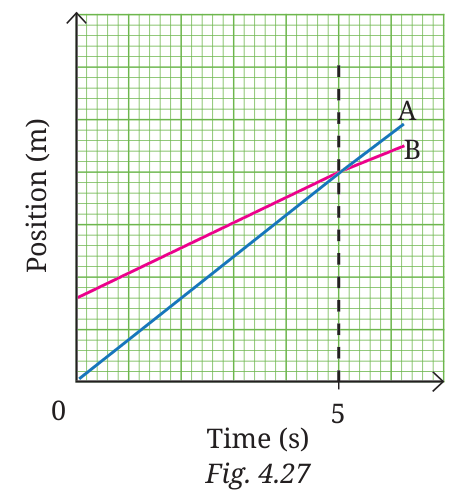
Fig. 4.27 shows a position-time graph of two objects A and B moving along parallel tracks in the same direction. Do A and B ever have equal velocity? Justify your answer.
Answer
No. Both graphs are straight lines, so each object moves with a constant velocity equal to the slope of its line. Line A (starting from the origin) is steeper than line B throughout, so A's velocity is always greater than B's. The point where the lines cross only shows that A and B are at the same position at that instant (A overtakes B), not that they have the same velocity.
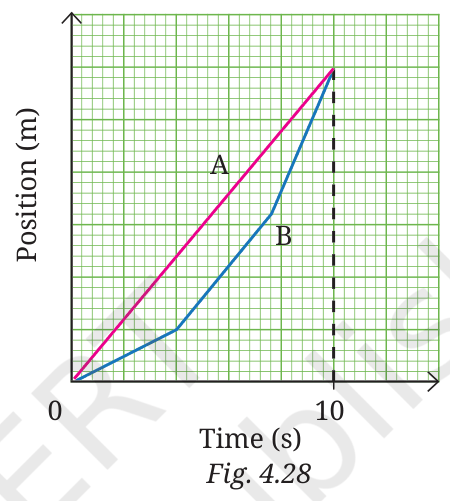
Fig. 4.28 shows the position–time graphs of A (straight line) and B (curve) moving in a straight line from 0 to 10 s, with the same initial and final positions. Choose the correct option(s).
Answer
(i) and (ii).
(i) Both start and end at the same positions in 10 s, so their displacements and average velocities are equal.
(ii) Both move in one direction only (position keeps increasing), so the distance covered equals the displacement for each. They cover equal distances in 10 s, so their average speeds are also equal. B's speed is lower than A's in some segments and higher in others, but this does not change the average. Options (iii) and (iv) are wrong.
A truck driver driving at 54 km h−1 notices a speed limit sign of 40 km h−1 for trucks. He slows down to 36 km h−1 in 36 s. What was the distance travelled by him during this time? Assume constant acceleration.
Answer
u = 54 km/h = 15 m/s; v = 36 km/h = 10 m/s; t = 36 s
For constant acceleration, s = (u + v)/2 × t = (15 + 10)/2 × 36 = 12.5 × 36 = 450 m
(Check: a = (10 − 15)/36 = −0.139 m/s²; s = 15 × 36 + ½(−0.139)(36²) = 540 − 90 = 450 m.)
A car starts from rest and accelerates uniformly to 20 m s−1 in 5 s. It then travels at 20 m s−1 for 10 s and finally applies the brake to stop in 6 s. Find the total distance travelled.
Answer
Stage 1: s1 = (0 + 20)/2 × 5 = 50 m
Stage 2: s2 = 20 × 10 = 200 m
Stage 3: s3 = (20 + 0)/2 × 6 = 60 m
Total distance = 50 + 200 + 60 = 310 m (this is the area under the v–t graph).
A bus is travelling at 36 km h−1 when the driver sees an obstacle 30 m ahead. The driver takes 0.5 s to react before pressing the brake. Then the velocity reduces with constant acceleration of 2.5 m s−2 (deceleration). Will the bus be able to stop before reaching the obstacle?
Answer
u = 36 km/h = 10 m/s
Distance during reaction time = 10 × 0.5 = 5 m
Braking distance: v² = u² + 2as
⇒ 0 = 100 − 2 × 2.5 × s
⇒ s = 20 m
Total stopping distance = 5 + 20 = 25 m
Since 25 m < 30 m, yes, the bus stops safely, 5 m before the obstacle.
A student said, "The Earth moves around the Sun". In this context, discuss whether an object kept on the Earth can be considered to be at rest.
Answer
Rest and motion are relative – they depend on the reference point. An object kept on a table does not change its position with respect to the Earth (or the room), so for an observer on Earth it is at rest. But with respect to the Sun, the object moves along with the Earth (which rotates and revolves around the Sun), so it is in motion. Both statements are correct for their own frame of reference.
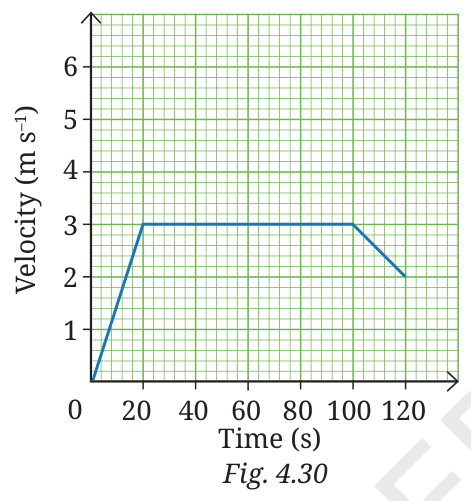
The velocity–time graph from 0 s to 120 s for a cyclist is shown in Fig. 4.30 (velocity rises from 0 to 3 m/s in 20 s, stays at 3 m/s till 100 s, then falls to 2 m/s at 120 s). Shade the areas representing displacement (i) while moving with constant velocity, (ii) when velocity is decreasing. Also calculate the displacement and average acceleration in the 120 s interval.
Answer
Shading: (i) Shade the rectangle under the horizontal line from t = 20 s to t = 100 s in one colour. (ii) Shade the trapezium under the falling line from t = 100 s to t = 120 s in another colour.
Displacement
0–20 s (triangle): ½ × 20 × 3 = 30 m
20–100 s (rectangle): 80 × 3 = 240 m
100–120 s (trapezium): ½ × (3 + 2) × 20 = 50 m
Total displacement = 30 + 240 + 50 = 320 m
Average acceleration = (final velocity − initial velocity)/time = (2 − 0)/120 = 0.0167 m s−2 (≈ 1/60 m s−2)
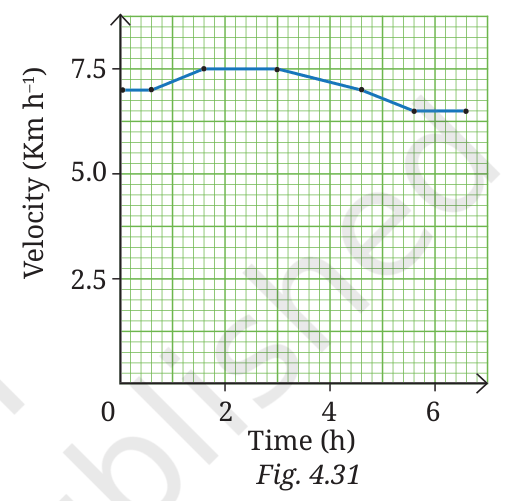
A girl preparing for a marathon runs on a straight road. Her velocity–time graph is shown in Fig. 4.31. Estimate the distance she ran.
Answer
Reading the graph: about 7 km/h for the first ~0.5 h, rising to 7.5 km/h by ~1.5 h, steady at 7.5 km/h till ~3 h, falling to 7 km/h at ~4.5 h and 6.5 km/h at ~5.5 h, then steady at 6.5 km/h till ~6.5 h.
Distance = area under the graph:
0–0.5 h: 7 × 0.5 = 3.5 km
0.5–1.5 h: (7 + 7.5)/2 × 1 = 7.25 km
1.5–3 h: 7.5 × 1.5 = 11.25 km
3–4.5 h: (7.5 + 7)/2 × 1.5 ≈ 10.9 km
4.5–5.5 h: (7 + 6.5)/2 × 1 = 6.75 km
5.5–6.5 h: 6.5 × 1 = 6.5 km
Total ≈ 46 km. (A quick check: average velocity about 7 km/h × about 6.5 h ≈ 45 km. Since this is an estimate from a graph, answers in the range 42–46 km are reasonable.)
On entering a state highway, a car moves with a constant velocity of 6 m s−1 for 2 minutes and then accelerates at 1 m s−2 for 6 seconds. Find the displacement in the 2 min 6 s interval by drawing a velocity–time graph.
Answer
Graph: A horizontal line at v = 6 m/s from t = 0 to t = 120 s, then a straight line rising from (120 s, 6 m/s) to (126 s, 12 m/s), since v = 6 + 1 × 6 = 12 m/s.
Displacement = area under the graph
Rectangle: 6 × 120 = 720 m
Trapezium: ½ × (6 + 12) × 6 = 54 m
Total = 774 m
Cars A and B start from rest with constant acceleration. Car A attains 5 m s−1 in 5 s; car B attains 3 m s−1 in 10 s. Plot the v–t graphs on the same axes and calculate the displacement in the two time intervals.
Answer
aA = 5/5 = 1 m s−2; aB = 3/10 = 0.3 m s−2
Car A: t (s) | 1 | 2 | 3 | 4 | 5 |
v (m/s) | 1 | 2 | 3 | 4 | 5 |
Car B: t (s) | 2 | 4 | 6 | 8 | 10 |
v (m/s) | 0.6 | 1.2 | 1.8 | 2.4 | 3.0 |
Both graphs are straight lines through the origin; A's line is steeper.
Displacement of A in 5 s = area of triangle = ½ × 5 × 5 = 12.5 m
Displacement of B in 10 s = ½ × 10 × 3 = 15 m
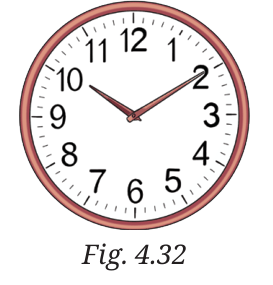
Rohan studies from 6 PM to 7:30 PM. Consider the tip of the minute hand (length 7 cm). During this interval, find its (i) distance travelled, (ii) displacement, (iii) speed, and (iv) velocity.
Answer
In 1.5 h the minute hand makes 1.5 rounds; at 6 PM the tip is at 12 and at 7:30 PM it is at 6.
(i) Distance = 1.5 × 2πr = 1.5 × 2 × (22/7) × 7 = 66 cm
(ii) Displacement = straight line from 12 to 6 = diameter = 14 cm, directed downward (from 12 towards 6)
(iii) Average speed = 66 cm ÷ 90 min = 0.73 cm/min (≈ 0.0122 cm/s)
(iv) Average velocity = 14 cm ÷ 90 min = 0.156 cm/min (≈ 0.0026 cm/s), directed from 12 towards 6
Extra Important Questions
Multiple Choice Questions (1 mark)
1. The slope of a position–time graph gives
(a) acceleration (b) velocity (c) displacement (d) distance
Answer: (b) velocity
2. The area under a velocity–time graph gives
(a) acceleration (b) velocity (c) displacement (d) speed
Answer: (c) displacement
3. 72 km h−1 equals
(a) 20 m s−1 (b) 7.2 m s−1 (c) 36 m s−1 (d) 2 m s−1
Answer: (a)
4. A horizontal line on a velocity–time graph means
(a) object at rest (b) uniform velocity (c) uniform acceleration (d) decreasing velocity
Answer: (b) uniform velocity
Short Answer Questions
Write the three kinematic equations for uniformly accelerated motion.
Answer
v = u + at; s = ut + ½at²; v² = u² + 2as
Differentiate between distance and displacement.
Answer
Distance is the total length of the path covered; it is a scalar and never negative. Displacement is the straight-line change in position from start to end in a given direction; it is a vector and can be zero or negative. |Displacement| ≤ distance.
What does a speedometer and an odometer measure?
Answer
A speedometer shows the instantaneous speed; an odometer shows the total distance travelled by the vehicle.