
Circle of Learning • New NCERT textbook "Exploration" (2026-27) • Pause and Ponder + Revise, Reflect, Refine (all questions) + extra important questions
Pause and Ponder (In-text Questions)
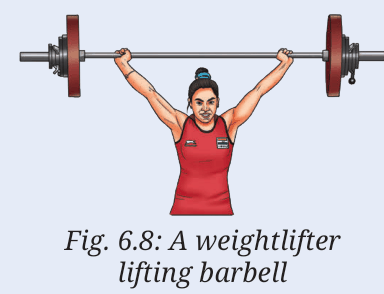
A weightlifter lifts a barbell (Fig. 6.8). List two forces that are acting on the barbell. Are these forces balanced if the weightlifter keeps the barbell steady?
Answer
The two forces are: (1) the weight of the barbell (gravitational force) acting downward, and (2) the upward force applied by the weightlifter's hands. When the barbell is held steady (at rest), it has no acceleration, so the net force is zero – the two forces are balanced (equal in magnitude, opposite in direction).
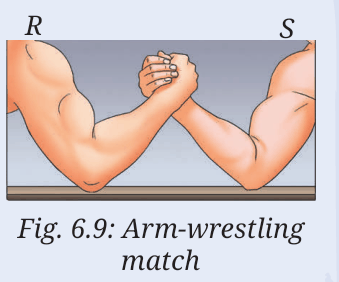
Two players R and S are in an arm-wrestling match (Fig. 6.9). At the instant when the arms tilt to the front direction (out of the page towards you), are the forces exerted by the players balanced? If not, which player exerted the larger force?
Answer
No, the forces are not balanced. The clasped hands are moving (accelerating) towards the viewer, so there is a net force in that direction. The player who is pushing the hands towards the front – player S in the figure (the front direction is the side towards which S is trying to pin R's hand) – is exerting the larger force. If the forces were balanced, the hands would stay still in the middle.
An object is moving with a constant velocity. Is there a net force acting upon it?
Answer
No. Constant velocity means zero acceleration. By Newton's laws, zero acceleration means the net force is zero (all forces acting on it are balanced).
Suppose no net force is acting on an object. Which of the following situations are possible? (i) Object remains at rest if at rest. (ii) Object keeps moving with a constant velocity if already moving. (iii) Object is moving with a constant acceleration.
Answer
(i) and (ii) are possible – this is Newton's first law. (iii) is not possible, because any acceleration needs a net force.
In the real world, it is difficult to find a situation where no forces act on an object. But by applying additional forces, a condition can be achieved where the net force is zero. Explain with an example.
Answer
Example: a cyclist on a level road. If she stops pedalling, friction and air resistance slow her down. If she pedals so that the forward force exactly equals the friction and air resistance, the net force becomes zero and she moves with constant velocity.
Another example: a car moving at constant speed on a highway – the engine's forward force balances friction and air drag. Or a book on a table – its weight is balanced by the upward normal force from the table.
A toy car of mass 100 g is moving with a constant velocity of 0.5 m s−1. What is the net force acting on the toy car?
Answer
Constant velocity
⇒ acceleration = 0
⇒ net force F = ma = 0.1 × 0 = 0 N.
Two children of different masses are sitting on identical swings. To impart identical initial acceleration, for which child would you require to apply a larger force? Explain why.
Answer
For the heavier child. By Newton's second law, F = ma. For the same acceleration a, the force needed is directly proportional to the mass, so a larger mass needs a larger force.
How are glass items packed for transportation using bubble wrap or hay protected from damage?
Answer
If a package is dropped or jolted, the glass item must be brought to rest (its momentum changes). Bubble wrap or hay is soft and squeezes, so it increases the time over which the item is stopped. Since force = change in momentum ÷ time, a longer stopping time means a much smaller force acts on the glass, so it does not break.
Revise, Reflect, Refine (Textbook Exercise)
Using a horizontal force F, a table is moved across the floor at a constant velocity. How much is the frictional force exerted by the floor on the table?
Answer
At constant velocity the net force is zero, so the frictional force equals the applied force: F, acting in the opposite direction.
For a ball moving on a smooth frictionless surface, choose the appropriate option:
(i) If no net force is applied, the velocity of the ball will remain the same.
(ii) If a net force is applied in the direction of its motion, the magnitude of the velocity will increase.
(iii) If a net force is applied opposite to the direction of its motion, the magnitude of the velocity will decrease.
Answer
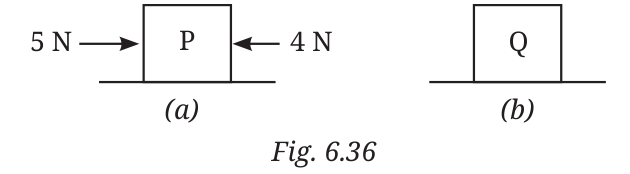
Block P has forces of 5 N and 4 N acting in opposite directions; block Q is moving with constant velocity. Which statement is correct?
Answer
(i) P experiences a net force and Q does not experience a net force. (Net force on P = 5 − 4 = 1 N; Q has constant velocity, so net force is zero.)
In a snake boat race practice, 95 oarsmen row to push the boat forward but 5 row in the opposite direction by mistake. If each applies 200 N, what is the net force on the boat?
Answer
Forward force = 95 × 200 = 19000 N; backward force = 5 × 200 = 1000 N
Net force = 19000 − 1000 = 18000 N in the forward direction.
When a net force acts on an object, the object accelerates
Answer
(iv) in the direction of force, with acceleration proportional to the force acting on the object.
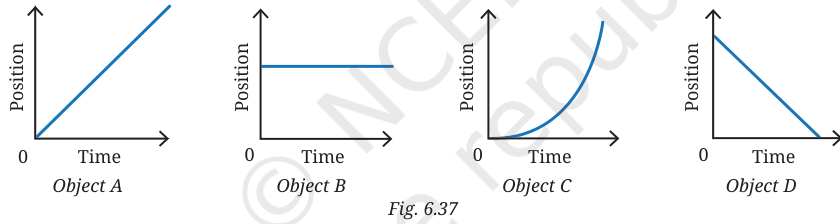
The position–time graphs for four objects A, B, C and D are given in Fig. 6.37. A net force acts on:
Answer
(iii) Object C.
A (straight rising line) and D (straight falling line) move with constant velocity; B (horizontal line) is at rest. Only C's graph is curved with increasing slope, meaning its velocity is changing (accelerating), so a net force acts on C.
A sailor jumps out from a small boat to the shore. As the sailor jumps forward, will the boat move? If yes, in which direction and why?
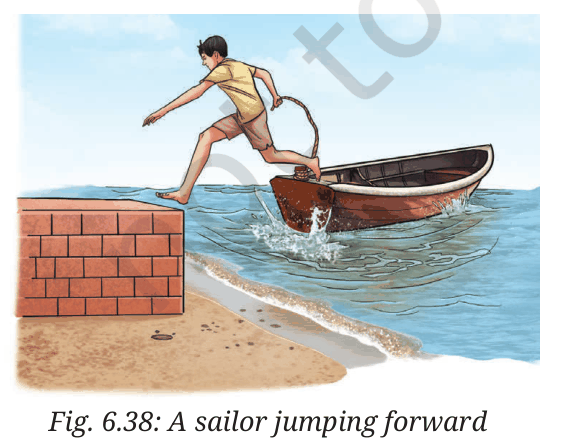
Answer
Yes, the boat moves backward (away from the shore). To jump forward, the sailor pushes the boat backward with his feet (action). The boat pushes him forward with an equal and opposite force (reaction). These forces act on different bodies, so the sailor moves forward and the light boat moves backward. (Also, momentum is conserved – the forward momentum of the sailor equals the backward momentum of the boat.)
During a high jump event, a landing mat or sand bed is placed for the athlete to fall upon. Explain the reason.
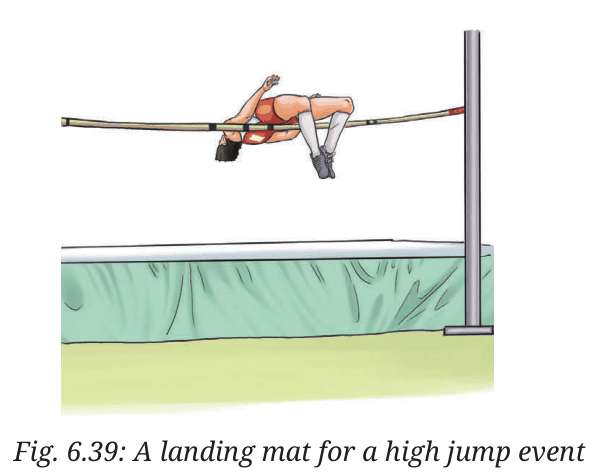
Answer
When the athlete lands, his momentum must be reduced to zero. A soft mat or sand bed sinks under him and increases the time taken to stop. Since force = change in momentum ÷ time, the force on his body becomes much smaller, which prevents injury. Landing on a hard floor would stop him in a very short time with a very large force.
A hand cart loaded with vegetables collides with an identical but empty hand cart. During the collision:
Answer
(iv) the loaded cart and the empty cart both exert an equal magnitude of force on each other (Newton's third law). The empty cart, having less mass, will have a larger change in velocity.
The acceleration–mass graph for the acceleration produced by a force on objects of different masses is plotted in Fig. 6.40. Plot the force–mass graph for this case.
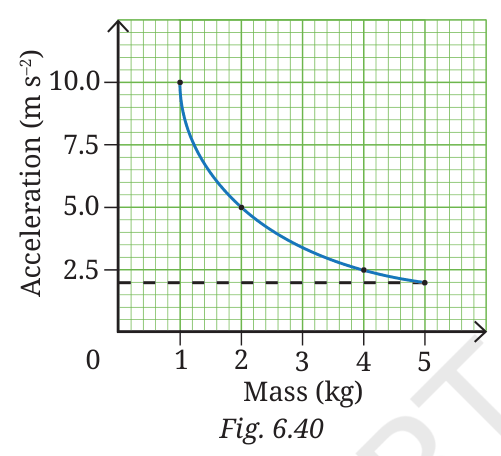
Answer
From the graph: at m = 1 kg, a = 10 m s−2
⇒ F = 10 N; at m = 2 kg, a = 5 m s−2
⇒ F = 10 N; at m = 4 kg, a = 2.5 m s−2
⇒ F = 10 N; at m = 5 kg, a = 2 m s−2
⇒ F = 10 N.
The same force (10 N) is acting in every case. So the force–mass graph is a straight horizontal line at F = 10 N, parallel to the mass axis (from m = 1 kg to 5 kg).
The velocity–time graph of an object of mass 10 kg moving along a straight line is shown in Fig. 6.41. Calculate the force acting on the object.
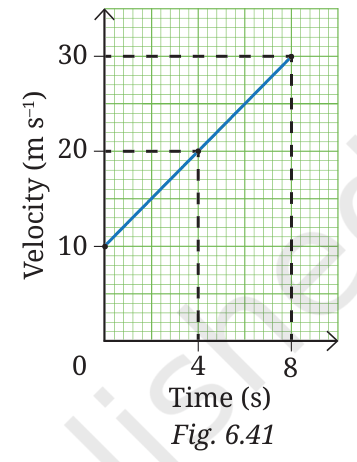
Answer
From the graph: v = 10 m/s at t = 0, 20 m/s at t = 4 s, 30 m/s at t = 8 s (a straight line).
Acceleration = slope = (30 − 10)/8 = 2.5 m s−2
F = ma = 10 × 2.5 = 25 N
A bullet of mass 50 g moving at 100 m s−1 enters a heavy stationary wooden block and stops after penetrating 50 cm. Estimate the stopping force (assume constant acceleration).
Answer
u = 100 m/s, v = 0, s = 0.5 m, m = 0.05 kg
v² = u² + 2as
⇒ 0 = 10000 + 2a(0.5)
⇒ a = −10000 m s−2
F = ma = 0.05 × 10000 = 500 N (opposite to the bullet's motion)
A footballer kicks a ball (mass 0.4 kg) with a speed of 108 km h−1. The estimated force was 800 N. Calculate the time of contact between the foot and the ball.
Answer
v = 108 km/h = 30 m/s; u = 0
Change in momentum = 0.4 × 30 = 12 kg m s−1
F = change in momentum ÷ t
⇒ t = 12/800 = 0.015 s
An object of mass 2 kg moving at 10 m s−1 enters a rough patch where friction is 7 N. At the same time an additional force of 3 N opposing the motion is applied. How much distance does it travel before coming to rest?
Answer
Total opposing force = 7 + 3 = 10 N
a = −10/2 = −5 m s−2
v² = u² + 2as
⇒ 0 = 100 − 10s
⇒ s = 10 m
A tractor pulls a harrow of mass m1 with net force F, giving acceleration a1. The same force F on a trolley of mass m2 gives acceleration a2. If the tractor pulls the trolley with the harrow placed on it (same F), find the acceleration in terms of a1 and a2.
Answer
m1 = F/a1 and m2 = F/a2
Combined mass = m1 + m2 = F(1/a1 + 1/a2) = F(a1 + a2)/(a1a2)
a = F/(m1 + m2) = a1a2 / (a1 + a2)
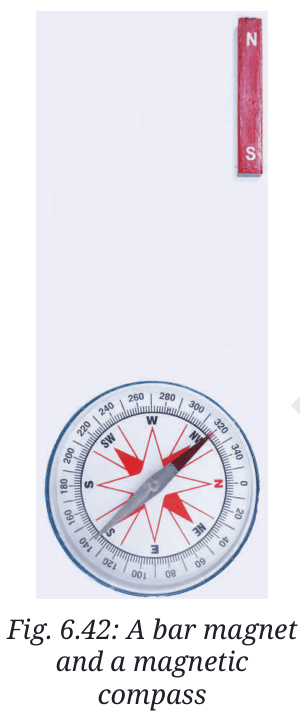
When the pole of a bar magnet is brought close to a magnetic compass, both exert equal and opposite magnetic forces on each other. However, the compass needle moves, whereas the bar magnet does not move. Explain why.
Answer
Equal forces do not mean equal effects. The compass needle is very light and is balanced on a nearly frictionless pivot, so even a small force gives it a noticeable acceleration and it turns. The bar magnet is much heavier and is held in the hand (or rests on a table with friction), so the same small force cannot overcome the friction/grip and produces practically no acceleration (a = F/m is tiny for a large mass).
Extra Important Questions
Multiple Choice Questions (1 mark)
1. Newton's first law is also called the law of
(a) momentum (b) inertia (c) action–reaction (d) gravitation
Answer: (b) inertia
2. 1 newton is equal to
(a) 1 kg m s−1 (b) 1 kg m s−2 (c) 1 g cm s−2 (d) 1 kg m² s−2
Answer: (b)
3. Action and reaction forces
(a) act on the same body (b) act on different bodies (c) cancel each other (d) are unequal
Answer: (b) act on different bodies
Which has more inertia?
Answer
(a) a bicycle (b) a car (c) a truck (d) a football
Answer: (c) a truck
Short Answer Questions
State Newton's three laws of motion.
Answer
First: an object continues in its state of rest or of uniform motion in a straight line unless a net force acts on it. Second: the acceleration of an object is directly proportional to the net force and inversely proportional to its mass, in the direction of the force (F = ma). Third: when one object exerts a force on another, the second exerts an equal and opposite force on the first.
Why do passengers fall forward when a moving bus stops suddenly?
Answer
The bus and the passengers' feet stop, but the upper body continues moving forward due to inertia of motion.
Why does a cricketer lower his hands while catching a fast ball?
Answer
Moving the hands back increases the time taken to stop the ball, which reduces the force on the hands (F = change in momentum ÷ time).