
Circle of Learning • New NCERT textbook "Exploration" (2026-27) • Activities + Pause and Ponder + Revise, Reflect, Refine (all questions) + extra important questions
Pause and Ponder (In-text Questions)
A common talcum powder contains 4% m/m zinc oxide, which acts as an antiseptic. How much zinc oxide is present in 300 g of the talcum powder?
Answer
Mass of zinc oxide = 4% of 300 g = (4/100) × 300 = 12 g
You mix two tablespoons (15 mL each) of orange juice concentrate with water to make 150 mL of juice per person. What is the % v/v of orange juice concentrate in the mixture?
Answer
Volume of concentrate = 2 × 15 = 30 mL; volume of juice (solution) = 150 mL
% v/v = (30/150) × 100 = 20% v/v
Vinegar contains 5% v/v acetic acid. Glacial acetic acid is 100% acetic acid. If you want to make vinegar from glacial acetic acid, how would you proceed?
Answer
5% v/v means 5 mL acetic acid in every 100 mL of solution. So measure 5 mL of glacial acetic acid, add it slowly to some water in a measuring cylinder/flask, and then add more water until the total volume becomes 100 mL. Mix well. (For 1 litre of vinegar, take 50 mL acetic acid and make up to 1000 mL with water.) Always add acid to water, not water to acid, and handle it carefully.
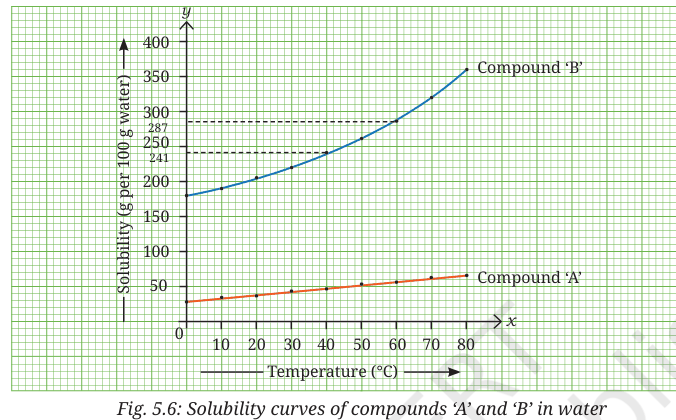
Refer to the solubility curves in Activity 5.2. If equal masses of hot, saturated solutions of compounds 'A' and 'B' are cooled from 80 °C to 60 °C, which solution is likely to deposit more solid?
Answer
Compound B. Its solubility falls sharply on cooling (from about 360 g to about 287 g per 100 g water between 80 °C and 60 °C), so a large amount of B comes out as solid. The solubility of A changes very little in this range (only a few grams), so very little A separates.
Will there be any change in the size of common salt crystals if the rate of evaporation is increased or decreased? Explain.
Answer
Yes. If evaporation is fast, many tiny crystals form quickly and do not get time to grow, so the crystals are small. If evaporation is slow, fewer crystals form and particles have time to arrange themselves on them, so the crystals grow larger and better shaped.
State whether the following statements are True or False. Also, correct the False statements.
Answer
(i) Salt can be separated from a salt solution by evaporation or distillation. – True.
(ii) Distillation can be used for separation of two liquids even when these have the same boiling point. – False. Distillation separates liquids only when their boiling points are different (simple distillation for large differences, fractional distillation for differences less than 25 °C).
(iii) In paper chromatography, the solvent level should be above the sample spot at the beginning. – False. The solvent level should be below the spot; otherwise the sample dissolves directly into the solvent instead of rising with it.
(iv) Evaporation and crystallization are the same processes. – False. In evaporation, the solvent is removed completely and the solid left may contain impurities. In crystallization, a hot saturated solution is cooled slowly so that pure crystals separate, leaving impurities in the remaining solution.
Why do immiscible liquids form two separate layers in a separating funnel?
Answer
Immiscible liquids (like oil and water) do not dissolve in each other. They also have different densities, so the denser liquid settles at the bottom and the lighter liquid floats on top, forming two separate layers.
Is sublimation different from evaporation? Justify.
Answer
Yes. Sublimation is the direct change of a solid into vapour without becoming a liquid (e.g. naphthalene, camphor, ammonium chloride). Evaporation is the change of a liquid into vapour from its surface at temperatures below its boiling point (e.g. water drying from clothes).
Clouds are made up of tiny water droplets or ice crystals floating in the air. What type of mixture do you think clouds are and why?
Answer
Clouds are a colloid (an aerosol – liquid/solid dispersed in a gas). The droplets are too small to settle down quickly and stay spread through the air, they are not seen as separate particles, and they scatter light (Tyndall effect), which is why clouds look white. When the droplets grow larger, they can no longer stay suspended and fall as rain – then they behave like a suspension.
Why do cities with a lot of smoke and dust in the air often look hazy?
Answer
Smoke and fine dust particles remain suspended in the air as a colloid. These particles scatter light in all directions (Tyndall effect), so less light comes straight to our eyes from distant objects and everything looks blurred and hazy.
Activities
Activity 5.2 – Fill in the blanks (Fig. 5.6)
(i) The solubility of compound 'A' at 20 °C is less than its solubility at 60 °C.
(ii) The solubility of compound 'B' at 20 °C is less than its solubility at 60 °C.
(iii) The solubility of B increases more than that of A with an increase in temperature.
Compound B dissolves more in a given amount of water at any given temperature.
Activity 5.4 – Salt from seawater: Seawater is let into shallow pans/beds near the coast. The Sun's heat and wind evaporate the water gradually, so the solution becomes more and more concentrated until it is saturated. On further evaporation, crystals of common salt separate out. These are collected, washed and dried.
Activity 5.9 – Table 5.1
Property | Solution | Colloid | Suspension |
Nature | Homogeneous | Heterogeneous (looks homogeneous) | Heterogeneous |
Particle size | Less than 1 nm | 1–1000 nm | More than 1000 nm |
Visibility of particles | Not visible | Not visible to naked eye | Visible |
Tyndall effect | No | Yes | Yes (if light passes) |
Settling on standing | No | No | Yes |
Separation by filtration | Not possible | Not possible | Possible |
Revise, Reflect, Refine (Textbook Exercise)
Which of the following mixtures are correctly classified as homogeneous (Hm) and heterogeneous (Ht)?
Answer
(iv) Muddy water — Ht, Milk — Ht, Blood — Ht, Brass — Hm.
(In (i) smoke is wrongly called Hm; in (ii) brass, vinegar and muddy water are wrong; in (iii) milk is wrongly called Hm.)
Which among the following mixtures show the Tyndall effect? (a) air and dust particles (b) copper sulfate and water (c) starch and water (d) acetone and water. Explain the reason for the correct and incorrect options.
Answer
(iii) a and c.
Dust in air and starch in water are colloids; their particles are large enough (1–1000 nm) to scatter light, so a beam's path becomes visible. Copper sulfate in water and acetone in water are true solutions; their particles are smaller than 1 nm and cannot scatter light. So options (i), (ii) and (iv) are incorrect.
Complete Table 5.2 using the words and phrases given.
Answer
Solution | Suspension | Colloid | |
Properties | Small-sized particles (less than 1 nm diameter); particles remain evenly distributed; does not settle down; transparent; cannot be separated by filtration | Large-sized particles; settles down when left undisturbed (more than 1000 nm in diameter); scatters light; separates by filtration; heterogeneous mixture | Moderate-sized particles (1–1000 nm); particles remain evenly distributed; does not settle down; scatters light; cannot be separated by filtration; heterogeneous mixture |
Examples | Salt solution, brass | Sand in water, mud | Milk, smoke, butter |
(i) A cake recipe uses 75 g of sugar, 420 g of all-purpose flour and 5 g of sodium hydrogencarbonate. Express the concentration of each component in the mixture using an appropriate method.
(ii) A brass alloy contains 70% copper by mass. Calculate the quantities of copper and zinc in 120 g of brass.
(i) All are solids, so use mass by mass percentage (% m/m). Total mass = 75 + 420 + 5 = 500 g.
Answer
Sugar = (75/500) × 100 = 15% m/m
Flour = (420/500) × 100 = 84% m/m
Sodium hydrogencarbonate = (5/500) × 100 = 1% m/m
(ii) Copper = 70% of 120 g = 84 g; Zinc = 120 − 84 = 36 g (30%).
The label on a cooking oil pack says one litre (910 g). If this oil is mixed with water, will it form a separate layer? If so, which substance will be on top? How will you separate the two layers? Also, draw the diagram of the apparatus used.
Answer
Density of oil = 910 g ÷ 1000 mL = 0.91 g/mL, which is less than that of water (1 g/mL). Oil and water are immiscible, so they form two layers, with oil on top.
They can be separated using a separating funnel: pour the mixture into the funnel, let it stand till two clear layers form, open the stopcock to let the lower water layer run out into a beaker, and close it just when the oil reaches the stopcock. The oil remains in the funnel.
Diagram: a pear-shaped separating funnel clamped to a stand, upper layer labelled "oil", lower layer labelled "water", stopcock at the bottom, beaker below collecting water.
Assertion (A): Solutions do not exhibit the Tyndall effect. Reason (R): The particles in solutions are larger than 100 nm, so they cannot scatter light.
Answer
(iii) A is true, but R is false. Particles in a solution are smaller than 1 nm, which is why they cannot scatter light.
How would you separate the mixtures given in Table 5.3? Mention the reason for choosing your method.
Answer
Mixture | Method of separation | Reason |
Mud from muddy water | Sedimentation and decantation, followed by filtration | Mud particles are insoluble and heavy; they settle down and are held back by filter paper. |
Plasma from other components in blood | Centrifugation | Blood cells are denser and are forced to the bottom on fast spinning; plasma stays on top. |
Naphthalene and sand | Sublimation | Naphthalene sublimes on heating; sand does not. |
Chalk powder and common salt | Dissolve in water, filter, then evaporate the filtrate | Salt is soluble in water, chalk is not. |
Common salt and water | Evaporation (to get salt) or distillation (to get both) | Water is volatile, salt is not. |
Oil from water | Separating funnel | The two liquids are immiscible and have different densities. |
Pigments of a flower | Paper chromatography | Pigments dissolve in the same solvent but travel at different speeds on paper. |
Two miscible liquids, A (boiling point 60 °C) and B (boiling point 90 °C), are present in a mixture. Suggest a method to separate them. Also, draw a labelled diagram.
Answer
The boiling points differ by 30 °C (more than 25 °C), so they can be separated by (simple) distillation. On heating, A (lower boiling point) vaporises first at about 60 °C; its vapours pass through the condenser, cool and are collected in the receiver. B remains in the distillation flask.
Diagram: distillation flask on a burner with a thermometer at the side-arm level, connected to a water condenser (water in at the bottom, out at the top), leading to a receiver collecting liquid A (the distillate). Label: distillation flask, thermometer, condenser, water in, water out, receiver, distillate (A), burner.
Compare evaporation, crystallization and distillation. In which situation would you prefer each of these over the others?
Answer
Feature | Evaporation | Crystallization | Distillation |
What it does | Removes the solvent by heating; the solid solute is left behind | Hot saturated solution is cooled; pure crystals separate | Liquid is boiled, vapours are condensed and collected |
What is recovered | Only the solid | Pure solid (impurities stay in solution) | The liquid (and the residue) |
Purity | Solid may contain impurities | Very pure solid | Pure liquid |
Preferred when | We only need the dissolved solid and purity is not critical, e.g. salt from sea water | We need a pure solid, e.g. pure copper sulfate or sugar crystals | We need to recover the solvent, or separate liquids with different boiling points, e.g. drinking water from sea water, acetone from water |
Blood is an example of a colloidal mixture. (i) What would happen if blood behaved like a true suspension inside the body? (ii) In a blood sample, identify the dispersed phase and the dispersion medium.
Answer
(i) In a suspension, particles settle down on standing. Blood cells would settle in the blood vessels, especially when a person is resting; blood would not be uniform, organs would not get oxygen evenly, and the settled cells could block vessels. Blood must stay evenly mixed to carry oxygen and nutrients everywhere.
(ii) Dispersed phase: blood cells (RBCs, WBCs, platelets) and proteins. Dispersion medium: plasma (mainly water).
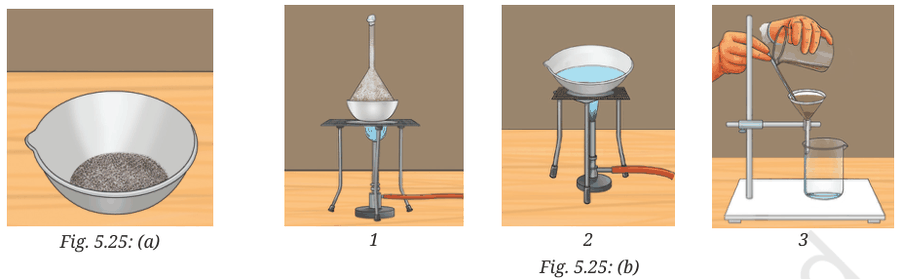
You are given a mixture of sand, common salt and naphthalene (Fig. 5.25a). Fig. 5.25b shows steps 1 (sublimation set-up with inverted funnel), 2 (evaporation in a china dish) and 3 (filtration). Write down the correct sequence of separation techniques.
Answer
Correct sequence: 1 → 3 → 2
- Sublimation (1): heat the mixture in a china dish covered with an inverted funnel; naphthalene sublimes and collects on the funnel.
- Dissolving and filtration (3): add water to the remaining sand and salt, stir and filter; sand stays on the filter paper as residue, salt solution passes as filtrate.
- Evaporation (2): heat the filtrate in a china dish to evaporate water and get common salt.
Why is distillation an effective method for separating a mixture of water and acetone?
Answer
Water and acetone are miscible, so they cannot be separated by a separating funnel. But their boiling points differ widely – acetone boils at about 56 °C and water at 100 °C. On heating, acetone vaporises first, is condensed and collected, while water stays behind in the flask.
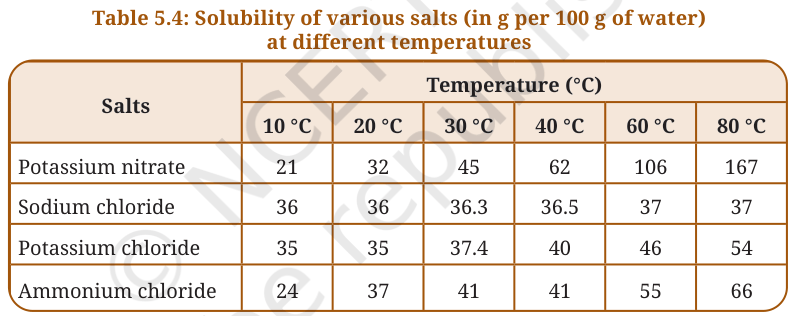
Use Table 5.4 (solubility in g per 100 g of water) to answer.
Answer
(i) Mass of potassium nitrate needed for a saturated solution in 50 g of water at 40 °C:
At 40 °C, 100 g water dissolves 62 g. So 50 g water dissolves 31 g.
(ii) A saturated solution of potassium chloride at 80 °C is cooled to room temperature (25 °C). What would she observe?
Answer
Crystals of potassium chloride would separate out. At 80 °C, 54 g dissolves per 100 g water, but at 25 °C only about 36 g can stay dissolved (between 35 g at 20 °C and 37.4 g at 30 °C). So about 18 g per 100 g of water comes out as crystals.
(iii) Effect of temperature, and comparison of the four salts from 10 °C to 80 °C:
In general, the solubility of these salts increases with temperature, but by very different amounts:
- Potassium nitrate – increases enormously, from 21 g to 167 g (about 8 times).
- Ammonium chloride – increases a lot, from 24 g to 66 g.
- Potassium chloride – increases moderately, from 35 g to 54 g.
- Sodium chloride – almost unchanged, from 36 g to 37 g.
Student A dissolves 20 g of sugar in 80 g of water; B dissolves 20 g in 100 g of water; C dissolves 30 g in 80 g of water. (i) Calculate % m/m for each. (ii) Whose solution is the most concentrated?
Answer
(i) % m/m = mass of solute ÷ mass of solution × 100
A: 20/(20 + 80) × 100 = 20%
B: 20/(20 + 100) × 100 = 16.67%
C: 30/(30 + 80) × 100 = 27.27%
(ii) Student C's solution is the most concentrated because it has the largest mass of sugar for each gram of solution.
Examine Fig. 5.26. (i) Identify the separation technique 'S'. (ii) Label the apparatus A, B and C. (iii) Which mixtures can be separated by this technique? Boiling points: water 100 °C, acetone 56 °C, alcohol 78 °C, chloroform 61 °C, benzene 80 °C.
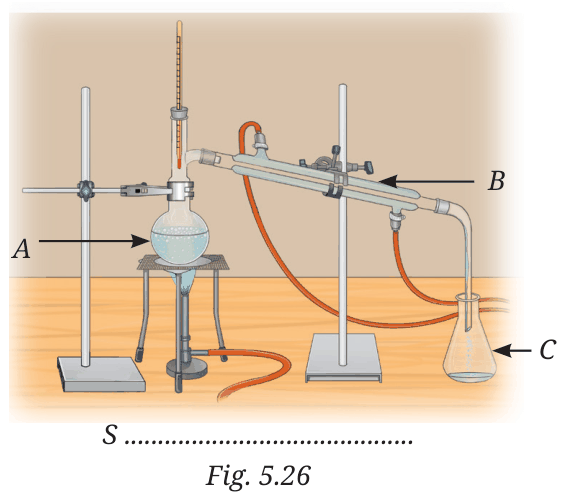
(i) S = Distillation (simple distillation).
(ii) A – Distillation flask (round-bottom flask); B – Condenser; C – Receiver (conical flask collecting the distillate).
(iii) Mixtures that can be separated:
Answer
- (a) water — acetone: Yes – boiling points differ by 44 °C.
- (b) water — salt: Yes – water distils over and salt is left in the flask.
- (c) acetone — alcohol: difference is 22 °C (less than 25 °C), so fractional distillation is needed, not this simple set-up.
- (d) sand — salt: No – both are solids; use dissolving, filtration and evaporation.
- (e) alcohol — chloroform: difference 17 °C – needs fractional distillation.
- (f) alcohol — benzene: difference only 2 °C – cannot be separated by simple distillation.
Extra Important Questions
Multiple Choice Questions (1 mark)
Fractional distillation is used when the difference in boiling points is:
Answer
(a) more than 25 °C (b) less than 25 °C (c) exactly 100 °C (d) zero
Answer: (b) less than 25 °C
Which technique separates cream from milk?
Answer
(a) Filtration (b) Centrifugation (c) Sublimation (d) Chromatography
Answer: (b) Centrifugation
3. 'Chromatography' literally means
(a) separation of liquids (b) writing with colour (c) study of colours (d) heating colours
Answer: (b) writing with colour
4. Brass is an alloy of
(a) copper and tin (b) copper and zinc (c) iron and carbon (d) iron and chromium
Answer: (b) copper and zinc
Short Answer Questions
Define % m/m, % m/v and % v/v.
Answer
% m/m = (mass of solute ÷ mass of solution) × 100; % m/v = (mass of solute ÷ volume of solution) × 100; % v/v = (volume of solute ÷ volume of solution) × 100.
What is a saturated solution?
Answer
A solution in which no more solute can dissolve at a given temperature is called a saturated solution.
Why is a pencil line used (and not ink) to mark the base line in paper chromatography?
Answer
Pencil (graphite) does not dissolve in the solvent and will not move up with it, whereas ink would separate and spoil the result.