
Circle of Learning • New NCERT textbook "Exploration" (2026-27) • Pause and Ponder + Revise, Reflect, Refine (all questions) + extra important questions
Pause and Ponder (In-text Questions)
If many organisms share common features, could they also share a common ancestry?
Answer
Yes, very likely. Organisms that share many basic features (such as body plan, type of cells, similar bones or similar DNA) are thought to have inherited them from a common ancestor. For example, all vertebrates have a backbone, suggesting they evolved from a shared ancestor. The more features two groups share, the more closely related they probably are. (Some similar features can also arise separately as adaptations to similar habitats, so scientists confirm relationships with many features and DNA studies.)
How can a single-celled organism carry out all its life processes when billions of cells are required to perform similar functions in multicellular organisms like us?
Answer
In a unicellular organism (like Amoeba or Paramecium), the single cell has specialised organelles that do different jobs – food vacuoles for digestion, contractile vacuoles for removing extra water, mitochondria for respiration, cilia or pseudopodia for movement, the nucleus for control and reproduction. Its small size gives it a large surface area for its volume, so it can exchange gases, food and wastes directly with its surroundings by diffusion. In multicellular organisms, the body is large, so these tasks are divided among specialised cells, tissues and organs (division of labour).
Which plant features reduce their dependence on water but still require moist conditions?
Answer
In bryophytes (mosses) and pteridophytes (ferns), features like root-like rhizoids or true roots, a waxy covering on parts of the body and (in ferns) vascular tissues help them get and keep water on land, so they are less dependent on water than algae. But they still need moist conditions because their male gametes must swim through a film of water to reach the egg for fertilisation, and they reproduce by spores, not seeds.
Answer
Why do taller plants need specialised transport tissues?
In tall plants, water and minerals have to be carried from the roots to leaves many metres above, and food has to be carried from leaves to all other parts. Simple diffusion from cell to cell is far too slow over such distances. Specialised tissues – xylem (water and minerals) and phloem (food) – act as pipelines that move materials quickly. Xylem also gives mechanical support so the plant can stand tall.
How do seeds and fruits affect where and how plants can survive?
Answer
Seeds contain an embryo with stored food and a protective seed coat, so they can survive dry or cold periods and germinate later when conditions are right – plants no longer need water for reproduction. Fruits protect seeds and help in their dispersal by wind, water and animals, so plants can spread to new and distant places, reduce competition with the parent and colonise many habitats. This is why seed plants (gymnosperms and angiosperms) live almost everywhere on land.
An earthworm (Annelida) and a beetle (Arthropoda) both have segmented bodies but the beetle has a hard external skeleton. How does the beetle's external skeleton help it survive?
Answer
The hard exoskeleton (made of chitin):
- protects the soft internal organs from injury and predators;
- prevents water loss, so the beetle can live in dry places (an earthworm needs moist soil);
- provides points for muscle attachment and, with jointed legs, allows efficient movement;
- gives the body support and a fixed shape.
Does the term 'biodiversity' relate only to the variety of organisms, or does it encompass other elements?
Answer
It covers more than the number of kinds of organisms. Biodiversity includes: genetic diversity (variation within a species), species diversity (variety of species) and ecosystem diversity (variety of habitats such as forests, deserts, wetlands, oceans), along with the interactions between organisms and their environment.
If you find a new organism in a pond, what features will you observe to classify it and why?
Answer
- Cell structure – prokaryotic or eukaryotic; unicellular or multicellular (separates Monera, Protista and others).
- Presence of a cell wall and what it is made of.
- Mode of nutrition – does it have chlorophyll (autotroph) or feed on others (heterotroph)?
- Body organisation – tissues, organs, symmetry, segmentation, backbone.
- Movement – cilia, flagella, fins, legs.
- Mode of reproduction.
These features are basic and stable, so they help place the organism in the right kingdom and group and compare it with known species.
Why do genetic studies provide deep information about living beings?
Answer
DNA carries the instructions for all features of an organism and is passed from parents to offspring. Comparing DNA shows how closely organisms are related, even when they look different (or how different they are even if they look alike). It reveals common ancestry, helps identify new species, and explains how traits are inherited and how species have evolved.
Answer
How can changes in climate affect biodiversity?
Rising temperatures, changing rainfall, droughts, floods and melting ice change habitats. Species that cannot adapt or move may decline or become extinct (e.g. corals bleaching in warmer seas, Himalayan species losing cold habitats). Flowering and breeding times may shift so that pollinators and plants no longer match. Pests and diseases may spread to new areas. Overall, climate change reduces biodiversity and disturbs the balance of ecosystems.
Revise, Reflect, Refine (Textbook Exercise)
Hari called an animal an insect while Meena said it was an earthworm. Which feature confirms that it is an insect?
Answer
(ii) Body with jointed legs. (Insects are arthropods with jointed legs; earthworms have no legs.)
Sponges lack true tissues and organs. Which feature of sponge cells supports their classification under the animal kingdom?
Answer
(iii) Presence of a cell membrane – i.e. their cells have only a cell membrane and no cell wall, like all animal cells. (They also cannot photosynthesise and do have mitochondria, so options (i), (ii) and (iv) are wrong.)
Observe two different animals in your immediate environment. What features help you distinguish between them? How do these features help place them into different groups?
Answer
Example: a house sparrow and a cockroach.
Feature | Sparrow | Cockroach |
Backbone | Present | Absent |
Skeleton | Internal (bones) | External (chitin exoskeleton) |
Body covering | Feathers | Hard cuticle |
Limbs | Two legs + two wings | Six jointed legs, wings |
Body | Not segmented | Segmented (head, thorax, abdomen) |
The backbone places the sparrow among vertebrates (Chordata), class Aves; the jointed legs, exoskeleton and segmented body place the cockroach in Arthropoda (Insecta).
How would a scientist justify choosing cellular organisation as a more fundamental characteristic for classification rather than the presence of xylem and phloem?
Answer
Cellular organisation (prokaryotic or eukaryotic, unicellular or multicellular, with or without cell wall) is shared by every living organism, so it can be used to compare and group all life forms at the broadest level. Xylem and phloem are present only in some plants (pteridophytes, gymnosperms, angiosperms) and absent in all animals, fungi, protists, bacteria and even in algae and mosses. So it can only be used for sub-dividing plants, not for basic classification. Fundamental features are those that appeared early in evolution and on which other features depend.
An unlabelled slide shows a single-celled organism with a well-defined nucleus and multiple cilia. Which group would it most likely belong to? Give reasons.
Answer
It belongs to Kingdom Protista (e.g. Paramecium). It is unicellular (not plant, animal or fungus) and has a well-defined nucleus, so it is eukaryotic (not Monera). Cilia for locomotion are typical of protists such as Paramecium.
How does the diversity of organisms contribute to the balance and stability of an ecosystem?
Answer
Each species plays a role – producers make food, consumers control populations, decomposers recycle nutrients, pollinators help plants reproduce. With many species, food webs have many links, so if one species declines, others can take its place and the ecosystem continues to function. Diverse ecosystems recover better from disturbances like drought, disease or pests. Low diversity makes an ecosystem fragile.
If all unicellular organisms were grouped into a single kingdom, what problems would arise?
Answer
Bacteria (prokaryotes, no true nucleus or membrane-bound organelles) would be grouped with Amoeba, Euglena, yeast and diatoms (eukaryotes with a true nucleus and organelles). These differ fundamentally in cell structure, mode of nutrition (autotrophic, heterotrophic, saprophytic), cell wall composition and evolutionary history. Such a group would hide these differences, wrongly suggest close relationships and make it harder to study, identify and understand them. Yeast, for example, is closer to fungi than to bacteria.
Viruses were studied in earlier classes. Why are they not placed in any of the five kingdoms? Give reasons.
Answer
- Viruses are acellular – they have no cell, cytoplasm, cell membrane or organelles; they are just genetic material (DNA or RNA) inside a protein coat.
- They show life processes (reproduction) only inside a living host cell; outside, they are inactive like non-living particles (they can even be crystallised).
- They have no metabolism of their own.
Since the five kingdom system is based on cell structure and nutrition, viruses do not fit into it.
If you were asked to revise the five kingdom classification, would you create a separate category for viruses or keep them outside the system? Justify and explain what this indicates about the evolving nature of scientific classification.
Answer
Sample answer: I would keep viruses outside the kingdoms of cellular life but in a separate group of "acellular infectious agents". Including them in a kingdom would mean treating them as living organisms, although they lack cells and their own metabolism. Yet they have genes, mutate and evolve, so they must still be studied and classified (today scientists classify them separately by their genetic material and structure).
This shows that classification is not fixed. It is a human-made system that changes as new organisms are discovered and new tools (like DNA studies) give better information – from two kingdoms to five kingdoms and now to domains.
Viruses contain genetic material but lack cellular organisation. Which features prevent them from fitting into the five kingdom system? What does this tell us about the limitations of classification systems?
Answer
Features: no cellular organisation (no cell membrane, cytoplasm or organelles), no independent metabolism or nutrition, and reproduction only inside a host cell. The five kingdom system is built on cell type, body organisation and mode of nutrition, which cannot be applied to viruses.
This shows that any classification system is based on chosen criteria and may fail for organisms that do not fit those criteria. Nature does not always have sharp boundaries (such as between living and non-living), so systems must be revised as knowledge grows.
Both pteridophytes and bryophytes lack flowers and seeds, yet they are placed in different groups. Explain.
Answer
Bryophytes (e.g. moss, Marchantia) | Pteridophytes (e.g. ferns, Marsilea) |
No true roots, stems or leaves; have rhizoids | True roots, stems and leaves |
No vascular tissue (no xylem, phloem) | Vascular tissue present (xylem and phloem) |
Small, grow close to the ground in moist shade | Can grow taller |
"Amphibians of the plant kingdom" | First true land plants with conducting tissues |
The presence of a vascular system and differentiated body is the key feature that separates them.
In the classification hierarchy, which group — class or genus — has fewer members but more features in common?
Answer
Genus. As we move down the hierarchy (kingdom
⇒ phylum
⇒ class
⇒ order
⇒ family
⇒ genus
⇒ species), each group contains fewer organisms, and the members share more and more features. A genus is a lower level than a class, so it has fewer members that are more closely related and share more common features.
A new organism shows locomotion and autotrophic nutrition. Which character(s) would help identify it as belonging to Protista?
Answer
Locomotion and autotrophy alone are not enough. The scientist should check that it is unicellular and eukaryotic (has a well-defined nucleus and membrane-bound organelles such as chloroplasts), and moves using structures like flagella or cilia. An organism with all these, like Euglena, belongs to Protista. (If it lacked a true nucleus it would be Monera; if multicellular with tissues, it would be a plant or an animal.)
A researcher identified a unicellular eukaryotic organism as fungi. What identification key would you suggest to keep a unicellular organism in Kingdom Fungi?
Answer
A unicellular eukaryote belongs to Fungi if it:
- has a cell wall made of chitin;
- has no chlorophyll (cannot photosynthesise);
- is heterotrophic by absorption – saprophytic (absorbs nutrients from dead organic matter) or parasitic;
- stores food as glycogen and reproduces by budding or spores;
- has no cilia or flagella for locomotion.
Example: yeast.
Case study – organisms P, Q, R, S and T with key observations.
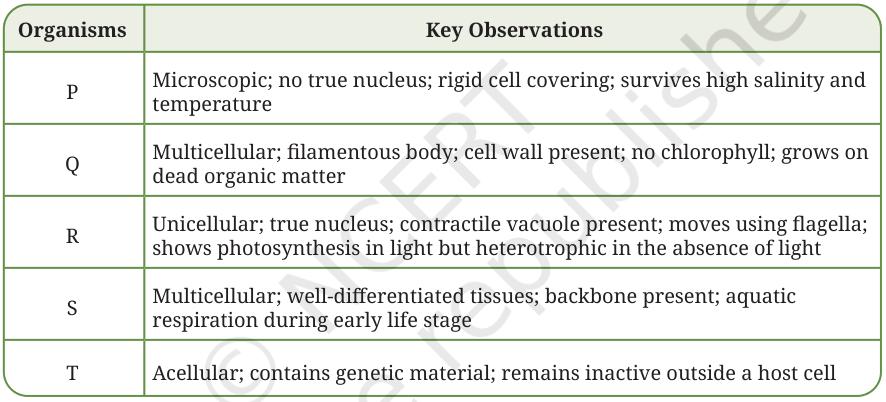
(i) Q belongs to Kingdom Fungi – it is multicellular and filamentous with a cell wall, has no chlorophyll and grows on dead organic matter (saprophytic).
(ii) P belongs to Kingdom Monera – it has no true nucleus (prokaryotic). (Surviving high salinity and temperature suggests archaebacteria.)
Answer
(iii) R is unicellular, moves using flagella, has a contractile vacuole and can photosynthesise (like Euglena) – so it is placed in Protista. Q is multicellular and filamentous, has a cell wall, no chlorophyll and absorbs food from dead matter – so it is placed in Fungi. Cell number/body organisation, locomotion and mode of nutrition separate them.
(iv) S is heterotrophic, but heterotrophic nutrition is also seen in many monerans, protists and fungi. Nutrition alone cannot separate them. S must be classified by its body organisation – multicellular with well-differentiated tissues, a backbone (vertebrate), and aquatic respiration (gills) in early life followed by a change – suggesting an amphibian (like a frog) in Kingdom Animalia.
(v) T lacks cellular organisation – the most basic criterion of the five kingdom system. It is like a virus. This shows that classification systems are man-made, depend on chosen criteria and cannot always include every form of life; they need revision as new discoveries are made.
(vi) If classified only by habitat, R (a protist in a pond) and S (a vertebrate living in water early in life) – and even P if found in water – would be grouped together as "aquatic organisms", while Q and P (if in damp soil) would be grouped as "soil organisms". Organisms with completely different cell structure, nutrition and ancestry would be put together, and closely related organisms living in different places would be separated. This would hide true relationships and make identification and study misleading.
(vii) It should be placed under Fungi. It is multicellular and eukaryotic (fits both), but it lacks chlorophyll and absorbs nutrients externally from its host – this absorptive (parasitic) nutrition is a key feature of fungi. Animals ingest food and digest it inside the body. To confirm, the scientist should also check for a chitin cell wall (fungi) – animal cells have no cell wall.
Extra Important Questions
Multiple Choice Questions (1 mark)
1. The five kingdom classification was proposed by
(a) Linnaeus (b) R.H. Whittaker (c) Darwin (d) Haeckel
Answer: (b) R.H. Whittaker (1969)
2. The basic unit of classification is
(a) genus (b) family (c) species (d) class
Answer: (c) species
Which of the following belongs to Monera?
Answer
(a) Amoeba (b) Yeast (c) Bacteria (d) Euglena
Answer: (c) Bacteria
4. Naked seeds are found in
(a) angiosperms (b) gymnosperms (c) pteridophytes (d) bryophytes
Answer: (b) gymnosperms
Short Answer Questions
Write the scientific name of humans and explain binomial nomenclature.
Answer
Homo sapiens. In binomial nomenclature (by Carolus Linnaeus), each organism has two names – the genus (first letter capital) and the species (all small letters), printed in italics or underlined when handwritten.
Name the five kingdoms with one example each.
Answer
Monera (bacteria), Protista (Amoeba), Fungi (mushroom), Plantae (mango tree), Animalia (dog).
Differentiate between gymnosperms and angiosperms.
Answer
Gymnosperms bear naked seeds not enclosed in a fruit (pine, cycas). Angiosperms bear seeds enclosed inside fruits and have flowers (mango, wheat).