
Circle of Learning • New NCERT textbook "Exploration" (2026-27) • Pause and Ponder + Revise, Reflect, Refine (all questions) + extra important questions
Pause and Ponder (In-text Questions)
What argument would you give for the necessity of a cell wall in plants usually fixed in one place versus in animals usually moving from one place to the other?
Answer
Plants stay fixed in one place and cannot run away from wind, rain, grazing animals or loss of water. A rigid cell wall gives each cell strength and shape, helps the plant stand upright, and protects it from bursting when it takes in water. Animals move from place to place, so their cells need to be flexible to allow movement, changes in shape (e.g. muscle contraction) and quick responses. A rigid wall would make movement impossible, so animal cells have only a flexible cell membrane.
What consequences would you predict for a plant cell if its cell wall were to become as flexible as a cell membrane?
Answer
The cell would lose its fixed shape and strength. When it takes in water by osmosis, it would keep swelling and could burst, since there would be no rigid wall to resist the pressure. Plants would not be able to stay upright, would droop easily, and would be more open to damage by microbes and mechanical injury.
Why is it important to cut the two potato pieces in roughly equal size and measure their initial weight before placing them in different liquids?
Answer
Equal size gives both pieces about the same surface area and volume, so the only difference between them is the liquid they are kept in (a fair test). Measuring the initial weight lets us compare it with the final weight and find out whether each piece gained water (weight increases) or lost water (weight decreases) by osmosis.
Do white flowers contain any pigment? Give reasons.
Answer
White flowers have no coloured pigment in their petals – their plastids are mostly colourless leucoplasts rather than chromoplasts. They look white because the petal cells (with air spaces between them) scatter and reflect all colours of light equally. (They may contain colourless pigments like flavonoids, but no pigment that gives colour.)
Draw a well-labelled schematic diagram of a plant or an animal cell using these clues — (i) Nucleus appears as a dark and round body inside the cell. (ii) ER spreads like a network of extended nuclear envelope. (iii) Mitochondria and chloroplasts are rod shaped.
Answer
Draw a rectangular plant cell. Show:
- An outer thick boundary – cell wall; just inside it a thin line – cell membrane.
- A large dark round nucleus with a darker nucleolus.
- A network of tubes starting from the nuclear envelope – endoplasmic reticulum (dots on part of it for RER).
- Rod-shaped mitochondria (with folded inner membrane) and rod/oval green chloroplasts.
- A large central vacuole, a stack of flattened sacs – Golgi apparatus, small dots – ribosomes, and the cytoplasm filling the space.
(For an animal cell, leave out the cell wall, chloroplasts and large vacuole, and add lysosomes and centrosome.)
Instead of many small ones, why does a cell not have a single giant mitochondrion? How does this relate to the concept of surface area?
Answer
The reactions that release energy (ATP) take place on the membranes of mitochondria, and materials (food, oxygen) must enter and products must leave through their surface. Many small mitochondria together have a much larger surface area-to-volume ratio than one giant mitochondrion of the same total volume. So they can exchange materials faster and produce more energy. Many small mitochondria can also be spread throughout the cell, close to wherever energy is needed.
If the skin cells start dividing by meiosis instead of mitosis, what do you think will happen to a cut on the skin?
Answer
Meiosis halves the number of chromosomes and produces cells that are genetically different from the parent cell. The new skin cells would have only half the chromosomes and would not be identical to normal skin cells, so they could not function properly. The cut would not heal normally, and the tissue formed would be abnormal. Healing and repair need mitosis, which makes identical cells with the full set of chromosomes.
Activities – Expected Observations
Activity 2.2 (potato pieces in plain water and in salt/sugar solution): The piece in plain water gains water by osmosis, becomes firm and its weight increases. The piece in concentrated salt (or sugar) solution loses water by osmosis, becomes soft and its weight decreases.
Activity 2.3 (onion peel and cheek cells): Onion peel cells appear rectangular, closely packed, with a distinct cell wall, a nucleus at one side and a large vacuole. Cheek cells appear flat, irregular, with no cell wall and a centrally placed nucleus that takes up the blue stain.
Activity 2.5 (onion root tips): Growing root tips show many cells in different stages of mitosis, because the root tip is a region of active cell division.
Revise, Reflect, Refine (Textbook Exercise)
Differentiate between the following pairs of terms based on the clues given in parentheses: (i) Cell membrane and cell wall (permeability) (ii) RER and SER (structure) (iii) Chloroplasts and chromoplasts (pigments)
Answer
Pair | First | Second |
(i) Permeability | Cell membrane is selectively permeable – allows only some substances to pass. | Cell wall is freely (fully) permeable – lets most substances pass. |
(ii) Structure | RER has ribosomes attached to its surface, so it looks rough. | SER has no ribosomes, so it looks smooth. |
(iii) Pigments | Chloroplasts contain the green pigment chlorophyll. | Chromoplasts contain coloured pigments other than chlorophyll – yellow, orange or red. |
Two similar animal cells are placed in two different solutions: Cell X in pure water, Cell Y in a concentrated salt solution. Cell X swells, and Cell Y shrinks. Which statement provides the correct explanation?
Answer
(iii) Water moved into Cell X and moved out of Cell Y through the cell membrane.
Cell X is in a dilute (hypotonic) medium, so water enters by osmosis. Cell Y is in a concentrated (hypertonic) medium, so water leaves by osmosis. It is the movement of water, not of salt, that causes the change.
Look at the diagram of a cell in Fig. 2.20. Identify the parts labelled from (a) to (g) and correctly match them with their functions.
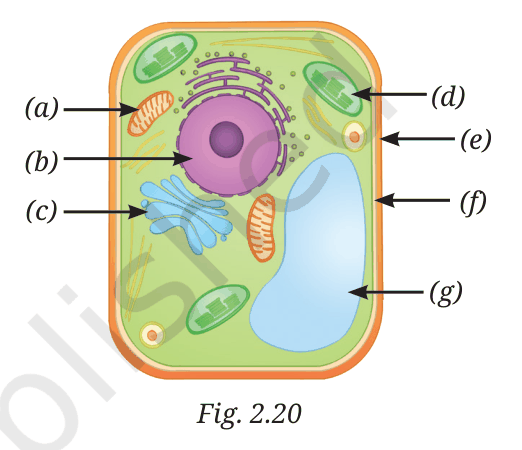
Answer
Label | Part | Function |
(a) | Mitochondrion | (ii) Site of cellular respiration |
(b) | Nucleus | (i) Controlling all the activities of a cell |
(c) | Golgi apparatus | (vi) Packs and stores materials received from ER |
(d) | Chloroplast | (vii) Helps in manufacturing food |
(e) | Cell wall | (v) Provides structural rigidity to the cell |
(f) | Cell membrane | (iv) Separates the cell contents from surroundings |
(g) | Vacuole | (iii) Storage organelle that also provides rigidity to the cell |
Which of the following option(s) of the pairs of cell organelles are correctly placed under the given categories? (Present in the plant cells / Absent in the animal cells)
Answer
(i) Leucoplast / Cell wall (ii) Mitochondria / Ribosome (iii) Cell wall / Golgi apparatus (iv) Lysosome / Endoplasmic reticulum
Answer: (i) only. Leucoplasts are present in plant cells and the cell wall is absent in animal cells. In the other options, ribosomes, Golgi apparatus and ER are all present in animal cells.
Renu says all parts of plants, even roots, contain plastids. Rohit says plastids are absent in roots because roots are underground and do not photosynthesise. Who is correct? Justify your answer.
Answer
Renu is correct. Roots do not have chloroplasts (they get no light), but they do have other plastids – colourless leucoplasts that store food such as starch, oils or proteins. For example, carrot roots contain chromoplasts (orange colour) and many storage roots contain starch-storing leucoplasts. So plastids are not only for photosynthesis.
Mitochondria and chloroplasts are two important organelles in a plant cell. Discuss how these two organelles are structurally and functionally similar to each other, and different from each other.
Answer
Similarities
- Both are bounded by a double membrane.
- Both have their own DNA and ribosomes and can make some of their own proteins.
- Both are involved in energy conversion.
Differences
Mitochondria | Chloroplasts |
Found in almost all eukaryotic cells (plants and animals). | Found only in green plant cells and algae. |
Inner membrane is folded into cristae. | Contain stacks of thylakoids (grana) with chlorophyll. |
Break down food (glucose) to release energy as ATP – respiration. | Trap light energy to make food (glucose) – photosynthesis. |
Use oxygen and release carbon dioxide. | Use carbon dioxide and release oxygen. |
Which of the following pairs of cell organelles contains DNA?
Answer
(ii) Mitochondria, Nucleus
A researcher placed one carrot in plain water and another of similar size in concentrated salt solution. After 24 hours she recorded her observations.
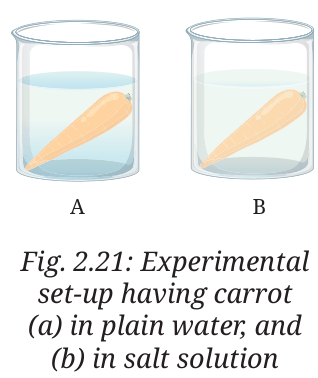
Answer
(i) What hypothesis does she want to test? (ii) What would you suggest for improvement of this experiment? (iii) Why does the carrot in plain water stay stiff and crunchy, but the carrot in concentrated salt solution become rubbery and limp?
Answer
(i) Hypothesis: "Water moves into or out of plant cells by osmosis depending on the concentration of the surrounding solution – cells gain water in plain water and lose water in a concentrated salt solution."
(ii) Improvements: weigh (or measure the length of) both carrots before and after; use carrots of the same size and freshness, the same volume of liquid and the same temperature; repeat with several carrots; add one more set with a different salt concentration to see the trend.
(iii) In plain water, water enters the carrot cells by osmosis; the vacuoles fill up and press against the cell walls, so the cells become turgid and the carrot stays stiff and crunchy. In concentrated salt solution, water leaves the cells by osmosis; the cells lose turgidity (plasmolysis), so the carrot becomes rubbery and limp.
Indicate the presence or absence of the following structures in bacterial and animal cells.
Answer
Structure | Bacterial cell | Animal cell |
Chromosome | Present (single, circular, in nucleoid) | Present |
Nucleus | Absent (no nuclear membrane) | Present |
Mitochondria | Absent | Present |
Golgi complex | Absent | Present |
Chromoplasts | Absent | Absent |
Potato cup experiment: Cup A empty, Cup B with sugar, Cup C with salt, Cup D (boiled potato) with sugar, all placed in beakers of water. (i) Explain why water gathers in the hollowed portion of Cup B and Cup C. (ii) Why is Cup A necessary? (iii) Explain why water does not gather in Cups A and D.
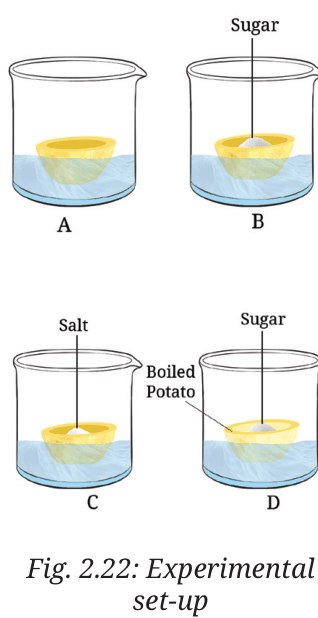
Answer
(i) Sugar and salt make the solution inside cups B and C more concentrated than the water outside. The living potato cells act as a selectively permeable membrane, so water moves from the beaker into the cups by osmosis.
(ii) Cup A is the control. It shows that water collects only when a solute is present, and not because of the potato itself.
(iii) In Cup A there is no solute, so there is no difference in concentration and no osmosis. In Cup D, boiling has killed the potato cells, so their membranes are no longer selectively permeable and osmosis cannot take place.
Identify the pair that incorrectly matches the cell organelle with its function: (i) Ribosome — Protein synthesis (ii) SER — Lipid and cellulose synthesis (iii) Lysosome — Digestion of foreign agents
Answer
Answer (as per the NCERT answer key): (iii) Lysosome — Digestion of foreign agents.
In this chapter, lysosomes are described as the clean-up system of the cell – they break down the cell's own waste materials and damaged, worn-out organelles using their digestive enzymes. So "digestion of foreign agents" is not the function given for lysosomes. Ribosomes make proteins and SER makes lipids (fats) and hormones.
What outcome do you expect, if all the mitochondria are removed from a eukaryotic cell?
Answer
The cell would not be able to carry out aerobic respiration, so it could not produce enough ATP (energy). It might survive for a short time on the small amount of energy from anaerobic breakdown of glucose in the cytoplasm, but its activities would slow down and it would finally die. Also, since mitochondria are made only from existing mitochondria, the cell could never make new ones.
Which phenomenon inhibits the formation of tumours in the human body? Can plants also develop tumours? Explain.
Answer
Contact inhibition prevents tumours. Normal cells stop dividing when they touch neighbouring cells. Cancer cells lose this control and keep dividing, forming tumours.
Plant cells do not show contact inhibition because of their rigid cell walls; they follow a different growth pattern. Plants can still develop tumour-like growths (galls), for example crown gall caused by the bacterium Agrobacterium, or galls caused by insects and fungi. But since plant cells are held in place by cell walls, such growths cannot spread to other parts of the plant the way cancer spreads in animals.
The cell membrane is made up of proteins and lipids. Which cell organelles help in the synthesis of the cell membrane? Write the path of these compounds from their site of synthesis to the cell membrane and show this through a labelled diagram.
Answer
Organelles involved: Ribosomes on the RER make the proteins; the SER makes the lipids; the Golgi apparatus modifies and packages them.
Path: Proteins (made on RER) and lipids (made in SER)
⇒ move through the ER channels
⇒ carried in small vesicles
⇒ Golgi apparatus (modified, sorted, packed)
⇒ secretory vesicles
⇒ fuse with the cell membrane, adding new proteins and lipids to it. This is called membrane biogenesis.
Diagram: Draw nucleus
⇒ RER (with ribosome dots, label "proteins") and SER (label "lipids")
⇒ small vesicles
⇒ Golgi stack
⇒ vesicles
⇒ cell membrane, with arrows showing the direction.
What would happen if gametes are formed by mitotic divisions?
Answer
Mitosis keeps the chromosome number the same, so gametes would have the full (diploid) number of chromosomes instead of half. When two such gametes fuse at fertilisation, the offspring would have double the normal number of chromosomes. The chromosome number would keep doubling with every generation, causing serious abnormalities. Gametes also would not show the variation produced by meiosis.
Farmer Deepa preserved excess amla and lemons as pickles, murabbas and sharbat by adding salt, sugar or jaggery. Answer: (i) Which scientific concept has the farmer applied? (ii) How does the addition of high concentrations of salt and sugar prevent the growth of spoilage-causing bacteria and fungi? (iii) Suggest a healthy recipe of this kind for food preservation. (iv) What are the scientific values addressed in this case?
Answer
(i) Osmosis (using a hypertonic medium) for food preservation.
(ii) High salt or sugar makes the surroundings more concentrated than the cell sap of bacteria and fungi. Water inside their cells comes out by osmosis (they get plasmolysed). Without water they cannot grow or multiply, so the food does not spoil.
(iii) Example: Amla–ginger murabba with jaggery – boil amla pieces lightly, cook them in thick jaggery syrup with a little ginger and cardamom, cool and store in clean dry glass jars. Or lemon–ginger pickle with salt, turmeric and a little mustard oil, sun-dried and stored in glass jars. Use moderate sugar/salt and clean, dry containers.
(iv) Values: applying scientific knowledge to daily life, reducing food waste, sustainability, entrepreneurship, care for health and hygiene, and economic self-reliance (food security and income for the community).
Extra Important Questions
Multiple Choice Questions (1 mark)
Which organelle is called the 'packaging and shipping centre' of the cell?
Answer
(a) ER (b) Golgi apparatus (c) Lysosome (d) Ribosome
Answer: (b) Golgi apparatus
Normal cells stop dividing when they touch neighbouring cells. This is called:
Answer
(a) osmosis (b) contact inhibition (c) plasmolysis (d) meiosis
Answer: (b) contact inhibition
3. Meiosis produces
(a) two identical cells (b) four cells with half the chromosome number (c) four identical cells with full chromosome number (d) one cell
Answer: (b)
4. Starch in potato cells is stored in
(a) chloroplasts (b) chromoplasts (c) leucoplasts (d) vacuoles
Answer: (c) leucoplasts
Short Answer Questions
Why are lysosomes called "suicide bags"?
Answer
They contain powerful digestive enzymes. When a cell is damaged, lysosomes may burst and digest the cell itself.
Differentiate between mitosis and meiosis.
Answer
Mitosis occurs in body cells for growth and repair and gives two identical daughter cells with the same chromosome number. Meiosis occurs in reproductive cells to form gametes, takes place in two steps and gives four daughter cells, each with half the chromosome number.
What is plasmolysis?
Answer
When a plant cell is placed in a concentrated (hypertonic) solution, it loses water by osmosis and its cytoplasm shrinks away from the cell wall. This is plasmolysis.