
Circle of Learning • New NCERT textbook "Exploration" (2026-27) • Pause and Ponder + Revise, Reflect, Refine (all questions) + extra important questions
Pause and Ponder (In-text Questions)
In a china-rose (hibiscus) plant, a pollen tube grows through the style after pollen lands on the stigma. Which process is about to happen next?
Answer
Fertilisation. The pollen tube carries the male gametes down the style to the ovule in the ovary, where a male gamete fuses with the female gamete (egg) to form a zygote.
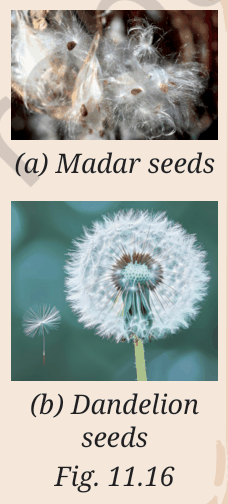
Look at the pictures of calotropis (madar) seeds and dandelion seeds (Fig. 11.16). What kind of seed dispersal are these seeds adapted for?
Answer
Both are adapted for dispersal by wind. Their seeds are very light and carry tufts of fine silky hairs (like a parachute), so the wind can carry them far away from the parent plant.
A farmer plants two varieties of maize side by side, but seeds form only when pollen from one variety reaches the stigma of the other. What type of pollination is this?
Answer
Cross-pollination – transfer of pollen from the flower of one plant to the stigma of a flower on another plant of the same species. (In maize it is carried mainly by wind.)
Why do animals with external fertilisation generally produce more eggs than animals with internal fertilisation?
Answer
In external fertilisation (e.g. frogs, fish), eggs and sperm are released into water. Many eggs never meet a sperm, and many eggs and young ones are eaten by predators or destroyed by water currents and temperature changes. Producing a very large number of eggs increases the chance that at least some will be fertilised and survive. In internal fertilisation, the chance of fertilisation is high and the young are better protected, so fewer eggs are enough.
In animals, in which fertilisation method are the gametes more protected?
Answer
In internal fertilisation, because fusion of gametes takes place inside the female's body, safe from predators, drying and changes in the environment.
Ravi notices that he is growing taller rapidly, his shoulders are broadening, and his voice cracks. What stage of life is he entering?
Answer
He is entering adolescence (puberty). These changes are caused by sex hormones (mainly testosterone) as the reproductive organs mature.
Rina's period occurs every 28 days. Her last period was on the 5th of March. On which day is she most likely to get her next period?
Answer
Counting 28 days from 5th March: March has 31 days, so 5 March + 28 days = 2nd April.
A human zygote has just formed. How many chromosomes does it have?
Answer
46 chromosomes (23 pairs) – 23 from the sperm and 23 from the egg.
What protective devices can be used during sexual activity to reduce the spread of STIs?
Answer
Condoms (male or female condoms). They act as a barrier and prevent body fluids from passing between partners, reducing the spread of sexually transmitted infections such as HIV, gonorrhoea and syphilis.
If a couple uses oral contraceptive pills but not condoms, which risks remain and why?
Answer
Oral pills only prevent pregnancy by changing hormone levels so that eggs are not released. They give no protection against sexually transmitted infections (STIs), because there is no barrier to stop body fluids and germs passing between partners. Also, if pills are missed, there is a risk of pregnancy, and pills may have side effects.
Many animals' young can walk or find food soon after birth, but human babies are dependent on adults for a long time. What are some advantages and disadvantages of this for humans as a species?
Answer
Advantages: the long period of care allows the large brain to keep developing after birth; children learn language, skills, culture and social behaviour from adults; strong family and social bonds form.
Disadvantages: babies are very vulnerable for years; parents must invest a great deal of time, energy and resources; fewer offspring can be raised at a time, so population grows slowly.
Revise, Reflect, Refine (Textbook Exercise)
A flower's anthers are removed before it matures. Later, pollen from another plant of the same species is dusted onto its stigma and seeds are produced. Which process has been ensured here?
Answer
Answer (as per the NCERT answer key): (iii) Fertilisation.
Seeds can form only after fertilisation – the fusion of the male gamete (from the pollen) with the egg inside the ovule. Since seeds were produced, fertilisation has definitely taken place. (Removing the anthers prevented self-pollination, and dusting pollen from another plant was a way of cross-pollinating the flower; the production of seeds confirms that this led to fertilisation.)
Arrange the stages of sexual reproduction in plants in the correct order: (i) Pollen germination on stigma (ii) Fertilisation (iii) Pollination (iv) Formation of zygote
Answer
(iii) → (i) → (ii) → (iv)
Pollination
⇒ pollen germination on stigma
⇒ fertilisation
⇒ formation of zygote
Assertion (A): The zygote formed after fertilisation immediately attaches to the uterus wall. Reason (R): The uterus wall is always prepared to receive the zygote.
Answer
Answer (as per the NCERT answer key): (iv) A is false, but R is true.
A is false: the zygote is formed in the oviduct. It undergoes several mitotic divisions while travelling to the uterus and only then implants in the uterine lining – it does not attach immediately.
R: the uterus prepares itself to receive the zygote – before ovulation each month its inner lining becomes thick and rich in blood vessels. (If fertilisation does not occur, this lining breaks down and is shed during menstruation, and the uterus prepares again in the next cycle.)
Why does asexual reproduction produce offspring that are genetically identical to the parent?
Answer
Asexual reproduction involves only one parent and no fusion of gametes. New individuals are formed by mitosis, which copies the parent's DNA exactly. So the offspring get the same genetic material as the parent (they are clones), apart from rare copying errors.
Explain why the menstrual cycle stops during pregnancy.
Answer
Once the embryo is implanted, the thick, blood-rich uterine lining is needed to nourish and protect it. Hormones (such as progesterone) produced during pregnancy keep this lining intact and stop the release of new eggs. Since the lining does not break down and no egg is released, menstruation stops until after childbirth.
Why are flowers that bloom at night white or light in colour as compared to flowers that bloom during the day?
Answer
Night-blooming flowers are pollinated by night-active animals such as moths and bats. In darkness, bright colours cannot be seen, but white or pale flowers reflect even dim moonlight and are easy to spot. Such flowers are usually also strongly scented (e.g. raat-ki-rani, jasmine) to attract pollinators. Day-blooming flowers use bright colours to attract bees and butterflies.
Why do vegetatively propagated plants tend to be more vulnerable to diseases than sexually reproduced plants?
Answer
Vegetatively propagated plants are genetically identical (clones) to the parent and to each other. There is no variation, so if a disease attacks one plant, all the others are equally unable to resist it, and the whole crop may be destroyed. Diseases can also pass directly from the parent through stems, tubers or cuttings. Sexually reproduced plants show variation, so some of them may resist the disease.
If all flowers in a type of plant were only capable of self-pollination, how would it affect genetic diversity over several generations?
Answer
Genetic diversity would decrease. Self-pollination combines gametes from the same plant, so no new genes enter from other plants. Over generations, the plants become more and more alike (uniform). The population would be less able to adapt to new diseases, pests or climate changes, and harmful traits may become more common.
A farmer wants to produce a large number of genetically identical plants quickly. Suggest suitable reproduction methods and explain why they are effective.
Answer
- Tissue culture (micropropagation): a small piece of tissue is grown in a nutrient medium in the lab to produce thousands of identical plantlets in a short time, even from one parent, and they can be disease-free.
- Vegetative propagation: cuttings (sugarcane, rose), layering, grafting (mango), tubers (potato), rhizomes (ginger), bulbs (onion).
These are effective because they are asexual – offspring are genetically identical to the chosen good parent, they grow faster than plants from seeds, and they do not need pollination or seed formation.
Suresh prepares slides with pollen grains in different sugar concentrations (0%, 2.5%, 5%, 7.5%, 10%) to study pollen germination. (i) What hypotheses can be tested? (ii) What parameters should be kept the same?
Answer
(i) Hypotheses:
- Pollen grains germinate better in sugar solution than in plain water.
- The rate of pollen germination increases with sugar concentration up to a certain level and then decreases (there is an optimum concentration).
- Very high sugar concentration slows down or prevents germination (due to water loss by osmosis).
- Pollen tube length depends on sugar concentration.
(ii) Parameters to keep the same: the type and age of pollen (from the same species/flower), amount of pollen on each slide, volume of solution, temperature, light, humidity, duration of observation and the method of counting germinated grains.
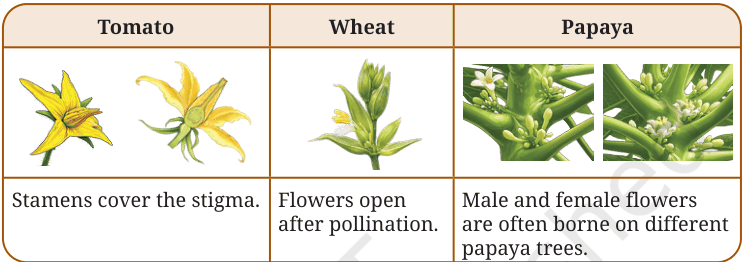
Find out which type(s) of pollination might have been followed: Tomato – stamens cover the stigma; Wheat – flowers open after pollination; Papaya – male and female flowers are often borne on different trees.
Answer
Plant | Clue | Type of pollination |
Tomato | Stamens cover the stigma, so pollen falls directly on it | Self-pollination |
Wheat | Pollination happens before the flower opens | Self-pollination (inside the closed flower) |
Papaya | Male and female flowers on different trees | Cross-pollination only (by insects/wind) |
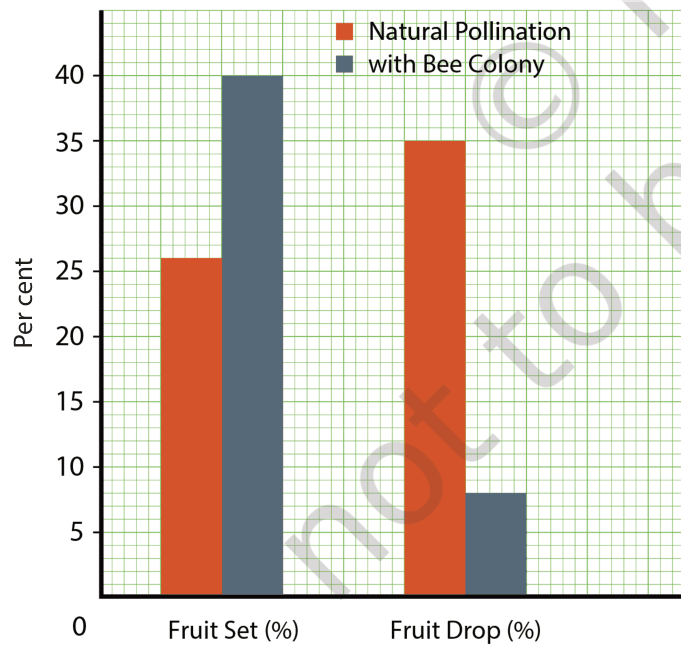
Apple orchards: Place A – natural pollinators only; Place B – beekeeping added. Fig. 11.24: Place A – fruit set ≈ 26%, fruit drop ≈ 35%; Place B – fruit set ≈ 40%, fruit drop ≈ 8%. (i) Hypotheses? (ii) Parameters? (iii) Compare and analyse. (iv) Inference?
Answer
(i) Hypotheses: "Adding bee colonies (more pollinators) increases fruit setting in apple orchards" and "Better pollination reduces premature fruit drop", so yield increases.
(ii) Parameters: Variable changed – presence of bee colonies (pollination method). Measured – fruit set (%) and fruit drop (%). Kept the same – apple variety, age of trees, fertiliser, irrigation, orchard management and the same season (although the locations differ, which is a limitation).
(iii) Comparison: With bee colonies (Place B), fruit set rose from about 26% to about 40%, and fruit drop fell from about 35% to about 8%. So Place B had many more fruits forming and far fewer falling early, giving a much higher yield.
(iv) Inference: Insufficient pollination is a major reason for the declining apple yield. Keeping honeybees in orchards improves pollination, increases fruit setting and reduces fruit drop. Beekeeping also gives honey as an extra income, so mixed farming with bees is beneficial for farmers.
A student claims, "In humans, ovulation always happens on day 14 of the menstrual cycle". Critically examine this claim.
Answer
The claim is not correct.
- Day 14 is only an average for a 28-day cycle. Cycle length differs from person to person (roughly 21–35 days), so ovulation day also differs (it usually happens about 14 days before the next period, not 14 days after the last).
- Even in the same person, the timing can vary from month to month due to stress, illness, diet, exercise or hormonal changes.
- In the first years after puberty and near menopause, cycles are often irregular, and in some cycles ovulation may not happen at all.
Extra Important Questions
Multiple Choice Questions (1 mark)
1. Budding is seen in
(a) Amoeba (b) Hydra and yeast (c) Spirogyra (d) Plasmodium
Answer: (b) Hydra and yeast
2. The male reproductive part of a flower is the
(a) pistil (b) stamen (c) sepal (d) petal
Answer: (b) stamen
3. After fertilisation, the ovary develops into
(a) seed (b) fruit (c) flower (d) embryo
Answer: (b) fruit
4. Fertilisation in humans takes place in the
(a) uterus (b) ovary (c) oviduct (fallopian tube) (d) vagina
Answer: (c) oviduct
Short Answer Questions
Differentiate between asexual and sexual reproduction.
Answer
Asexual reproduction involves one parent, no gametes and gives identical offspring. Sexual reproduction involves two parents (usually), fusion of male and female gametes and gives offspring with variation.
What is vegetative propagation? Give two examples.
Answer
Formation of new plants from vegetative parts such as stem, root or leaf. Examples: potato (tuber), Bryophyllum (leaf buds), rose (stem cutting), ginger (rhizome).
Name two agents of pollination.
Answer
Insects (bees, butterflies), birds, wind, water, bats (any two).