
Circle of Learning • New NCERT textbook "Exploration" (2026-27) • Pause and Ponder + Revise, Reflect, Refine (all questions) + extra important questions
Pause and Ponder (In-text Questions)
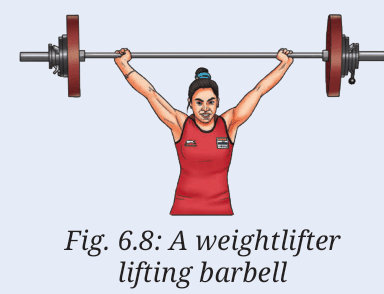
A weightlifter is holding a barbell steady in her hands (Fig. 6.8). Is she doing any work on the barbell while holding it steady?
Answer
No. Work = force × displacement in the direction of force. She applies an upward force, but the barbell does not move, so the displacement is zero and the work done on the barbell is zero. (She feels tired because her muscles use energy internally.)
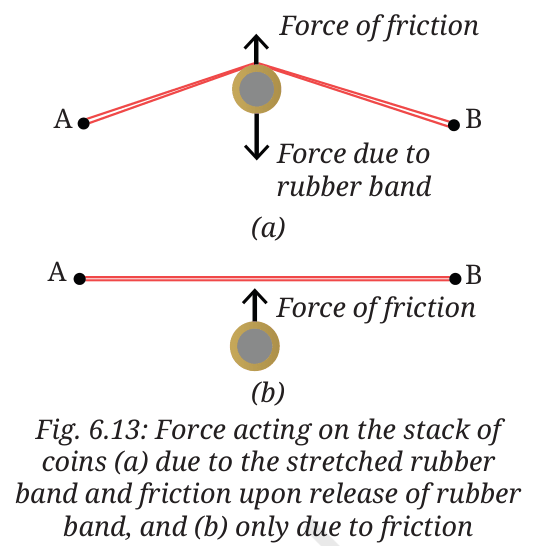
Is the work done by friction on the stack of coins that travels on a rough surface (Fig. 6.13c) — positive, negative or zero?
Answer
Negative. Friction acts opposite to the direction of motion of the coins, so the force and displacement are in opposite directions. Friction takes away kinetic energy, which is why the coins slow down and stop.
When you pedal a bicycle on a flat road, your muscles supply energy. In what forms does this muscular energy appear as you ride?
Answer
- Kinetic energy of the bicycle and rider (and of the rotating wheels and pedals).
- Heat (thermal energy) due to friction in the chain, wheels and between tyres and road, and also heat in our body.
- Work done against air resistance (ends up as heat in the air).
- A little sound energy from the moving parts.
Two objects A and B of mass m and 4m have the same kinetic energy. What is the ratio of the magnitude of velocities of A and B?
Answer
½ m vA² = ½ (4m) vB²
⇒ vA² = 4 vB²
⇒ vA = 2 vB
vA : vB = 2 : 1
Does the kinetic energy of an object which moves with constant velocity change with its position?
Answer
No. Kinetic energy = ½mv² depends only on mass and speed. If the velocity is constant, the kinetic energy stays the same at every position.
Does the potential energy of an object near the surface of the Earth change if it moves with constant velocity in the horizontal direction? What if the object is gradually raised in the vertical direction?
Answer
Moving horizontally: No change, because its height above the ground stays the same (PE = mgh).
Raised vertically: its potential energy increases as its height h increases.
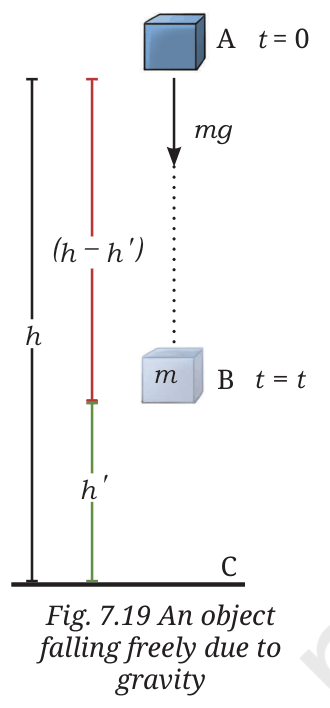
For the situation in Fig. 7.19 (an object of mass m dropped from height h), calculate the mechanical energy of the ball just before it hits the ground and show that even at this position, it is mgh.
Answer
Just before hitting the ground, height = 0, so PE = 0.
Velocity: v² = u² + 2gh = 0 + 2gh
⇒ v² = 2gh
KE = ½mv² = ½m(2gh) = mgh
Mechanical energy = KE + PE = mgh + 0 = mgh. It is the same as at the starting point, showing that mechanical energy is conserved (ignoring air resistance).
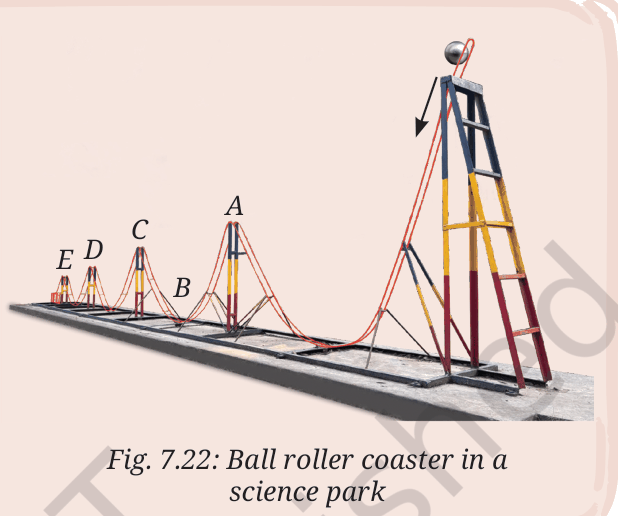
In an exhibit (Fig. 7.22), a ball is released from the highest point A. Describe how the kinetic and potential energy change at points A, B and C. Why do subsequent points, such as C, D and E, usually have lower heights than the previous ones? Could it have anything to do with energy lost due to friction?
Answer
At A (highest point, released from rest): PE is maximum, KE is zero.
At B (lowest point): PE is minimum; most of it has changed into KE, so KE (and speed) is maximum.
At C (rising again): some KE changes back into PE; the ball slows down.
Each later peak (C, D, E) is lower because some mechanical energy is lost at every stage as heat and sound due to friction with the track and air resistance. Since the ball has less mechanical energy left, it cannot rise as high as before. Yes, it is due to energy lost to friction.
Explain why roads on hills are built to wind around in gentle slopes rather than going straight up.
Answer
A winding road acts like an inclined plane. The work needed to reach the top (mgh) is the same either way, but on a gentle slope it is spread over a much longer distance, so a smaller force is needed at every moment. Vehicles can climb easily without very powerful engines, and the risk of slipping or rolling back is also reduced.
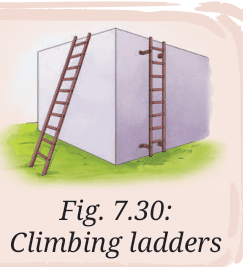
To reach a higher floor, we find climbing an inclined ladder easier in comparison to climbing a vertical ladder. Explain why.
Answer
An inclined ladder works like an inclined plane – we climb the same height over a longer distance, so we need less force per step. Part of our weight is also supported by the ladder's steps. On a vertical ladder we must lift our entire weight directly with our arms and legs.
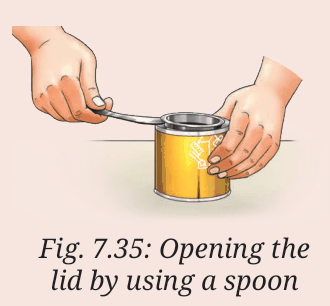
Why is it easier to open the lid of a can by using a spoon (Fig. 7.35)?
Answer
The spoon acts as a lever. The rim of the can is the fulcrum, the lid is the load (very close to the fulcrum) and we apply effort at the far end of the spoon handle. Since the effort arm is much longer than the load arm, a small effort produces a large force on the lid, so it opens easily.
Why do you push an object closer to the scissors' fulcrum when you want to cut an object which is hard?
Answer
Scissors are a lever with the fulcrum at the rivet. Moving the hard object closer to the fulcrum reduces the load arm while the effort arm (handles) stays the same. This increases the mechanical advantage, so the same effort produces a much larger cutting force.
Many designs of perpetual motion machines have been proposed but none actually work. Why do all real machines eventually slow down and stop? Explain in terms of work and energy.
Answer
A machine cannot create energy; the work it gives out can never be more than the energy put in. In every real machine some energy is always lost as heat and sound due to friction and air resistance. If no fresh energy is supplied, the stored energy keeps decreasing with each cycle, and the machine slows down and stops. A perpetual motion machine would need 100% efficiency (no losses) or would have to create energy, which violates the law of conservation of energy.
Revise, Reflect, Refine (Textbook Exercise)
State whether True or False.
(i) Work is said to be done when a force is applied, even if the object does not move. – False (displacement is needed).
(ii) Lifting a bucket vertically upward results in positive work done on the bucket. – True.
(iii) The SI unit for both work and energy is joule (J). – True.
(iv) A motionless stretched rubber band has kinetic energy. – False (it has potential energy, not kinetic energy).
(v) Energy can change from one form to another. – True.
Answer
Fill in the blanks.
(i) Work done = force × displacement (in the direction of force).
(ii) 1 joule of work is done when a force of 1 newton displaces an object by 1 metre in the direction of the force.
(iii) The kinetic energy of a body of mass m and velocity v is ½mv².
(iv) The potential energy of an object of mass m at a small height h is mgh.
(v) Power is defined as the rate at which work is done.
Answer
When a ball thrown upwards reaches its highest point, which statement(s) are correct?
Answer
Correct: (iii) Its kinetic energy is zero, and (iv) Its potential energy is maximum.
(i) and (ii) are wrong – gravity still acts on the ball (force = mg) and its acceleration is still g downward, even though its velocity is momentarily zero.
Identify the energy transformation in each situation.
Answer
Situation | Energy transformation |
(i) A truck moving uphill | Chemical energy (fuel) |
(ii) Unwinding of a watch spring | Elastic potential energy |
(iii) Photosynthesis in green leaves | Light (solar) energy |
(iv) Water flowing from a dam | Gravitational potential energy |
(v) Burning of a matchstick | Chemical energy → heat and light energy |
(vi) Explosion of a fire cracker | Chemical energy |
(vii) Speaking into a microphone | Sound energy → electrical energy |
(viii) A glowing electric bulb | Electrical energy |
(ix) A solar panel | Light (solar) energy |
A student (mass 50 kg) is lifted straight up in an elevator to the top of a 72.5 m building; later the student climbs the stairs to the top. g = 10 m s−2. (i) Gain in PE by elevator? (ii) Gain in PE by stairs? (iii) What do you conclude?
(i) PE = mgh = 50 × 10 × 72.5 = 36,250 J
(ii) Same height gained, so PE = 36,250 J
(iii) The gain in potential energy depends only on the change in height (initial and final positions), and not on the path taken.
Answer
A crane lifts a mass m to the 10th floor in a certain time. It then raises the same mass to the 20th floor of the same building in double the time. How much more energy and power are required? (All floors have equal height.)
Answer
Let each floor have height h and the first lift take time t.
Energy to 10th floor: E1 = mg(10h); Power P1 = E1/t
Lifting from the ground to the 20th floor: E2 = mg(20h) = 2E1; time = 2t
P2 = 2E1/2t = E1/t = P1
So it needs twice the energy (E1 more) but the same power.
(If the mass is raised from the 10th floor to the 20th floor in time 2t, the extra energy needed is E1 and the power is E1/2t = half of P1.)
Which factors determine the energy required to raise a flag to the top of a tall flagpole using a pulley? Does raising the flag slowly or quickly change the amount of work done? If the speed is doubled, how does the power requirement change?
Answer
The energy needed depends on the mass (weight) of the flag (and rope), the height of the pole (W = mgh), and the friction in the pulley.
Raising it slowly or quickly does not change the work done – it depends only on the force and the height.
If the speed is doubled, the same work is done in half the time, so the power required doubles (P = W/t).
A man (60 kg) rides a scooter (100 kg) and accelerates to velocity v. The next day his son (40 kg) joins him. If the scooter reaches the same speed in the same time, what is the ratio of fuel used on the two days? (No losses.)
Answer
Fuel used = kinetic energy gained = ½Mv²
Day 1: M = 60 + 100 = 160 kg; Day 2: M = 160 + 40 = 200 kg
Ratio = ½(160)v² : ½(200)v² = 160 : 200 = 4 : 5
On a seesaw with sliding seats, a child sits on one side and an adult (twice the child's weight) on the other. The seesaw is balanced. Draw a figure showing the distances from the fulcrum.
Answer
For balance (law of the lever): adult's weight × adult's distance = child's weight × child's distance
2W × dadult = W × dchild
⇒ dchild = 2 × dadult
Figure: Draw a plank on a triangular fulcrum. Place the adult at distance d (e.g. 1 m) on one side and the child at distance 2d (e.g. 2 m) on the other side. Label the weights 2W and W. The child must sit twice as far from the fulcrum as the adult.
A ball of mass 2 kg is thrown up with a velocity of 20 m s−1. (i) Identify the sign of the work done by gravity during upward and downward motion. (ii) If the ball reaches a height of 19.4 m, how much work was done by air resistance? (g = 10 m s−2)
(i) Upward motion: gravity acts down while the ball moves up – work done by gravity is negative. Downward motion: gravity and displacement are both downward – work is positive.
(ii) Initial KE = ½ × 2 × 20² = 400 J
Answer
PE at the top = mgh = 2 × 10 × 19.4 = 388 J (KE at top = 0)
Energy lost to air resistance = 400 − 388 = 12 J
Work done by air resistance = −12 J
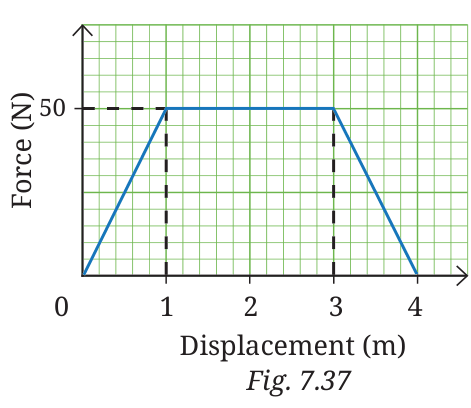
A 10.0 kg block moves on a frictionless floor. A variable force (Fig. 7.37: rising from 0 to 50 N between 0 and 1 m, constant 50 N from 1 m to 3 m, falling to 0 at 4 m) acts in the direction of motion. If KE at 0 m is 180 J, find the speed (i) at 0 m, (ii) at 4 m. Does the block have negative acceleration in any portion?
(i) 180 = ½ × 10 × v² ⇒ v² = 36 ⇒ v = 6 m s−1
(ii) Work done by the force = area under F–x graph
Answer
= ½ × 1 × 50 + 2 × 50 + ½ × 1 × 50 = 25 + 100 + 25 = 150 J
KE at 4 m = 180 + 150 = 330 J
⇒ ½ × 10 × v² = 330
⇒ v² = 66
⇒ v ≈ 8.1 m s−1
No, the block never has negative acceleration. The force always acts in the direction of motion (it is never negative); between 3 m and 4 m it only decreases, so the acceleration decreases but stays positive. The block keeps speeding up.
Gravity on the Moon is about 1/6 of that on Earth. An astronaut throws a ball up to 8 m on Earth. How high will a ball thrown with the same velocity go on the Moon?
Answer
Maximum height h = u²/2g, so h ∝ 1/g.
hMoon = 8 × 6 = 48 m
A 1000 kg car moves at constant speed. The driver sees an obstruction and brakes to a stop. Fig. 7.38: speed 35 m/s from A (t = 0) to B (t = 1 s), then falls to 0 at C (t = 3 s). (i) Describe the motion between A and B. (ii) KE at A. (iii) Work done by the brakes between B and C. (iv) What does the KE transform into?
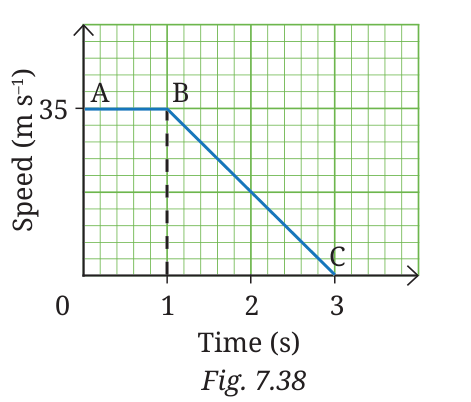
(i) Between A and B, the car moves with a constant speed of 35 m s−1 (uniform motion) – this 1 s is the driver's reaction time before braking.
(ii) KE = ½ × 1000 × 35² = 500 × 1225 = 612,500 J (≈ 6.1 × 10⁵ J)
(iii) By the work–energy theorem, work done by brakes = change in KE = 0 − 612,500 = −612,500 J
(iv) Mainly into heat (thermal energy) in the brakes, tyres and road, and a little sound.
Answer
The PE–displacement graph of a 0.5 kg ball on a frictionless track is shown in Fig. 7.39. At O, velocity is 0 and PE is 30 J. Calculate the velocity at P (PE = 20 J), Q (PE = 30 J) and R (PE = 40 J).
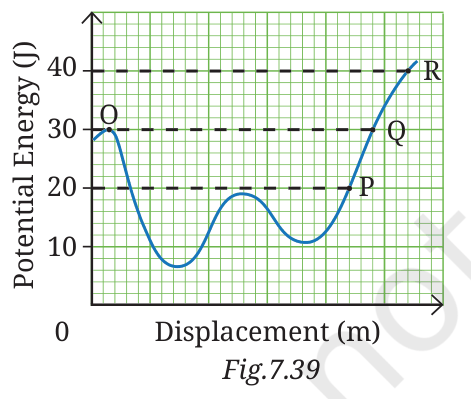
Answer
Total mechanical energy = 30 J + 0 = 30 J (conserved)
At P: KE = 30 − 20 = 10 J
⇒ ½ × 0.5 × v² = 10
⇒ v² = 40
⇒ v ≈ 6.3 m s−1
At Q: KE = 30 − 30 = 0
⇒ v = 0 m s−1 (the ball just reaches Q and stops)
At R: PE would be 40 J, which is more than the total energy of 30 J. So the ball can never reach R – it turns back at Q.
A coconut of mass 1.5 kg falls from a 10 m tree onto wet sand and stops by making a depression. (i) Velocity just before hitting the sand? (ii) If the average resistive force of sand is 3000 N and all its energy creates the depression, find the depth. (g = 10 m s−2)
(i) v² = 2gh = 2 × 10 × 10 = 200 ⇒ v = 10√2 ≈ 14.1 m s−1
(ii) KE just before impact = mgh = 1.5 × 10 × 10 = 150 J
Answer
Work done by sand = force × depth
⇒ 3000 × d = 150
⇒ d = 0.05 m = 5 cm
Extra Important Questions
Multiple Choice Questions (1 mark)
1. The SI unit of power is
(a) joule (b) newton (c) watt (d) pascal
Answer: (c) watt (1 W = 1 J/s)
2. If the speed of a body is doubled, its kinetic energy becomes
(a) double (b) half (c) four times (d) same
Answer: (c) four times
3. A pair of scissors is an example of a lever with the fulcrum
(a) between load and effort (b) at one end (c) beyond the load (d) none
Answer: (a)
Work done by the force of gravity on a satellite in a circular orbit is:
Answer
(a) positive (b) negative (c) zero (d) infinite
Answer: (c) zero (force is perpendicular to motion)
Short Answer Questions
State the work–energy theorem.
Answer
The net work done on an object is equal to the change in its kinetic energy: W = ½mv² − ½mu².
What is mechanical advantage of a simple machine?
Answer
Mechanical advantage = load ÷ effort. A machine with MA greater than 1 lets us lift a heavy load with a smaller effort.
State the law of conservation of energy.
Answer
Energy can neither be created nor destroyed; it can only be changed from one form to another. The total energy of an isolated system remains constant.