
Circle of Learning • New NCERT textbook "Exploration" (2026-27) • Pause and Ponder + Revise, Reflect, Refine (all questions) + extra important questions
Pause and Ponder (In-text Questions)
You may have noticed that fibres of coconut husk are hard and brittle, whereas the leaf stalks of coriander are soft and flexible. Find out the reason.
Answer
Coconut husk is made of sclerenchyma – dead, long, narrow cells whose walls are thickened with lignin. Lignin makes them hard and stiff. Coriander leaf stalks contain collenchyma – living, elongated cells thickened only at the corners with cellulose and pectin. This gives support with flexibility, so the stalks bend easily without breaking.
Why do you think that a thick cuticle on the outer wall of epidermis is advantageous for a plant living in the desert but disadvantageous for a plant living underwater?
Answer
The cuticle is a waxy, waterproof layer. In the desert it greatly reduces water loss by evaporation, helping the plant survive dry conditions. Underwater there is no danger of drying; instead, the plant needs to absorb water, dissolved gases and minerals directly through its surface. A thick cuticle would block this exchange, so submerged plants have a thin or no cuticle.
Once water is absorbed by plant roots, it has to travel against gravity through xylem. How do the 'dead' cells of the xylem work together with the living cells of leaves at the top to keep the water moving?
Answer
The dead xylem vessels and tracheids form continuous hollow tubes from roots to leaves with no cell contents in the way. In the leaves, living cells lose water by evaporation through the stomata (transpiration). This loss creates a pull (suction) that draws water up the xylem tubes like water through a straw. The water molecules stick to each other and to the walls of the xylem, forming an unbroken column that keeps moving upward. So the dead xylem provides the pipeline while living leaf cells create the pulling force.
What do you think will happen if there were no stomata in the epidermis of the stem or leaves?
Answer
- Carbon dioxide could not enter the leaf, so photosynthesis would stop and the plant would starve.
- Oxygen could not be exchanged properly for respiration.
- Transpiration would stop, so the upward pull of water and minerals through the xylem would become very weak, and the plant could not cool itself.
The plant would not survive for long.
Look at the picture (Fig. 3.17) of poses of classical and folk dances of India. Can you identify which joints are involved? Also, what type of movement each joint allows?
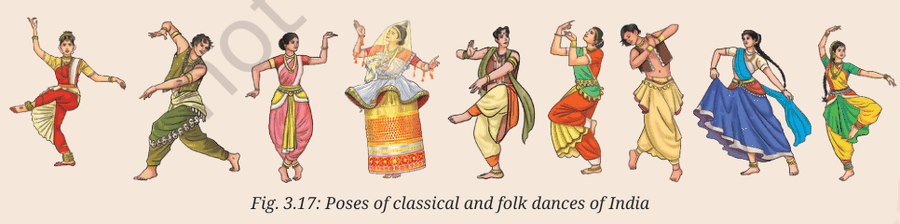
Answer
Joint | Type | Movement allowed | Seen in dance as |
Shoulder and hip | Ball and socket | Movement in all directions, including rotation | Arms raised and swung in circles; leg lifted sideways (e.g. Bharatanatyam, Bhangra) |
Elbow and knee | Hinge | Bending and straightening in one plane | Bent knees in araimandi pose; folded arms |
Neck (between first two vertebrae) | Pivot | Turning/rotation of the head | Side-to-side neck movements (e.g. in Kathakali, Bharatanatyam) |
Wrist and ankle | Gliding/condyloid | Sliding and bending in two directions | Hand gestures (mudras), foot tapping in Kathak |
Activities – Expected Observations
Activity 3.4 (bones and muscles as part of body weight): Example – for a body weight of 45 kg, with ~13% bone and ~35% muscle, bone ≈ 45 × 0.13 ≈ 5.9 kg and muscle ≈ 45 × 0.35 ≈ 15.8 kg. Muscles form a much larger part of body weight than bones.
Activity 3.5 (movements of body parts): Shoulder and hip allow complete rotation (ball and socket); elbow and knee allow only bending in one direction (hinge); the neck allows turning of the head (pivot).
Revise, Reflect, Refine (Textbook Exercise)
Meristematic tissues divide repeatedly. What property of their cells allows them to do this?
Answer
(iii) They have thin walls, dense cytoplasm and large prominent nucleus.
If a plant is unable to transport food from leaves to roots which tissue is malfunctioning?
Answer
(ii) Phloem
Why are the epithelial tissues that line an animal's internal organs usually only one or a few cells thick?
Answer
(iii) To allow quick exchange of materials across them.
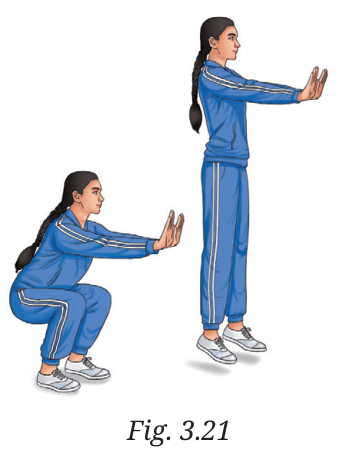
You can perform these two jumps: Straight-leg jump — keep knees and ankles stiff. Normal jump — bend knees and ankles naturally. How did your ankle, knee and hip positions differ between the two jumps?
Answer
In the straight-leg jump, the ankles, knees and hips stay almost straight; the jump is low, and landing is hard and jarring because the joints cannot absorb the shock.
In the normal jump, we first bend (flex) the hips, knees and ankles, then straighten them quickly to push off, so we jump higher. On landing, these joints bend again and act like springs, cushioning the impact. This shows how joints and muscles work together for movement and shock absorption.
Which type of joint is involved when you bend your knees and ankles?
Answer
(ii) Hinge (the knee is a hinge joint; the ankle also works mainly as a hinge for up–down bending).
Assertion–Reason questions.
Answer
A. Assertion: Epithelium is well-suited for gas exchange in the lungs. Reason: It consists of multiple layers of tall cells that slow down diffusion.
Answer: (iii) – (A) is true, but (R) is false. The lung epithelium is a single layer of thin, flat (squamous) cells that allow fast diffusion.
B. Assertion: Cardiac muscle can contract continuously without fatigue. Reason: Cardiac muscle cells have a high number of mitochondria and an abundant blood supply.
Answer: (i) – Both true, and (R) correctly explains (A).
C. Assertion: Tendons connect bone to bone and allow joint movement. Reason: Tendons are made of tough connective tissue that transmits force from muscle to bone.
Answer: (iv) – (A) is false (tendons connect muscle to bone; ligaments connect bone to bone), but (R) is true.
D. Assertion: In a hinge joint, movement occurs primarily in one plane. Reason: The bone ends are shaped to allow sliding in all directions.
Answer: (iii) – (A) is true, but (R) is false. The bone ends in a hinge joint are shaped to allow movement only back and forth.
Plot a graph between the age of a teak tree (years, x-axis) and the diameter (cm) and number of annual rings (y-axis) using the data: Age 5, 10, 20, 25, 30, 40 years; DBH 4, 8, 24, 28, 32, 40 cm; annual rings 5, 10, 20, 25, 30, 40.
Answer
Graph: Take age on the x-axis (0–40 years) and plot two lines on the y-axis: (1) diameter: (5, 4), (10, 8), (20, 24), (25, 28), (30, 32), (40, 40); (2) number of rings: (5, 5), (10, 10), (20, 20), (25, 25), (30, 30), (40, 40).
(i) The diameter of the stem keeps increasing with age. Growth is slower in the first 10 years (about 0.8 cm per year), fastest between 10 and 20 years (1.6 cm per year), and then steadier at about 0.8 cm per year. So the girth of the tree increases throughout its life, though not at the same rate every year.
(ii) The number of annual rings is equal to the age of the tree – one ring is added each year. As the number of rings increases, the diameter also increases. So the diameter is directly related to the number of annual rings (more rings
⇒ thicker stem), although the width of each ring may differ from year to year depending on conditions such as rainfall.
(iii) The lateral meristem (vascular cambium), located between the xylem and phloem in the stem (and cork cambium below the bark), is responsible for the increase in girth.
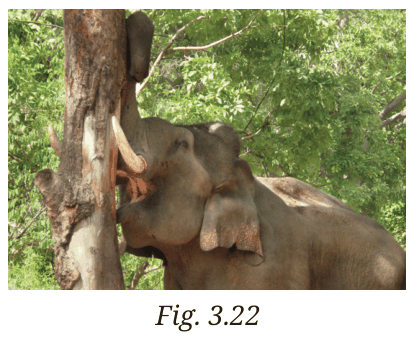
A tree was severely debarked by an elephant. (i) Which function(s) of the tree is/are hampered by debarking? (ii) Which plant tissue would be affected by further damage to the tree trunk even after debarking? (iii) Which function would be hampered if the tissues beneath the bark were severely damaged? (iv) What assumptions are you making? How would the answer change if your assumptions are changed?
Answer
(i) The bark protects the tree from water loss, insects, fungi and injury. More importantly, the outer bark region contains the phloem, so transport of food from leaves to roots is hampered. If a complete ring of bark is removed, the roots starve and the tree may slowly die.
(ii) Further damage would affect the vascular cambium and then the xylem (sapwood) inside.
(iii) Damage to the cambium would stop growth in girth and formation of new xylem and phloem; damage to the xylem would stop the upward transport of water and minerals, so the leaves would wilt and the tree would die quickly.
(iv) Assumptions: the bark has been removed all around the trunk (a complete ring); the phloem lies just under the bark; the tree cannot form new bark quickly. If only a small patch of bark was removed, food could still travel through the remaining phloem and the wound could heal, so the tree would likely survive.
A young mango sapling's stem bends flexibly during monsoon winds and does not break. Which tissue is responsible for this flexibility? Predict the impact if the existing tissue was replaced by sclerenchyma.
Answer
Collenchyma is responsible. Its living cells are thickened only at the corners, so they provide support along with flexibility. If it were replaced by sclerenchyma (dead, lignified, rigid cells), the young stem would become stiff and brittle. It would be unable to bend in strong winds and would be more likely to snap. Also, sclerenchyma cells are dead and cannot grow, so the young growing stem would not be able to elongate easily.
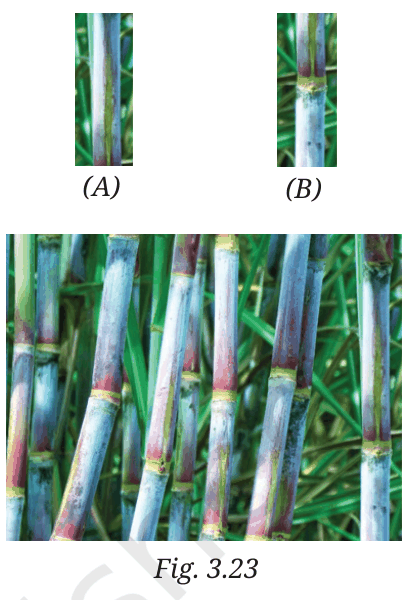
Sohan used two types of sugarcane cuttings, 'A' and 'B'. Type 'B' sprouted and grew, type 'A' did not. (i) Why could type 'B' grow but not type 'A'? (ii) What difference was present in type 'B'? (iii) What observation or measurement was made to determine whether this change had an effect? (iv) What parameters should be kept the same for a fair comparison?
Answer
(i) Type 'B' contained a node with a bud, which has meristematic (actively dividing) tissue that can produce new shoots and roots. Type 'A' was only an internode piece without a bud, so it had no tissue able to form a new plant.
(ii) Type 'B' had a node (with an eye bud and root primordia), whereas type 'A' had none.
(iii) Whether the cuttings sprouted (appearance of shoots and roots) after a few weeks; one could also measure the number of shoots and their height.
(iv) Same length and thickness of cuttings, same variety and age of sugarcane, same soil, same amount of water, light and temperature, and the same time period of observation.
Rohan says, "A tissue is a group of similar cells performing similar functions". Rajiv argues that this is true for simple tissues but different for complex tissues. Explain.
Answer
Rajiv is right. Simple tissues (parenchyma, collenchyma, sclerenchyma) are made of one type of cell, all similar and doing the same job. Complex tissues (xylem and phloem) are made of more than one type of cell – e.g. xylem has tracheids, vessels, xylem parenchyma and xylem fibres – which differ in structure but work together to perform a common function (conducting water). So a better definition is: a tissue is a group of cells, similar or different in structure, that work together to perform a particular function.
Coconut husk fibres are used for mats which are tough and fibrous. Which tissue has structural features suitable for providing this strength? Explain why living parenchyma couldn't serve the same purpose.
Answer
Sclerenchyma – its cells are long, narrow, dead and have very thick walls hardened with lignin, often with almost no space inside. This makes them tough and strong.
Parenchyma cells have thin cellulose walls, are living, loosely packed and filled with cytoplasm and large vacuoles. They are soft and decay easily, so they cannot provide toughness or last long as fibres.
Vibha claims, "Meristematic cells are located only at the root and shoot apices". What do you think? What question can Neha ask Vibha to help her understand further?
Answer
The statement is incorrect. Apical meristem is at the tips of roots and shoots, but there are also lateral meristems (cambium) that increase the girth of the stem and root, and intercalary meristems at the base of leaves or internodes (e.g. in grasses).
Neha could ask: "If meristems are only at the tips, how does a tree trunk become thicker every year?" or "How does grass grow again after its top has been cut off by a lawn mower?"
A plant cell and an animal cell are of the same size. (i) Which cell will have a larger vacuole? Give reasons. (ii) What assumptions are you making?
Answer
(i) The plant cell. A mature plant cell usually has one large central vacuole that may fill most of the cell. It stores water, minerals and wastes and keeps the cell turgid to support the plant. Animal cells have small, temporary vacuoles or none.
(ii) Assumptions: the plant cell is a mature cell (not a meristematic cell, which has small or no vacuoles), and the animal cell is a typical body cell (not a fat-storing cell, which has a very large fat droplet).
A textbook states, "Each plant tissue performs only one specific function". What questions would you ask to critically examine this statement? What examples of tissues would you take?
Answer
Questions to ask
- Does parenchyma only store food, or does it also do other jobs?
- Does the epidermis only protect, or does it also help in exchange of gases and absorption of water?
- Does xylem only conduct water, or does it also give mechanical support?
Examples: Parenchyma stores food, carries out photosynthesis (chlorenchyma), and helps in floating (aerenchyma). Epidermis protects the plant, has stomata for gas exchange and transpiration, and root hairs for absorbing water. Xylem conducts water and minerals and also provides strength (wood). So the statement is not correct – many plant tissues perform more than one function.
Extra Important Questions
Multiple Choice Questions (1 mark)
Which tissue increases the length of the plant?
Answer
(a) Lateral meristem (b) Apical meristem (c) Permanent tissue (d) Cork
Answer: (b) Apical meristem
2. Ligaments connect
(a) muscle to bone (b) bone to bone (c) muscle to muscle (d) skin to muscle
Answer: (b) bone to bone
Which muscle is involuntary and striated?
Answer
(a) Skeletal (b) Smooth (c) Cardiac (d) None
Answer: (c) Cardiac
Which of the following is a dead tissue?
Answer
(a) Collenchyma (b) Sclerenchyma (c) Parenchyma (d) Phloem parenchyma
Answer: (b) Sclerenchyma
Short Answer Questions
Name the elements of xylem and phloem.
Answer
Xylem: tracheids, vessels, xylem parenchyma, xylem fibres. Phloem: sieve tubes, companion cells, phloem parenchyma, phloem fibres.
Why is blood considered a connective tissue?
Answer
Blood has cells (RBCs, WBCs, platelets) in a fluid matrix (plasma), and it connects all parts of the body by transporting gases, nutrients, hormones and wastes.
How does cork protect a plant?
Answer
Cork cells are dead, tightly packed and their walls contain suberin, which makes them impermeable to water and gases. This forms the bark that protects the stem from water loss, injury and infection.