
NCERT Solutions Class 9 Maths (Ganita Manjari) Chapter 8 – Predicting What Comes Next: Exploring Sequences and Progressions
Circle of Learning • New NCERT textbook "Ganita Manjari" (2026-27) • In-text Exercises, Think and Reflect, Exercise Sets 8.1–8.3, End-of-Chapter Exercises – step-by-step solutions
Think and Reflect and In-text Exercises (Sections 8.1–8.3)
Describe the pattern and predict the next terms.
Answer
Natural numbers: add 1 each time
⇒ 7, 8, 9 …
Odd numbers: add 2 each time
⇒ 13, 15, 17 …
Triangular numbers: add 2, then 3, then 4, … (the nth term is 1 + 2 + … + n)
⇒ 28, 36, 45 …
Square numbers: add 3, 5, 7, 9, … (consecutive odd numbers); the nth term is n²
⇒ 49, 64, 81 …
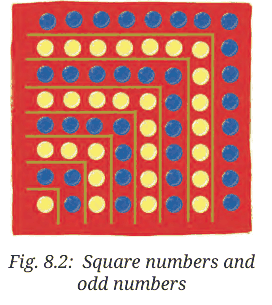
2. Fig. 8.2 – squares and odd numbers. Each square of dots grows into the next by adding an L-shaped border; the borders contain 1, 3, 5, 7, … dots. So n² = 1 + 3 + 5 + … + (2n − 1).
Sequence 1, 4, 7, 10, 13, … – next four terms and the first 10 partial sums.
Answer
Next terms: 16, 19, 22, 25.
Running totals: 1, 5, 12, 22, 35, 51, 70, 92, 117, 145.
4. t₅, t₆, t₇, t₈ of the triangular numbers: 15, 21, 28, 36.
5. Other kinds of sequences: e.g. even numbers 2, 4, 6, … (increasing, constant gap); powers of 2: 1, 2, 4, 8, … (each term doubles); 1, −1, 1, −1, … (alternating); 1, ½, ¼, ⅛, … (decreasing, getting close to 0); prime numbers 2, 3, 5, 7, 11, … (no simple rule); Virahānka–Fibonacci 1, 2, 3, 5, 8, … (each term is the sum of the previous two).
6. Why is an explicit formula useful? It gives any term directly from its position n (e.g. the 300th term) without working out all the earlier terms. It also lets us test whether a number belongs to the sequence and find its position.
7. Using uₙ = 2n − 1: u₅₃ = 105, u₁₀₈ = 215, u₁₁₇₀ = 2339.
8. sₙ = 5n − 2: first six terms 3, 8, 13, 18, 23, 28; s₁₀₀ = 498; s₁₀₀₀ = 4998.
Why must n be a natural number? n is a position in the list (1st, 2nd, 3rd …); there is no "94.6th" term. So a number is in the sequence only if solving sₙ = number gives a natural number n.
9. nth square number: tₙ = n².
10. Primes 2, 3, 5, 7, 11, …: There is no simple formula that produces the primes; the gaps (1, 2, 2, 4, 2, 4, 2, 4, 6 …) are irregular. Next primes: 31, 37, 41, 43.
tₙ = 3n − 7.
(i) t₁ = −4, t₂ = −1, t₃ = 2, t₁₂ = 29, t₁₈ = 47, t₅₀ = 143.
(ii) 3n − 7 = 332 ⇒ 3n = 339 ⇒ n = 113. So 332 is the 113th term.
(iii) 3n − 7 = 557 ⇒ 3n = 564 ⇒ n = 188, a natural number. So yes, 557 is the 188th term.
Answer
12. Example 3: Is 133 a term of u₁ = 1, uₙ = 2uₙ₋₁ + 3? Terms: 1, 5, 13, 29, 61, 125, 253, … 133 lies between 125 and 253, and the terms keep increasing, so 133 is not a term.
13. Next two Virahānka–Fibonacci terms after 34: 21 + 34 = 55, 34 + 55 = 89.
Exercise Set 8.1
Answer
First five terms
(i) tₙ = 3n − 4: −1, 2, 5, 8, 11
(ii) tₙ = 2 − 5n: −3, −8, −13, −18, −23
(iii) tₙ = n² − 2n + 3: 1 − 2 + 3 = 2; 4 − 4 + 3 = 3; 9 − 6 + 3 = 6; 16 − 8 + 3 = 11; 25 − 10 + 3 = 18 → 2, 3, 6, 11, 18
tₙ = 5n − 3: t₁₀ = 50 − 3 = 47; t₁₅ = 75 − 3 = 72.
Answer
Answer
Are 97 and 172 terms of tₙ = 5n − 3?
5n − 3 = 97 ⇒ 5n = 100 ⇒ n = 20 → yes, 97 is the 20th term.
5n − 3 = 172 ⇒ 5n = 175 ⇒ n = 35 → yes, 172 is the 35th term.
5n − 3 = 607 ⇒ 5n = 610 ⇒ n = 122. 607 is the 122nd term.
Answer
t₁ = −5, tₙ₊₁ = tₙ + 3. First five terms: −5, −2, 1, 4, 7.
Answer
This is an AP with a = −5, d = 3, so tₙ = −5 + 3(n − 1) = 3n − 8. Setting 3n − 8 = 52 gives n = 20. So yes, 52 is the 20th term.
T₁ = 1, T₂ = 2, T₃ = 4, Tₙ = Tₙ₋₁ + Tₙ₋₂ + Tₙ₋₃.
Answer
T₄ = 4 + 2 + 1 = 7; T₅ = 7 + 4 + 2 = 13; T₆ = 13 + 7 + 4 = 24; T₇ = 24 + 13 + 7 = 44; T₈ = 44 + 24 + 13 = 81.
Think and Reflect and In-text Exercises (Arithmetic Progressions)
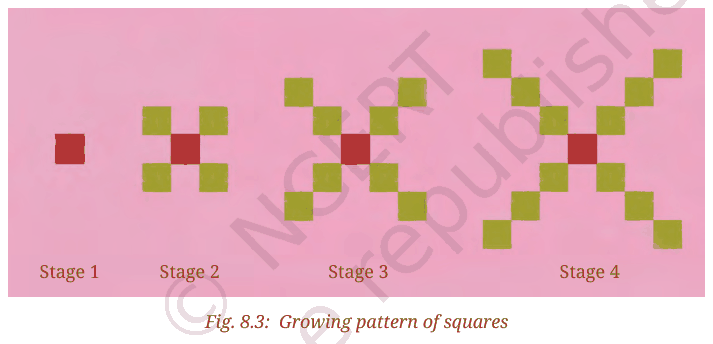
1. Growing squares (Fig. 8.3): 1, 5, 9, 13, … Each stage adds 4. Stage 5: 17, Stage 6: 21; Stage 10: 37, Stage 11: 41, Stage 12: 45; Stage 20: 77; Stage n: 4n − 3.
Which sequences in this chapter are APs?
Answer
APs (constant difference): natural numbers (d = 1), odd numbers (d = 2), 1, 4, 7, 10, … (d = 3), −7, −3, 1, 5, 9, … (d = 4), 1, 5, 9, 13, … (d = 4), and those given by 2n − 1, 5n − 2, 3n − 7, 3n − 4, 2 − 5n.
Not APs (differences change): triangular numbers, square numbers, 1, ½, ⅓, …, primes, 1, 5, 13, 29, …, 3, 6, 30, 870, …, and the Virahānka–Fibonacci sequence.
3. Verify that these are APs and find tₙ
(i) 2, 5, 8, 11, …: d = 3, tₙ = 2 + 3(n − 1) = 3n − 1.
(ii) −5, −1, 3, 7, …: d = 4, tₙ = −5 + 4(n − 1) = 4n − 9.
When the pairs (n, tₙ) are plotted, the points lie on a straight line, as for every AP.
4. Find tₙ
(i) ½, 5/2, 9/2, 13/2, …: a = ½, d = 2 ⇒ tₙ = ½ + 2(n − 1) = 2n − 3/2 (= (4n − 3)/2).
(ii) 1.5, 3.5, 5.5, 7.5, …: a = 1.5, d = 2 ⇒ tₙ = 2n − 0.5.
5. Recursive rules: 2, 5, 8, …: t₁ = 2, tₙ = tₙ₋₁ + 3. −5, −1, 3, …: t₁ = −5, tₙ = tₙ₋₁ + 4. ½, 5/2, …: t₁ = ½, tₙ = tₙ₋₁ + 2. 1.5, 3.5, …: t₁ = 1.5, tₙ = tₙ₋₁ + 2 (each for n ≥ 2).
6. Taxi fare for 10 km: 200 + 40 × 10 = ₹600.
7. Sum 1 + 2 + … + 100 by the same method: yes – each pair adds to 101, so 2S = 100 × 101 ⇒ S = 5050.
8. S₂₀, S₅₀, S₁₀₀₀: 20 × 21/2 = 210; 50 × 51/2 = 1275; 1000 × 1001/2 = 5,00,500.
9. 10th, 17th, 80th triangular numbers: 10 × 11/2 = 55; 17 × 18/2 = 153; 80 × 81/2 = 3240.
Exercise Set 8.2
AP 3, 8, 13, …: a = 3, d = 5. t₁₀ = 3 + 9 × 5 = 48; t₂₆ = 3 + 25 × 5 = 128.
Answer
AP 21, 18, 15, …: a = 21, d = −3, so tₙ = 21 − 3(n − 1) = 24 − 3n.
Answer
24 − 3n = −81
⇒ 3n = 105
⇒ n = 35: −81 is the 35th term.
24 − 3n = 0
⇒ n = 8, a natural number, so yes, 0 is a term (the 8th): 21, 18, 15, 12, 9, 6, 3, 0.
AP 11, 8, 5, 2, …: a = 11, d = −3. tₙ = 11 − 3(n − 1) = 14 − 3n.
Answer
Recursive rule: t₁ = 11, tₙ = tₙ₋₁ − 3 for n ≥ 2.
a + 2d = 12 and a + 49d = 106. Subtracting: 47d = 94 ⇒ d = 2, so a = 8.
Answer
t₂₉ = 8 + 28 × 2 = 64.
Two-digit multiples of 3: 12, 15, …, 99 – an AP with a = 12, d = 3. 12 + 3(n − 1) = 99 ⇒ n = 30 numbers.
Answer
Sum = (number of terms) × (first + last)/2 = 30 × (12 + 99)/2 = 15 × 111 = 1665.
Salary after k increments = 5,00,000 + 20,000k = 7,00,000 ⇒ k = 10. His income reached ₹7,00,000 after 10 years (i.e. in his 11th year of work).
Answer
Total = 1 + 2 + … + 25 = 25 × 26/2 = 325 marbles.
Answer
Think and Reflect and In-text Exercises (Geometric Progressions)
1. Growing pattern 3, 6, 12, 24, … (Fig. 8.6): Stage 5: 48, Stage 6: 96; Stage 10: 3 × 2⁹ = 1536, Stage 11: 3072, Stage 12: 6144; Stage 20: 3 × 2¹⁹ = 15,72,864; Stage n: 3 × 2ⁿ⁻¹.
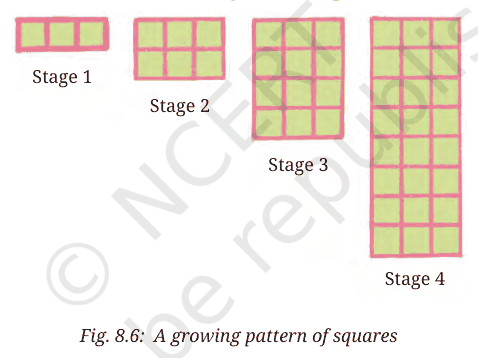
Difference from Fig. 8.3: there a fixed number (4) is added each stage (AP, slow straight-line growth); here the number is multiplied by 2 each stage (GP, very fast growth).
2. Examples 6–8: 1, 2, 4, 8, … is a GP with r = 2; 1, 3, 9, 27, … is a GP with r = 3; 1, −1, 1, −1, … is a GP with r = −1.
3. Check for GPs and find tₙ
(i) 2, 10, 50, 250, …: each ratio is 5 → GP, tₙ = 2 × 5ⁿ⁻¹.
(ii) 4, 8/3, 16/9, 32/27, …: each ratio is 2/3 → GP, tₙ = 4 × (2/3)ⁿ⁻¹.
(iii) 3, −3/2, 3/4, −3/8, …: each ratio is −½ → GP, tₙ = 3 × (−½)ⁿ⁻¹.
4. Recursive rule for tₙ = 3 × 10ⁿ⁻¹: t₁ = 3, tₙ = 10 × tₙ₋₁ for n ≥ 2.
Sierpiński triangle (Fig. 8.7):
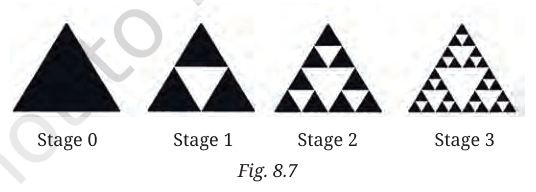
(a) Black triangles in Stages 0–3: 1, 3, 9, 27.
(b) Stage 4: 81; Stage 5: 243.
(c) Stage n: 3ⁿ (each black triangle becomes 3 smaller ones). The number grows very fast because it is multiplied by 3 at every stage.
Answer
(d) Each stage keeps 3 of every 4 equal parts, so the area is multiplied by ¾: Stage 1: ¾, Stage 2: 9/16, Stage 3: 27/64, Stage 4: 81/256 ≈ 0.32, Stage 5: 243/1024 ≈ 0.24. Stage n: (¾)ⁿ. As n increases, the black area keeps shrinking and gets closer and closer to 0 (but never reaches 0).
Exercise Set 8.3
t₁₂ = t₈ × r⁴ = 192 × 2⁴ = 192 × 16 = 3072.
Answer
GP 5, 25, 125, …: a = 5, r = 5. tₙ = 5 × 5ⁿ⁻¹ = 5ⁿ; t₁₀ = 5¹⁰ = 97,65,625.
Answer
Question 3*
t₁ = 2, tₙ₊₁ = 3tₙ − 2. Which term is 730?
t₂ = 4, t₃ = 10, t₄ = 28, t₅ = 82, t₆ = 244, t₇ = 730. So 730 is the 7th term.
(Pattern: tₙ − 1 = 1, 3, 9, 27, … so tₙ = 3ⁿ⁻¹ + 1; 3⁶ + 1 = 730.)
GP 2, 6, 18, …: a = 2, r = 3. 2 × 3ⁿ⁻¹ = 4374 ⇒ 3ⁿ⁻¹ = 2187 = 3⁷ ⇒ n = 8. 4374 is the 8th term.
Answer
Explicit: tₙ = 2 × 3ⁿ⁻¹. Recursive: t₁ = 2, tₙ = 3tₙ₋₁ for n ≥ 2.
Ball dropped from 80 m, rising to 60% each time.
(i) Bounce heights: 48, 28.8, 17.28, 10.368, 6.2208 m. After the 5th bounce it reaches 80 × (0.6)⁵ = 6.2208 m ≈ 6.22 m.
(ii) Up to the 6th time it hits the ground: the first fall of 80 m, then 5 bounces, each going up and coming down.
Answer
Distance = 80 + 2(48 + 28.8 + 17.28 + 10.368 + 6.2208) = 80 + 2 × 110.6688 = 301.3376 m ≈ 301.34 m.
Which term of 2, 2√2, 4, … is 128? r = √2, so tₙ = 2 × (√2)ⁿ⁻¹ = 2^((n+1)/2). Setting 2^((n+1)/2) = 128 = 2⁷ ⇒ n + 1 = 14 ⇒ n = 13. 128 is the 13th term.
Answer
Sierpiński square carpet.
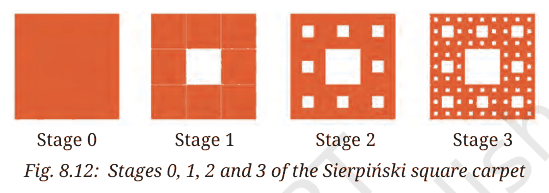
(i) Red squares in Stages 0–3: 1, 8, 64, 512.
(ii) Stage 4: 4096; Stage 5: 32,768.
(iii) Each red square becomes 8 smaller ones: explicit tₙ = 8ⁿ (n = 0, 1, 2, …); recursive t₀ = 1, tₙ = 8tₙ₋₁.
(iv) Each stage keeps 8 of 9 equal parts, so the area is multiplied by 8/9.
Answer
Stage 1: 8/9 ≈ 0.889; Stage 2: 64/81 ≈ 0.790; Stage 3: 512/729 ≈ 0.702; Stage 4: 4096/6561 ≈ 0.624; Stage 5: 32768/59049 ≈ 0.555.
Explicit: sₙ = (8/9)ⁿ; recursive: s₀ = 1, sₙ = (8/9) sₙ₋₁. As n increases, the red area keeps decreasing towards 0, while the number of red squares grows enormously.
End-of-Chapter Exercises
a + 10d = 38 and a + 15d = 73 ⇒ 5d = 35 ⇒ d = 7, a = −32. t₃₁ = −32 + 30 × 7 = 178.
Answer
t₇ − t₅ = 2d = 12 ⇒ d = 6. t₃ = a + 2d = 16 ⇒ a = 4. The AP is 4, 10, 16, 22, 28, …
Answer
Question 3*
The smallest three-digit multiple of 7 is 105 and the largest is 994. AP: 105, 112, …, 994. 105 + 7(n − 1) = 994 ⇒ n − 1 = 127 ⇒ n = 128.
Question 4*
Multiples of 4 between 10 and 250: 12, 16, …, 248. 12 + 4(n − 1) = 248 ⇒ n − 1 = 59 ⇒ 60 multiples.
Question 5*
GP with t₁ + t₂ = −4 and t₅ = 4t₃.
ar⁴ = 4ar² ⇒ r² = 4 ⇒ r = 2 or r = −2.
r = 2: a + 2a = −4 ⇒ a = −4/3. GP: −4/3, −8/3, −16/3, −32/3, …
r = −2: a − 2a = −4 ⇒ a = 4. GP: 4, −8, 16, −32, …
Question 6*
Express 100 as a sum of consecutive natural numbers.
If k consecutive numbers starting at m add to 100, then k(2m + k − 1)/2 = 100, i.e. k(2m + k − 1) = 200. The two factors have opposite parity and 2m + k − 1 > k. Checking the factor pairs of 200 gives:
• k = 5: 2m + 4 = 40 ⇒ m = 18: 18 + 19 + 20 + 21 + 22 = 100
• k = 8: 2m + 7 = 25 ⇒ m = 9: 9 + 10 + 11 + 12 + 13 + 14 + 15 + 16 = 100
(and trivially 100 itself, k = 1). These are the only ways.
Question 7*
The number doubles every hour: after n hours there are 30 × 2ⁿ bacteria. End of 2nd hour: 30 × 4 = 120; 4th hour: 30 × 16 = 480; nth hour: 30 × 2ⁿ.
Question 8*
t₄ + t₈ = 2a + 10d = 24; t₆ + t₁₀ = 2a + 14d = 44. Subtracting: 4d = 20 ⇒ d = 5, a = −13.
First three terms: −13, −8, −3.
Question 9*
n(n + 1)/2 > 1000. n = 44 gives 990 (not enough); n = 45 gives 1035. Smallest n = 45.
Question 10*
GP 2, 8, 32, …: a = 2, r = 4. 2 × 4ⁿ⁻¹ = 131072 ⇒ 4ⁿ⁻¹ = 65536 = 4⁸ ⇒ n = 9. It is the 9th term.
Explicit: tₙ = 2 × 4ⁿ⁻¹; recursive: t₁ = 2, tₙ = 4tₙ₋₁.
Question 11*
Sum of first three terms of a GP is 13/12, product is −1. Take the terms as a/r, a, ar.
Product: a³ = −1 ⇒ a = −1.
Sum: −1/r − 1 − r = 13/12 ⇒ r + 1/r = −25/12 ⇒ 12r² + 25r + 12 = 0 ⇒ (4r + 3)(3r + 4) = 0 ⇒ r = −3/4 or −4/3.
r = −3/4: terms 4/3, −1, 3/4. r = −4/3: terms 3/4, −1, 4/3 (the same numbers in reverse order).
Check: 4/3 − 1 + 3/4 = (16 − 12 + 9)/12 = 13/12 ✓; product = −1 ✓.
Question 12*
Let the GP have first term a and ratio r. Then x = ar³, y = ar⁹, z = ar¹⁵.
y² = a²r¹⁸ and xz = ar³ × ar¹⁵ = a²r¹⁸. Since y² = xz, i.e. y/x = z/y (= r⁶), x, y, z are in GP.
Question 13*
a + ar + ar² = 26 and a² + a²r² + a²r⁴ = 364.
Use 1 + r² + r⁴ = (1 + r + r²)(1 − r + r²). Dividing the second equation by the first: a(1 − r + r²) = 364/26 = 14.
Subtracting from a(1 + r + r²) = 26: 2ar = 12 ⇒ ar = 6. Then a + ar² = 20 ⇒ a + 36/a = 20 ⇒ a² − 20a + 36 = 0 ⇒ a = 2 or 18.
Terms: 2, 6, 18 (r = 3) or 18, 6, 2 (r = ⅓). Check: 4 + 36 + 324 = 364 ✓.
Question 14*
P₁ = 1, P₂ = 2, P₃ = 1 + 2 + 1 = 4, P₄ = 1 + 2 + 4 + 1 = 8, P₅ = 16, P₆ = 32, P₇ = 64, P₈ = 128.
Simpler recursion: Pₙ = (P₁ + … + Pₙ₋₂ + 1) + Pₙ₋₁ = Pₙ₋₁ + Pₙ₋₁, so Pₙ = 2Pₙ₋₁. Explicit formula: Pₙ = 2ⁿ⁻¹.
Question 15*
W₁ = 1, W₂ = 2, W₃ = W₁ + 2 = 3, W₄ = 1 + 2 + 2 = 5, W₅ = 1 + 2 + 3 + 2 = 8, W₆ = 1 + 2 + 3 + 5 + 2 = 13, W₇ = 21, W₈ = 34.
This is the Virahānka–Fibonacci sequence 1, 2, 3, 5, 8, 13, 21, 34. (Indeed Wₙ − Wₙ₋₁ = Wₙ₋₂, so Wₙ = Wₙ₋₁ + Wₙ₋₂.)
Extra Practice Questions
1. Find the 20th term of the AP 7, 11, 15, … 7 + 19 × 4 = 83
2. Find the sum 51 + 52 + … + 100. S₁₀₀ − S₅₀ = 5050 − 1275 = 3775
3. Find the 6th term of the GP 81, 27, 9, … 81 × (⅓)⁵ = 1/3
4. Is 1, 4, 9, 16, … an AP or a GP? Neither – the differences (3, 5, 7) and the ratios (4, 2.25, …) are not constant.