
Circle of Learning • New NCERT textbook "Ganita Manjari" (2026-27) • Exercise Sets 2.1–2.6, Think and Reflect, End-of-Chapter Exercises – step-by-step solutions
Think and Reflect (Algebraic Expressions)
Example 2 (garden): total cost = 200l + 160w + 50lw. (1) Identify the terms, variables and coefficients. (2) How is it different from the expression in Example 1 (4x + 5y + 3)?
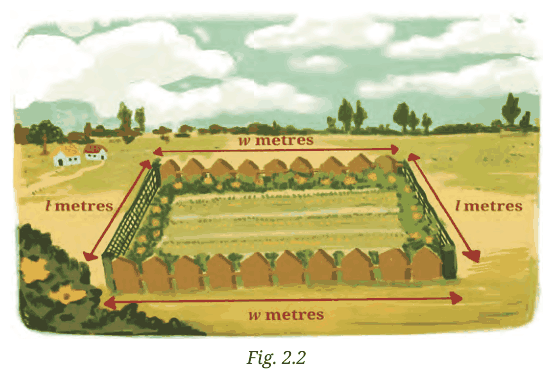
Answer
(1) Terms: 200l, 160w, 50lw. Variables: l and w. Coefficients: 200, 160 and 50.
(2) In Example 1, 4x + 5y + 3, every variable term has only one variable (degree 1) and there is a constant term 3. In Example 2 there is no constant term, and one term (50lw) is a product of two variables, so the expression has degree 2.
Example 3 (wire rectangle): area = 10x − x². (1) Identify terms, variables and coefficients. (2) Similarity or difference with Examples 1 and 3?
Answer
(1) Terms: 10x and −x². Variable: x. Coefficients: 10 and −1.
(2) Similarity: both are algebraic expressions made of terms with numbers and variables. Difference: Example 1 has two variables (x and y) and every term is of degree 1, while Example 3 has only one variable (x) and contains a squared term (degree 2).
Exercise Set 2.1
Find the degrees of: (i) 2x² − 5x + 3 (ii) y³ + 2y − 1 (iii) −9 (iv) 4z − 3
Answer
(i) 2 (ii) 3 (iii) 0 (a non-zero constant, −9 = −9x⁰) (iv) 1
Write polynomials of degrees 1, 2 and 3.
Answer
Degree 1: 3x + 5 Degree 2: x² − 4x + 1 Degree 3: 2y³ + y − 7 (many answers possible)
What are the coefficients of x² and x³ in x⁴ − 3x³ + 6x² − 2x + 7?
Answer
Coefficient of x² = 6; coefficient of x³ = −3.
Answer
What is the coefficient of z in 4z³ + 5z² − 11?
There is no z term, so the coefficient of z is 0.
Answer
What is the constant term of 9x³ + 5x² − 8x − 10?
−10
Think and Reflect (Linear Patterns)
Find the perimeter of squares with sides 1 cm, 1.5 cm, 2 cm, 2.5 cm and 3 cm. What happens to the perimeters if the sides increase by 0.5 cm?
Answer
Perimeter = 4 × side: 4 cm, 6 cm, 8 cm, 10 cm, 12 cm. Each time the side increases by 0.5 cm, the perimeter increases by 2 cm (a constant amount – a linear pattern).
Chess club (₹200 joining fee + ₹50 per match): if a player paid ₹750, how many matches did he play?
Answer
200 + 50n = 750
⇒ 50n = 550
⇒ n = 11 matches.
Area of the wire rectangle, 10x − x², as an input–output process: what is its value when x = 6 cm?
Answer
Yes – the input is the length x and the output is the area. For x = 6: 10(6) − 6² = 60 − 36 = 24 cm² (length 6 cm, width 4 cm).
Exercise Set 2.2
Find the value of 5x − 3 if (i) x = 0 (ii) x = −1 (iii) x = 2.
Answer
(i) 5(0) − 3 = −3 (ii) 5(−1) − 3 = −8 (iii) 5(2) − 3 = 7
Find the value of 7s² − 4s + 6 if (i) s = 0 (ii) s = −3 (iii) s = 4.
(i) 0 − 0 + 6 = 6
(ii) 7(9) − 4(−3) + 6 = 63 + 12 + 6 = 81
(iii) 7(16) − 4(4) + 6 = 112 − 16 + 6 = 102
Answer
Salil's mother is three times as old as Salil. After 5 years, their ages will add up to 70 years. Find their present ages.
Answer
Let Salil's age = x years; mother's age = 3x years.
(x + 5) + (3x + 5) = 70
⇒ 4x + 10 = 70
⇒ 4x = 60
⇒ x = 15
Salil is 15 years old and his mother is 45 years old.
The difference between two positive integers is 63. Their ratio is 2 : 5. Find them.
Answer
Let the integers be 2k and 5k. 5k − 2k = 63
⇒ 3k = 63
⇒ k = 21.
The integers are 42 and 105.
Ruby has 3 times as many two-rupee coins as five-rupee coins. She has ₹88 in all. How many coins of each type?
Answer
Let the number of five-rupee coins = x; two-rupee coins = 3x.
5x + 2(3x) = 88 ⇒ 11x = 88 ⇒ x = 8
8 five-rupee coins and 24 two-rupee coins.
A farmer cuts a 300 ft fence into two pieces; the longer piece is four times the shorter. How long are the pieces?
Answer
x + 4x = 300
⇒ 5x = 300
⇒ x = 60. The pieces are 60 ft and 240 ft.
The length of a rectangle is three more than twice its width and its perimeter is 24 cm. Find its dimensions.
Answer
Width = w, length = 2w + 3.
2(w + 2w + 3) = 24
⇒ 3w + 3 = 12
⇒ w = 3
Width = 3 cm, length = 9 cm.
Think and Reflect (Exploring Linear Patterns)
Tile pattern: predict the next three stages and write the sequence up to Stage 7.
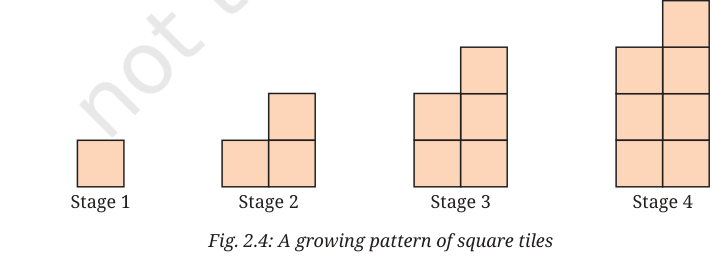
Each stage adds 2 tiles: 1, 3, 5, 7, 9, 11, 13.
Using 2n − 1, how many tiles are in the 15th and 26th stages? Which stage has 21 tiles? 47 tiles?
Answer
15th stage: 2(15) − 1 = 29; 26th stage: 2(26) − 1 = 51.
2n − 1 = 21
⇒ n = 11; 2n − 1 = 47
⇒ n = 24.
Bela has ₹100 and spends ₹5 a day. What amount is left on the 15th day? How many days to spend it all?
Answer
Amount after n days = 100 − 5n. After 15 days: 100 − 75 = ₹25. 100 − 5n = 0
⇒ n = 20 days.
Auto fare (₹25 for the first 2 km, then ₹15 per km): for how many km will the fare be ₹130?
Answer
25 + 15(d − 2) = 130
⇒ 15(d − 2) = 105
⇒ d − 2 = 7
⇒ d = 9 km.
Exercise Set 2.3
A student has ₹500 in her savings account and gets ₹150 every month. How much will she have at the end of every month from the second month onwards? Find a linear expression for the amount in the nth month.
Answer
End of month 1: ₹650; month 2: ₹800; month 3: ₹950; month 4: ₹1100; … (increasing by ₹150 each month).
Amount at the end of the nth month = 500 + 150n rupees.
A rally starts with 120 members; each hour 9 drop out. How many remain after 1, 2, 3, … hours? Find a linear expression for the nth hour.
Answer
After 1 h: 111; 2 h: 102; 3 h: 93; 4 h: 84; …
Members after n hours = 120 − 9n.
The length of a rectangle is 13 cm. Find the area if the breadth is (i) 12 cm, (ii) 10 cm, (iii) 8 cm. Find the linear pattern.
Answer
(i) 13 × 12 = 156 cm² (ii) 13 × 10 = 130 cm² (iii) 13 × 8 = 104 cm²
Area = 13b, where b is the breadth. Each time the breadth decreases by 2 cm, the area decreases by 26 cm² – a linear pattern.
A box has length 7 cm and breadth 11 cm. Find the volume if the height is (i) 5 cm, (ii) 9 cm, (iii) 13 cm. Find the linear pattern.
Answer
Base area = 7 × 11 = 77 cm².
(i) 77 × 5 = 385 cm³ (ii) 77 × 9 = 693 cm³ (iii) 77 × 13 = 1001 cm³
Volume = 77h. When the height increases by 4 cm, the volume increases by 308 cm³ each time.
Sarita reads 20 pages a day from a 500-page book. How many pages are left after 15 days? Express as a linear pattern.
Answer
Pages left after n days = 500 − 20n. After 15 days: 500 − 300 = 200 pages.
Think and Reflect (Linear Growth and Decay)
Journey cost C(d) = 100 + 60d: what is the cost for 15 km? For how many km will the cost be ₹700?
Answer
C(15) = 100 + 900 = ₹1000. 100 + 60d = 700
⇒ d = 10 km.
Tank h(t) = 3 − 0.5t: height at the end of 5 months?
h(5) = 3 − 2.5 = 0.5 m.
Exercise Set 2.4
A plant is 1.75 ft tall and grows 0.5 ft each month. (i) Height after 7 months. (ii) Table for t = 0 to 10. (iii) Expression relating h and t; why is it linear growth?
(iii) h = 1.75 + 0.5t
(i) h(7) = 1.75 + 3.5 = 5.25 ft
Answer
t (months) | 0 | 1 | 2 | 3 | 4 | 5 | 6 | 7 | 8 | 9 | 10 |
h (ft) | 1.75 | 2.25 | 2.75 | 3.25 | 3.75 | 4.25 | 4.75 | 5.25 | 5.75 | 6.25 | 6.75 |
It is linear growth because the height increases by the same amount (0.5 ft) in every equal interval (one month).
A phone bought for ₹10,000 loses ₹800 in value every year. (i) Value after 3 years. (ii) Table for t = 0 to 8. (iii) Expression; why linear decay?
(iii) v = 10000 − 800t
(i) v(3) = 10000 − 2400 = ₹7600
Answer
t (years) | 0 | 1 | 2 | 3 | 4 | 5 | 6 | 7 | 8 |
v (₹) | 10000 | 9200 | 8400 | 7600 | 6800 | 6000 | 5200 | 4400 | 3600 |
It is linear decay because the value decreases by the same amount (₹800) every year.
A village has population 750; every year 50 people move in. (i) Population after 6 years. (ii) Table for t = 0 to 10. (iii) Expression; why linear growth?
(iii) P = 750 + 50t
(i) P(6) = 750 + 300 = 1050
Answer
t (years) | 0 | 1 | 2 | 3 | 4 | 5 | 6 | 7 | 8 | 9 | 10 |
P | 750 | 800 | 850 | 900 | 950 | 1000 | 1050 | 1100 | 1150 | 1200 | 1250 |
Linear growth: the population increases by a constant 50 each year.
A ₹600 recharge reduces by ₹15 each day. (i) Equation for balance b(x) after x days; why linear decay? (ii) After how many days will it run out? (iii) Table for x = 1 to 10.
(i) b(x) = 600 − 15x. It is linear decay because the balance falls by the same ₹15 every day.
(ii) 600 − 15x = 0 ⇒ x = 40 days.
Answer
x (days) | 1 | 2 | 3 | 4 | 5 | 6 | 7 | 8 | 9 | 10 |
b(x) (₹) | 585 | 570 | 555 | 540 | 525 | 510 | 495 | 480 | 465 | 450 |
Think and Reflect (Linear Relationships)
In y = 20x + 150 (telecom bill), what do 20 and 150 represent?
Answer
20 is the cost (₹) per GB of data used (it is multiplied by x, the number of GB), and 150 is the fixed monthly fee (the bill when x = 0).
Exercise Set 2.5
Bill for 10 modules is ₹400 and for 14 modules is ₹500. If y = ax + b, find a and b.
Answer
10a + b = 400 … (1); 14a + b = 500 … (2)
(2) − (1): 4a = 100
⇒ a = 25; then b = 400 − 250 = 150.
a = 25, b = 150 (₹25 per module, fixed fee ₹150), i.e. y = 25x + 150.
Gym bill: ₹800 for 10 hours, ₹1100 for 15 hours. If y = ax + b, find a and b.
Answer
10a + b = 800; 15a + b = 1100
⇒ 5a = 300
⇒ a = 60; b = 800 − 600 = 200.
a = 60, b = 200 (₹60 per hour, fixed fee ₹200), i.e. y = 60x + 200.
°C = a°F + b. Ice melts at 0 °C = 32 °F and water boils at 100 °C = 212 °F. Find a and b.
Answer
0 = 32a + b … (1); 100 = 212a + b … (2)
(2) − (1): 100 = 180a ⇒ a = 5/9
b = −32a = −160/9
a = 5/9, b = −160/9, so °C = (5/9)(°F − 32).
Think and Reflect (Visualising Linear Relationships)
Complete the table for y = 2x + 1.
x | 1 | 2 | 5 | 7 | 9 | 12 | 20 |
y | 3 | 5 | 11 | 15 | 19 | 25 | 41 |
Example 12: guess the equation of the line through (−1, −3), (0, 0), (1, 3), (3, 9), (4, 12). In each point y is three times x, so the line is y = 3x.
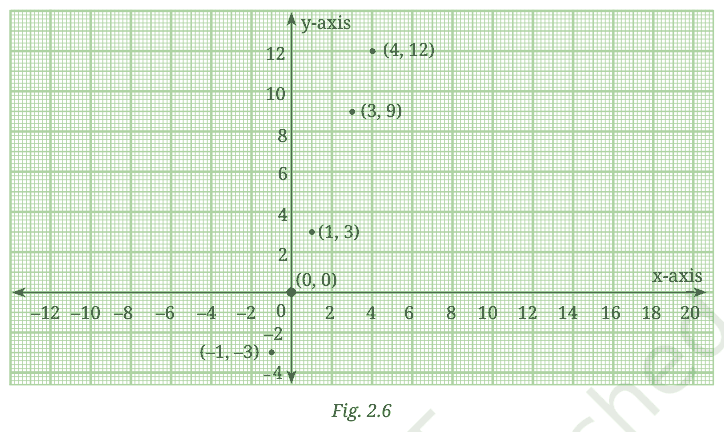
Differentiate between the graphs of y = 3x + 1 and y = −3x + 1.
Both cut the y-axis at the same point (0, 1) and are equally steep. y = 3x + 1 has a positive slope and rises from left to right; y = −3x + 1 has a negative slope and falls from left to right. They are mirror images of each other in the y-axis.
What can you conclude about y = ax + b when a is fixed but b varies (y = 2x − 1, 2x + 1, 2x + 5)?
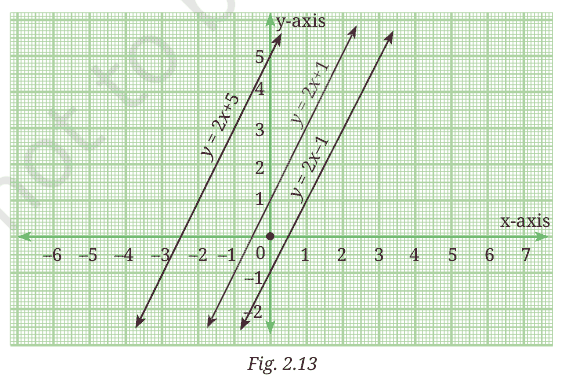
Answer
The lines have the same slope, so they are parallel. Changing b only shifts the line up or down; b is the point where the line cuts the y-axis.
Exercise Set 2.6
Draw the graphs of each set of lines and reflect on the role of 'a' and 'b'.
Answer
(i) y = 4x, y = 2x, y = x: All pass through the origin (b = 0). All rise from left to right. The larger the value of a, the steeper the line: y = 4x is steepest, y = x is least steep. Points to plot: (1, 4), (1, 2), (1, 1).
(ii) y = −6x, y = −3x, y = −x: All pass through the origin and fall from left to right (a negative). The larger |a| is, the steeper the line: y = −6x is steepest. Points: (1, −6), (1, −3), (1, −1).
(iii) y = 5x, y = −5x: Both pass through the origin and are equally steep; one rises, the other falls. They are mirror images of each other in the y-axis (and in the x-axis).
(iv) y = 3x − 1, y = 3x, y = 3x + 1: Same slope a = 3, so the lines are parallel. They cut the y-axis at (0, −1), (0, 0) and (0, 1) – b shifts the line up or down.
(v) y = −2x − 3, y = −2x, y = 2x + 3: y = −2x − 3 and y = −2x are parallel (same slope −2) and cut the y-axis at (0, −3) and (0, 0). y = 2x + 3 has slope +2 (rising) and y-intercept 3; it is the mirror image of y = −2x − 3 in the x-axis, and the two meet the x-axis at the same point (−1.5, 0).
Conclusion: 'a' (slope) decides the steepness and direction of the line – positive a means rising, negative a means falling, larger |a| means steeper. 'b' (y-intercept) decides where the line cuts the y-axis; lines with the same a and different b are parallel.
End-of-Chapter Exercises
Write a polynomial of degree 3 in x, in which the coefficient of x² is −7.
Answer
Example: x³ − 7x² + 2x + 1 (any cubic with −7x² as its x² term is correct).
Find the values: (i) 5x² − 3x + 7 if x = 1 (ii) 4t³ − t² + 6 if t = a
Answer
(i) 5 − 3 + 7 = 9 (ii) 4a³ − a² + 6
If we multiply a number by 5/2 and add 2/3 to the product, we get −7/12. Find the number.
Answer
(5/2)n + 2/3 = −7/12
(5/2)n = −7/12 − 8/12 = −15/12 = −5/4
n = (−5/4) × (2/5) = −1/2
A positive number is 5 times another. If 21 is added to both, one new number becomes twice the other. Find the numbers.
Answer
Let the numbers be x and 5x. Then 5x + 21 = 2(x + 21)
⇒ 5x + 21 = 2x + 42
⇒ 3x = 21
⇒ x = 7.
The numbers are 7 and 35. (Check: 28 and 56; 56 = 2 × 28 ✓)
You have ₹800 and save ₹250 every month. Find the amount after (i) 6 months (ii) 2 years. Express as a linear pattern.
Answer
Amount after n months = 800 + 250n.
(i) 800 + 1500 = ₹2300
(ii) 2 years = 24 months: 800 + 6000 = ₹6800
The digits of a two-digit number differ by 3. When the digits are interchanged and the new number is added to the original, we get 143. Find both numbers.
Answer
Let the digits be a and b. (10a + b) + (10b + a) = 143
⇒ 11(a + b) = 143
⇒ a + b = 13.
With a − b = 3: 2a = 16 ⇒ a = 8, b = 5.
The numbers are 85 and 58.
Draw the graphs, identify slopes and y-intercepts, and the points where the lines cut the y-axis. Are any lines parallel?
Answer
Equation | Form y = ax + b | Slope | y-intercept | Cuts y-axis at |
(i) y = −3x + 4 | y = −3x + 4 | −3 | 4 | (0, 4) |
(ii) 2y = 4x + 7 | y = 2x + 7/2 | 2 | 3.5 | (0, 3.5) |
(iii) 5y = 6x − 10 | y = (6/5)x − 2 | 6/5 | −2 | (0, −2) |
(iv) 3y = 6x − 11 | y = 2x − 11/3 | 2 | −11/3 | (0, −11/3) |
Lines (ii) and (iv) have the same slope (2), so they are parallel.
y = (9/5)(x − 273) + 32, where x is in Kelvin and y in °F. (i) Find y if x = 313 K. (ii) If y = 158 °F, find x.
(i) y = (9/5)(40) + 32 = 72 + 32 = 104 °F
(ii) 158 = (9/5)(x − 273) + 32 ⇒ (9/5)(x − 273) = 126 ⇒ x − 273 = 70 ⇒ x = 343 K
Answer
Work = force × distance. Express as a linear equation in w and d with force 3 units, draw its graph, and find the work for d = 2.
Answer
w = 3d. This is a straight line through the origin with slope 3; plot (0, 0), (1, 3), (2, 6), (3, 9).
When d = 2, w = 3 × 2 = 6 units. On the graph, the point (2, 6) lies on the line ✓.
The graph of a linear polynomial p(x) passes through (1, 5) and (3, 11). (i) Find p(x). (ii) Where does it cut the axes? (iii) Draw and verify.
(i) Slope a = (11 − 5)/(3 − 1) = 3. p(1) = 3 + b = 5 ⇒ b = 2. p(x) = 3x + 2.
(ii) y-axis: x = 0 ⇒ (0, 2). x-axis: 3x + 2 = 0 ⇒ x = −2/3 ⇒ (−2/3, 0).
(iii) Plot (1, 5), (3, 11), (0, 2) and (−2/3, 0) – all lie on one straight line.
Answer
p(x) = ax + b, q(x) = cx + d with: p(0) = 5; p(x) − q(x) cuts the x-axis at (3, 0); p(x) + q(x) = 6x + 4. Find p(x) and q(x).
Answer
p(0) = b = 5.
p + q = (a + c)x + (b + d) = 6x + 4
⇒ a + c = 6 and b + d = 4
⇒ d = −1.
p − q = (a − c)x + (b − d) = (a − c)x + 6. It is 0 at x = 3
⇒ 3(a − c) + 6 = 0
⇒ a − c = −2.
Solving a + c = 6 and a − c = −2: a = 2, c = 4.
p(x) = 2x + 5 and q(x) = 4x − 1.
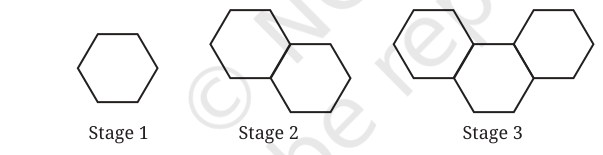
Growing pattern of hexagons made with matchsticks; each new hexagon shares one side with the previous one.
Answer
(i) Stage 1 needs 6 sticks; each new hexagon needs 5 more (one side is shared). Stage 4: 21 sticks; Stage 5: 26 sticks.
Stage | 1 | 2 | 3 | 4 | 5 | … | n |
Matchsticks | 6 | 11 | 16 | 21 | 26 | … | 5n + 1 |
(iii) Rule: 5n + 1
(iv) Stage 15: 5(15) + 1 = 76 matchsticks.
(v) 5n + 1 = 200
⇒ n = 199/5 = 39.8, which is not a whole number. So 200 matchsticks cannot form a stage exactly (stage 39 uses 196 and stage 40 uses 201).
p(x) = ax + b passes through (2, 3) and (6, 11); q(x) = cx + d passes through (4, −1) and is parallel to p(x). Find p(x), q(x) and where they meet the x-axis.
Answer
Slope of p = (11 − 3)/(6 − 2) = 2. p(2) = 4 + b = 3
⇒ b = −1. p(x) = 2x − 1.
q is parallel, so c = 2. q(4) = 8 + d = −1
⇒ d = −9. q(x) = 2x − 9.
x-axis: 2x − 1 = 0
⇒ (1/2, 0); 2x − 9 = 0
⇒ (9/2, 0).
What do all linear functions of the form f(x) = ax + a, a > 0, have in common?
Answer
f(x) = a(x + 1). So:
- They all pass through the point (−1, 0), since f(−1) = 0 for every a.
- They all have a positive slope a, so they all rise from left to right (linear growth).
- For each line, the y-intercept equals the slope (both are a).
Extra Practice Questions
1. Is x² + 1/x a polynomial? No – 1/x = x⁻¹ has a negative power.
2. Find the linear polynomial whose graph passes through (0, −4) and has slope 5. y = 5x − 4.
3. A taxi charges ₹50 plus ₹12 per km. Write the fare for d km and find the fare for 15 km. F = 50 + 12d; F(15) = ₹230.