
Circle of Learning • New NCERT textbook "Ganita Manjari" (2026-27) • Exercise Sets 4.1–4.5, Think and Reflect, End-of-Chapter Exercises – step-by-step solutions (all answers checked algebraically)
Think and Reflect (Patterns)
Find other patterns like "smallest + largest − 2 × middle of three consecutive squares = 2". For example, consider 4 consecutive squares.
For four consecutive squares n², (n + 1)², (n + 2)², (n + 3)²: (first + last) − (two middle ones) is always 4.
Check: 1 + 16 − 4 − 9 = 4; 4 + 25 − 9 − 16 = 4.
Proof: n² + (n + 3)² − (n + 1)² − (n + 2)² = (2n² + 6n + 9) − (2n² + 6n + 5) = 4.
Think and Reflect ((a + b)² versus a² + b²)
Since (a + b)² = a² + b² + 2ab, the term 2ab decides which is larger.
1. (a + b)² < a² + b² when ab < 0, i.e. a and b have opposite signs (e.g. a = 3, b = −2: 1 < 13).
2. (a + b)² > a² + b² when ab > 0, i.e. a and b have the same sign and neither is zero.
3. They are equal when ab = 0, i.e. a = 0 or b = 0.
Exercise Set 4.1
Answer
Using (a + b)² = a² + 2ab + b², expand
(i) (7x + 4y)² = 49x² + 2(7x)(4y) + 16y² = 49x² + 56xy + 16y²
(ii) (7x/5 + 3y/2)² = 49x²/25 + 2(7x/5)(3y/2) + 9y²/4 = 49x²/25 + 21xy/5 + 9y²/4
(iii) (2.5p + 1.5q)² = 6.25p² + 2(2.5p)(1.5q) + 2.25q² = 6.25p² + 7.5pq + 2.25q²
(iv) (3s/4 + 8t)² = 9s²/16 + 2(3s/4)(8t) + 64t² = 9s²/16 + 12st + 64t²
(v) (x + 1/(2y))² = x² + 2(x)(1/(2y)) + 1/(4y²) = x² + x/y + 1/(4y²)
(vi) (1/x + 1/y)² = 1/x² + 2/(xy) + 1/y²
Answer
Find: (i) 64² (ii) 105² (iii) 205²
(i) (60 + 4)² = 3600 + 480 + 16 = 4096
(ii) (100 + 5)² = 10000 + 1000 + 25 = 11025
(iii) (200 + 5)² = 40000 + 2000 + 25 = 42025
Exercise Set 4.2
Answer
Factor completely
(i) 9x² + 24xy + 16y² = (3x)² + 2(3x)(4y) + (4y)² = (3x + 4y)²
(ii) 4s² + 20st + 25t² = (2s)² + 2(2s)(5t) + (5t)² = (2s + 5t)²
(iii) 49x² + 28xy + 4y² = (7x)² + 2(7x)(2y) + (2y)² = (7x + 2y)²
(iv) 64p² + (32/3)pq + (4/9)q² = (8p)² + 2(8p)(2q/3) + (2q/3)² = (8p + 2q/3)² [= (4/9)(12p + q)²]
*(v) 3a² + 4ab + (4/3)b² = (1/3)(9a² + 12ab + 4b²) = (1/3)(3a + 2b)²
*(vi) (9/5)s² + 6sv + 5v² = (1/5)(9s² + 30sv + 25v²) = (1/5)(3s + 5v)²
(As the hint suggests, in (v) and (vi) we take out a common factor – here 1/3 and 1/5 – to get a perfect square inside.)
Using (a − b)² = a² − 2ab + b², find: (i) 79² (ii) 193² (iii) 299²
(i) (80 − 1)² = 6400 − 160 + 1 = 6241
(ii) (200 − 7)² = 40000 − 2800 + 49 = 37249
(iii) (300 − 1)² = 90000 − 600 + 1 = 89401
Answer
Think and Reflect (Fig. 4.4)
Label the squares and rectangles in Fig. 4.4 to represent (a + b + c)² = a² + b² + c² + 2ab + 2bc + 2ca.
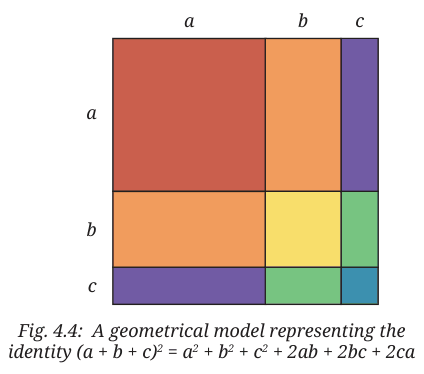
In the 3 × 3 grid (sides a, b, c along both edges): the three squares on the diagonal are a² (top-left), b² (middle) and c² (bottom-right). The two orange rectangles are ab each, the two purple rectangles are ac each and the two green rectangles are bc each. Total = a² + b² + c² + 2ab + 2bc + 2ca.
Exercise Set 4.3
Find the squares using a suitable identity: (i) 117² (ii) 78² (iii) 198² (iv) 214² (v) 1104² (vi) 1120²
(i) (100 + 10 + 7)² = 10000 + 100 + 49 + 2000 + 1400 + 140 = 13689 [(a + b + c)²]
(ii) (80 − 2)² = 6400 − 320 + 4 = 6084 [(a − b)²]
(iii) (200 − 2)² = 40000 − 800 + 4 = 39204 [(a − b)²]
(iv) (200 + 10 + 4)² = 40000 + 100 + 16 + 4000 + 1600 + 80 = 45796 [(a + b + c)²]
(v) (1100 + 4)² = 1210000 + 8800 + 16 = 1218816 [(a + b)²]
(vi) (1100 + 20)² = 1210000 + 44000 + 400 = 1254400 [(a + b)²]
Answer
Answer
Factor using suitable identities
(i) 16y² − 24y + 9 = (4y)² − 2(4y)(3) + 3² = (4y − 3)²
(ii) (9/4)s² + 6st + 4t² = (3s/2)² + 2(3s/2)(2t) + (2t)² = (3s/2 + 2t)²
(iii) m²/9 + mk/3 + k²/4 + 3nk + 2mn + 9n² = (m/3)² + (k/2)² + (3n)² + 2(m/3)(k/2) + 2(k/2)(3n) + 2(3n)(m/3) = (m/3 + k/2 + 3n)²
(iv) p²/16 − 2 + 16/p² = (p/4)² − 2(p/4)(4/p) + (4/p)² = (p/4 − 4/p)²
(v) 9a² + 4b² + c² − 12ab + 6ac − 4bc = (3a)² + (−2b)² + c² + 2(3a)(−2b) + 2(−2b)(c) + 2(c)(3a) = (3a − 2b + c)²
Expand using (a + b + c)²: (i) (p + 3q + 7r)² (ii) (3x − 2y + 4z)²
(i) p² + 9q² + 49r² + 2(p)(3q) + 2(3q)(7r) + 2(7r)(p) = p² + 9q² + 49r² + 6pq + 42qr + 14pr
(ii) 9x² + 4y² + 16z² + 2(3x)(−2y) + 2(−2y)(4z) + 2(4z)(3x) = 9x² + 4y² + 16z² − 12xy − 16yz + 24xz
Answer
Is this an identity? (a + b − c)² + (a − b + c)² + (a − b − c)² = 2a² + 2b² + 2c²
Answer
Expanding the LHS:
(a + b − c)² = a² + b² + c² + 2ab − 2bc − 2ca
(a − b + c)² = a² + b² + c² − 2ab − 2bc + 2ca
(a − b − c)² = a² + b² + c² − 2ab + 2bc − 2ca
Sum = 3a² + 3b² + 3c² − 2ab − 2bc − 2ca
This is not equal to 2a² + 2b² + 2c² for all values. E.g. a = b = c = 1: LHS = 1 + 1 + 1 = 3, RHS = 6. So it is not an identity.
(Note: with the fourth square (a + b + c)² added, the true identity is (a + b + c)² + (a + b − c)² + (a − b + c)² + (a − b − c)² = 4a² + 4b² + 4c² – see the next Think and Reflect.)
Think and Reflect (Śhrīdharāchārya's Identity)
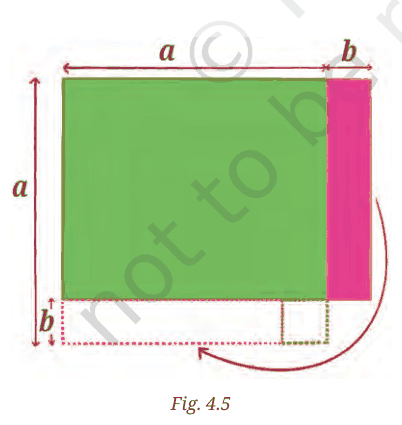
Justify a² = (a + b)(a − b) + b² from Fig. 4.5. Cut the strip of width b (and length a − b) from the right of the a × a square and move it to the bottom. The rectangle formed is (a + b) by (a − b); the square left over at the corner is b × b. So a² = (a + b)(a − b) + b².
Evaluate (i) 35² (ii) 65² (iii) 85² (iv) 105². Do you see a pattern?
Answer
(i) 35² = 40 × 30 + 25 = 1225 (ii) 65² = 70 × 60 + 25 = 4225 (iii) 85² = 90 × 80 + 25 = 7225 (iv) 105² = 110 × 100 + 25 = 11025
Pattern: for a number ending in 5, write n(n + 1) followed by 25, where n is the number formed by the digits before 5. E.g. 35²: 3 × 4 = 12
⇒ 1225.
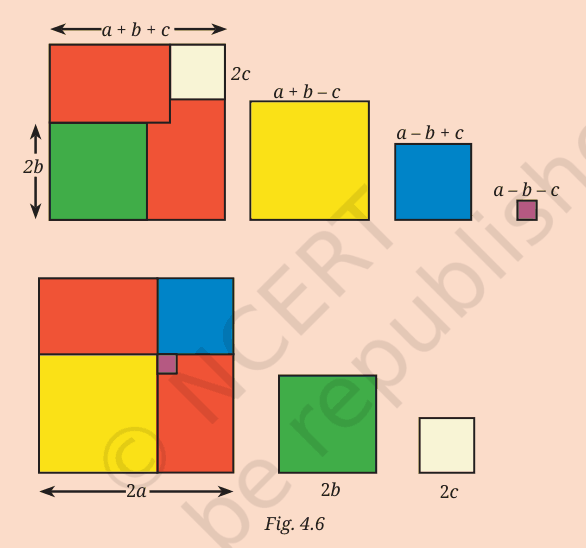
Identify the identity in Fig. 4.6.
Answer
The four squares of sides (a + b + c), (a + b − c), (a − b + c) and (a − b − c) together have the same area as the three squares of sides 2a, 2b and 2c:
(a + b + c)² + (a + b − c)² + (a − b + c)² + (a − b − c)² = (2a)² + (2b)² + (2c)² = 4a² + 4b² + 4c²
Think and Reflect (Algebra Tiles)
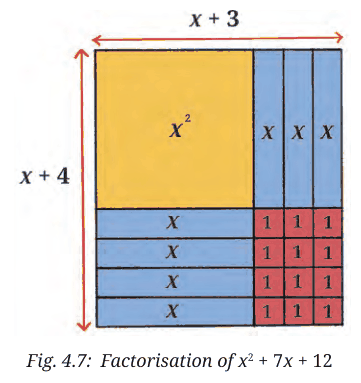
Suppose 7x in x² + 7x + 12 is split as 2x + 5x; can a rectangle be formed?
Answer
No. A rectangle (x + a)(x + b) needs a + b = 7 and ab = 12. With 2 and 5, ab = 10 ≠ 12, so the 12 unit tiles cannot fill the corner. Only the split 3x + 4x works (3 × 4 = 12).
1. Product of x + 2 and x + 3 using algebra tiles: one x² tile, 5 x-tiles and 6 unit tiles: x² + 5x + 6.
2. Lay out x² + 11x + 30: one x² tile, 11 x-tiles split as 5 along one side and 6 along the other, and 30 unit tiles in a 5 × 6 block – the rectangle has sides (x + 5) and (x + 6).
Generalise (x + a)(x + b): x² + (a + b)x + ab.
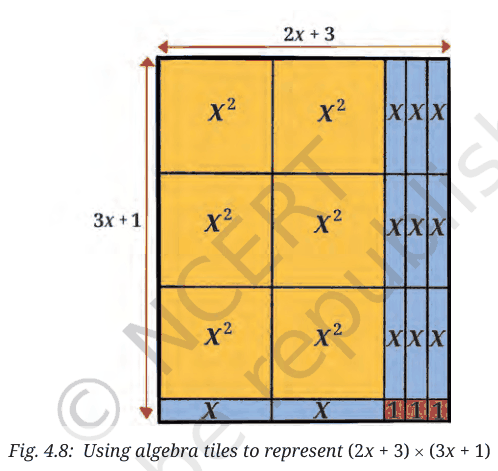
(px + a)(qx + b) = (pq)x² + (pb + qa)x + ab. Check with the distributive property: px·qx + px·b + a·qx + ab = pqx² + (pb + aq)x + ab ✓. For Fig. 4.8: (2x + 3)(3x + 1) = 6x² + 11x + 3.
Exercise Set 4.4
Answer
Fill in the blanks
(i) s² − 11s + 24 = (s − 3)(s − 8)
(ii) (3x − 7)(x + 1) = 3x² − 4x − 7
(iii) 10x² − 11x − 6 = (2x − 3)(5x + 2)
(iv) 6x² + 7x + 2 = (2x + 1)(3x + 2)
Use suitable identities: (i) 41² (ii) 27² (iii) 23 × 17 (iv) 135² (v) 97² (vi) 18 × 29 (vii) 34 × 43 (viii) 205²
(i) (40 + 1)² = 1600 + 80 + 1 = 1681
(ii) (30 − 3)² = 900 − 180 + 9 = 729
(iii) (20 + 3)(20 − 3) = 400 − 9 = 391
(iv) (100 + 30 + 5)² = 10000 + 900 + 25 + 6000 + 1000 + 300 = 18225 (or 13 × 14 = 182 → 18225)
(v) (100 − 3)² = 10000 − 600 + 9 = 9409
(vi) (20 − 2)(20 + 9) = 400 + 7(20) − 18 = 522 [(x + a)(x + b)]
Answer
(vii) (40 − 6)(40 + 3) = 1600 − 3(40) − 18 = 1462
(viii) (200 + 5)² = 42025
Answer
Factor
(i) 9a² + b² + 4c² − 6ab + 12ac − 4bc = (3a)² + (−b)² + (2c)² + 2(3a)(−b) + 2(−b)(2c) + 2(2c)(3a) = (3a − b + 2c)²
(ii) 16s² + 25t² − 40st = (4s − 5t)²
(iii) r² − r − 42: numbers with product −42 and sum −1 are −7 and 6 ⇒ (r − 7)(r + 6)
(iv) 49g² + 14gh + h² = (7g + h)²
(v) 64u² + 121v² + 4w² − 176uv − 32uw + 44vw = (8u)² + (−11v)² + (−2w)² + 2(8u)(−11v) + 2(−11v)(−2w) + 2(−2w)(8u) = (8u − 11v − 2w)²
Think and Reflect (James and Reshma)
Who is correct? Both are correct – they just use different identities first, and both reach the same product:
James: (a² − 2ab + b²)(a + b) = a³ + a²b − 2a²b − 2ab² + ab² + b³ = a³ − a²b − ab² + b³
Reshma: (a − b)(a² − b²) = a³ − ab² − a²b + b³ – the same.
New results from combining identities: e.g. (a + b)²(a − b)² = [(a + b)(a − b)]² = (a² − b²)² = a⁴ − 2a²b² + b⁴.
Think and Reflect (Cube Identities)
Predict (x + y)(x² − xy + y²). It equals x³ + y³.
Is x − y a factor of x⁴ − y⁴? Of x⁵ − y⁵?
x⁴ − y⁴ = (x² − y²)(x² + y²) = (x − y)(x + y)(x² + y²) – yes.
x⁵ − y⁵ = (x − y)(x⁴ + x³y + x²y² + xy³ + y⁴) – yes. In fact x − y is a factor of xⁿ − yⁿ for every natural number n.
Think and Reflect (Rational Expressions)
Simplify (36s² − 12st + t²)/(t² + 2ts − 48s²).
Numerator = (6s − t)². Denominator: t² + 2ts − 48s² = (t + 8s)(t − 6s).
So the expression = (6s − t)²/[(t + 8s)(t − 6s)] = (6s − t)²/[−(t + 8s)(6s − t)] = (t − 6s)/(t + 8s).
Exercise Set 4.5
Answer
Simplify (denominators assumed non-zero)
(i) (3p² − 3pq − 18q²)/(p² + 3pq − 10q²) = 3(p − 3q)(p + 2q)/[(p + 5q)(p − 2q)] = 3(p − 3q)(p + 2q)/((p + 5q)(p − 2q)) – no common factor cancels.
(ii) (n³ − 3n²m + 3nm² − m³)/(5m² − 10mn + 5n²) = (n − m)³/[5(n − m)²] = (n − m)/5
(iii) (w³ − v³ + x³ + 3wvx)/(w² + v² + x² − 2wv − 2vx + 2wx)
Numerator = w³ + (−v)³ + x³ − 3(w)(−v)(x) = (w − v + x)(w² + v² + x² + wv + vx − wx).
Denominator = (w − v + x)².
Result: (w² + v² + x² + wv + vx − wx)/(w − v + x)
(iv) (4y² − 20yz + 25z²)/(25z² − 4y²) = (2y − 5z)²/[(5z − 2y)(5z + 2y)] = (5z − 2y)/(5z + 2y)
(v) [(x² + x − 6)(x² − 7x + 12)]/[(x² − 6x + 8)(x² − 9)] = [(x + 3)(x − 2)(x − 3)(x − 4)]/[(x − 2)(x − 4)(x − 3)(x + 3)] = 1
(vi) (p⁴ − 16)/(p² − 4p + 4) = (p² + 4)(p + 2)(p − 2)/(p − 2)² = (p² + 4)(p + 2)/(p − 2)
Examples 17–18 (for practice)
Saira's rectangle (x² + 8x + 15): length x + 5, breadth x + 3. Pool: length 12 m, breadth 8 m.
End-of-Chapter Exercises
Answer
Use suitable identities to find the products
(i) (−3x + 4)² = 9x² − 24x + 16
(ii) (2s + 7)(2s − 7) = 4s² − 49
(iii) (p² + 1/2)(p² − 1/2) = p⁴ − 1/4
(iv) (2n + 7)(2n − 7) = 4n² − 49
(v) (s − 2t)(s² + 2st + 4t²) = s³ − (2t)³ = s³ − 8t³
(vi) (1/(2r) − 4r)² = 1/(4r²) − 2(1/(2r))(4r) + 16r² = 1/(4r²) − 4 + 16r²
(vii) (−3m + 4k − l)² = 9m² + 16k² + l² − 24mk − 8kl + 6lm
(viii) (x − y/3)³ = x³ − 3x²(y/3) + 3x(y/3)² − (y/3)³ = x³ − x²y + xy²/3 − y³/27
(ix) (7k/2 − 2m/3)³ = 343k³/8 − 3(49k²/4)(2m/3) + 3(7k/2)(4m²/9) − 8m³/27 = 343k³/8 − 49k²m/2 + 14km²/3 − 8m³/27
Answer
Find the values using suitable identities
(i) 17 × 21 = (19 − 2)(19 + 2) = 361 − 4 = 357
(ii) 104 × 96 = (100 + 4)(100 − 4) = 10000 − 16 = 9984
(iii) 24 × 16 = (20 + 4)(20 − 4) = 400 − 16 = 384
(iv) 147³ = (150 − 3)³ = 3375000 − 3(22500)(3) + 3(150)(9) − 27 = 3375000 − 202500 + 4050 − 27 = 3176523
(v) 199³ = (200 − 1)³ = 8000000 − 120000 + 600 − 1 = 7880599
(vi) 127³ = (130 − 3)³ = 2197000 − 152100 + 3510 − 27 = 2048383
(vii) (−107)³ = −(100 + 7)³ = −(1000000 + 210000 + 14700 + 343) = −1225043
(viii) (−299)³ = −(300 − 1)³ = −(27000000 − 270000 + 900 − 1) = −26730899
Answer
Factor
(i) 4y² + 1 + 1/(16y²) = (2y)² + 2(2y)(1/(4y)) + (1/(4y))² = (2y + 1/(4y))²
(ii) 9m² − 1/(25n²) = (3m − 1/(5n))(3m + 1/(5n))
(iii) 27b³ − 1/(64b³) = (3b)³ − (1/(4b))³ = (3b − 1/(4b))(9b² + 3/4 + 1/(16b²))
(iv) x² + 5x/6 + 1/6: numbers with sum 5/6 and product 1/6 are 1/2 and 1/3 ⇒ (x + 1/2)(x + 1/3) [= (2x + 1)(3x + 1)/6]
(v) 27u³ − 1/125 − 27u²/5 + 9u/25 = (3u)³ − 3(3u)²(1/5) + 3(3u)(1/5)² − (1/5)³ = (3u − 1/5)³
(vi) 64y³ + z³/125 = (4y)³ + (z/5)³ = (4y + z/5)(16y² − 4yz/5 + z²/25)
(vii) p³ + 27q³ + r³ − 9pqr = p³ + (3q)³ + r³ − 3(p)(3q)(r) = (p + 3q + r)(p² + 9q² + r² − 3pq − 3qr − pr)
(viii) 9m² − 12m + 4 = (3m − 2)²
(ix) 9x³ − 8y³/3 + z³/3 + 6xyz = (1/3)[(3x)³ + (−2y)³ + z³ − 3(3x)(−2y)(z)] = (1/3)(3x − 2y + z)(9x² + 4y² + z² + 6xy + 2yz − 3xz)
(x) 4x² + 9y² + 36z² + 12xz + 36yz + 24xy: compare with (2x + 3y + 6z)² = 4x² + 9y² + 36z² + 12xy + 36yz + 24xz. As printed (12xz and 24xy) the expression is not a perfect square and does not factor nicely – it appears to be a misprint. With the terms 12xy + 24xz, the answer is (2x + 3y + 6z)².
(xi) 27u³ − 1/216 − 9u²/2 + u/4 = (3u)³ − 3(3u)²(1/6) + 3(3u)(1/6)² − (1/6)³ = (3u − 1/6)³
Answer
Simplify
(i) (4x² + 4x + 1)/(4x² − 1) = (2x + 1)²/[(2x + 1)(2x − 1)] = (2x + 1)/(2x − 1)
(ii) 9(3a³ − 24b³)/(9a² − 36b²) = 27(a³ − 8b³)/[9(a² − 4b²)] = 3(a − 2b)(a² + 2ab + 4b²)/[(a − 2b)(a + 2b)] = 3(a² + 2ab + 4b²)/(a + 2b)
(iii) (s³ + 125t³)/(s² − 2st − 35t²) = (s + 5t)(s² − 5st + 25t²)/[(s − 7t)(s + 5t)] = (s² − 5st + 25t²)/(s − 7t)
Find possible length and breadth of rectangles with area: (i) 25a² − 30ab + 9b² (ii) 36s² − 49t²
(i) (5a − 3b)² ⇒ length = breadth = 5a − 3b (a square).
(ii) (6s − 7t)(6s + 7t) ⇒ length 6s + 7t, breadth 6s − 7t.
Answer
Find possible length, breadth and height of cuboids with volume: (i) 6a² − 24b² (ii) 3ps² − 15ps + 12p
(i) 6(a² − 4b²) = 6(a − 2b)(a + 2b) ⇒ 6, (a − 2b), (a + 2b) (or 2, 3(a − 2b), a + 2b, etc.).
(ii) 3p(s² − 5s + 4) = 3p(s − 1)(s − 4) ⇒ 3p, (s − 1), (s − 4).
Answer
A square playground of side 40 m has a path of width s m around it. Find the area of the path.
Answer
Outer square side = 40 + 2s. Area of path = (40 + 2s)² − 40² = 1600 + 160s + 4s² − 1600 = 4s² + 160s m² = 4s(s + 40) m².
If a number plus its reciprocal equals 10/3, find the number.
Answer
x + 1/x = 10/3
⇒ 3x² − 10x + 3 = 0
⇒ (3x − 1)(x − 3) = 0
⇒ x = 3 or x = 1/3.
A pool has area 2x² + 7x + 3 square hastas and width 2x + 1 hastas. Find its length.
Answer
2x² + 7x + 3 = (2x + 1)(x + 3). Length = x + 3 hastas.
If x − 2 and x − 1/2 are factors of px² + 5x + r, show that p = r.
Answer
If x − 2 is a factor, the expression is 0 at x = 2: 4p + 10 + r = 0 … (1)
If x − 1/2 is a factor, it is 0 at x = 1/2: p/4 + 5/2 + r = 0
⇒ p + 10 + 4r = 0 … (2)
(1) − (2): 3p − 3r = 0
⇒ p = r. (In fact p = r = −2.)
If a + b + c = 5 and ab + bc + ca = 10, prove a³ + b³ + c³ − 3abc = −25.
Answer
a² + b² + c² = (a + b + c)² − 2(ab + bc + ca) = 25 − 20 = 5.
a³ + b³ + c³ − 3abc = (a + b + c)(a² + b² + c² − ab − bc − ca) = 5 × (5 − 10) = −25. Proved.
By factoring, show that n³ − n is divisible by 6 for all natural numbers n.
Answer
n³ − n = n(n² − 1) = (n − 1) n (n + 1) – a product of three consecutive integers.
Among any two consecutive integers one is even, so the product is divisible by 2. Among any three consecutive integers one is a multiple of 3, so it is divisible by 3. Since 2 and 3 are co-prime, the product is divisible by 2 × 3 = 6.
Find the value of (i) x³ + y³ − 12xy + 64 when x + y = −4 (ii) x³ − 8y³ − 36xy − 216 when x = 2y + 6
Answer
Use: if a + b + c = 0, then a³ + b³ + c³ = 3abc.
(i) Take a = x, b = y, c = 4. Then a + b + c = x + y + 4 = 0, so x³ + y³ + 64 = 3(x)(y)(4) = 12xy. Hence x³ + y³ − 12xy + 64 = 0.
(ii) Take a = x, b = −2y, c = −6. Then a + b + c = x − 2y − 6 = 0, so x³ − 8y³ − 216 = 3(x)(−2y)(−6) = 36xy. Hence x³ − 8y³ − 36xy − 216 = 0.
Extra Practice Questions
1. Factor x² − 5x − 14. (x − 7)(x + 2)
2. Find 103 × 97 using an identity. (100 + 3)(100 − 3) = 10000 − 9 = 9991
3. If x + 1/x = 4, find x² + 1/x². (x + 1/x)² − 2 = 16 − 2 = 14