
Circle of Learning • New NCERT textbook "Ganita Manjari" Part II (2026-27) • Think and Reflect, Exercise Sets 12.1–12.4, End-of-Chapter Exercises – step-by-step solutions and proofs
Think and Reflect
1. Can any quadrilateral tile the plane? Yes – every quadrilateral, even a non-convex one, can tile the plane. Rotate copies by 180° about the midpoints of the edges; at each vertex the four different angles meet once and add up to 360°. (Shown in Section 12.4.) Squares, rectangles and parallelograms tile in an obvious grid.
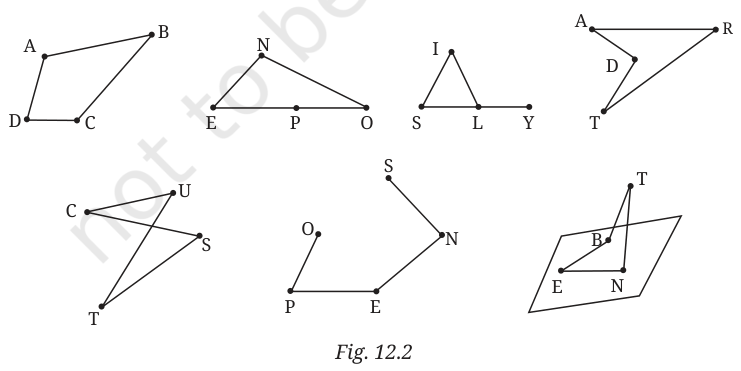
Which figures in Fig. 12.2 should be called quadrilaterals?
Answer
• ABCD – yes, an ordinary quadrilateral.
• NOPE – no: three vertices are collinear, so two "sides" lie along one line and the figure is really a triangle.
• SILY – no: three vertices are collinear and two sides overlap.
• DART – yes, but non-convex (it has a dent; one internal angle is more than 180°).
• CUTS – a self-intersecting quadrilateral; two sides cross, so ordinarily it is not counted as a quadrilateral.
• OPENS – no: a point that is not a vertex lies on two sides, so the sides touch.
• BENT – non-planar: its four vertices are not in one plane.
A precise definition (Definition 1) rules out the unwanted cases: the four points are in one plane, and every point of the four segments other than A, B, C, D lies on exactly one segment.
3. Adjacent angles. If opposite angles are equal (∠A = ∠C, ∠B = ∠D), then 2(∠A + ∠B) = 360°, so every pair of adjacent angles adds up to 180°. The converse is also true: if each pair of adjacent angles adds up to 180°, then ∠A + ∠B = 180° = ∠B + ∠C gives ∠A = ∠C, and similarly ∠B = ∠D.
So Theorem 3 can be stated: "If each pair of adjacent angles in a quadrilateral ABCD adds up to 180°, then ABCD is a parallelogram."
4. A line through the midpoint of one side, parallel to another side: guess – it bisects the third side (Theorem 7).
5. Another proof of the Centroid Theorem (Fig. 12.20). Let medians CP and BQ meet at M. Extend AM beyond M to S so that MS = AM (M is the midpoint of AS).
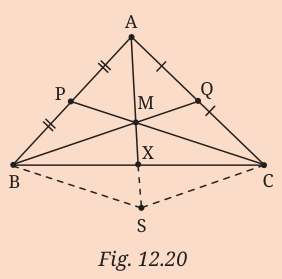
In ΔABS, P and M are midpoints of AB and AS, so PM ∥ BS. Since P, M, C are collinear, MC ∥ BS.
In ΔACS, Q and M are midpoints of AC and AS, so QM ∥ CS, i.e. MB ∥ CS.
So BSCM is a parallelogram, and its diagonals MS and BC bisect each other at X. Thus X is the midpoint of BC, so line AM is the third median – all three medians pass through M. Also MX = ½MS = ½AM, so AM : MX = 2 : 1.
Exercise Set 12.1
(i) Sides adjacent to AB: BC and DA. Side opposite to AB: CD.
(ii) Angles adjacent to ∠A: ∠B and ∠D. Angle opposite to ∠A: ∠C.
(iii) Opposite sides: two sides with no common endpoint (vertex). Opposite angles: angles at two vertices that are not joined by a side, i.e. not endpoints of a common side.
Answer
Question 2*
Precise definition of the internal angle at vertex A of quadrilateral ABCD (neighbours B and D, opposite vertex C):
Let ∠BAD be the ordinary angle (less than 180°) between rays AB and AD.
• If A does not lie inside triangle BCD (formed by the other three vertices), the internal angle at A is ∠BAD.
• If A lies inside triangle BCD, then A is a "dent", and the internal angle at A is the reflex angle 360° − ∠BAD.
Check with DART: D lies inside triangle ART, so its internal angle is reflex; A, R, T do not lie inside the triangle of the other three, so their internal angles are ordinary.
(a) AB ∥ DC: ABCD cannot be non-convex. AD is a transversal of the parallel lines AB and DC, and the quadrilateral lies between them, so ∠A + ∠D = 180° (co-interior angles). Similarly ∠B + ∠C = 180°. So every angle is less than 180°: ABCD is convex. (This is why the diagonals intersect in Theorem 5.)
Answer
(b) AB = CD: it can be non-convex. Example: A(0, 0), B(4, 0), C(1, 1), D(1, 5). Here AB = 4 = CD, and C lies inside triangle ABD, so ABCD has a dent at C.
(c) ∠A = ∠C: it can be non-convex. Example: a dart (arrowhead) symmetric about diagonal BD, with tip B and dent D. The two "wing" vertices A and C have equal angles (by symmetry), but the internal angle at D is more than 180°. (∠A and ∠C cannot both be reflex, since their sum would exceed 360°.)
The lines AB, BC, CA divide the plane into 7 regions. For D in each region:
Answer
Where D is | ABCD is |
Inside triangle ABC | Non-convex (dent at D) |
Beyond side AC (opposite B) | Convex |
Beyond side AB (opposite C) | Self-intersecting (CD crosses AB) |
Beyond side BC (opposite A) | Self-intersecting (DA crosses BC) |
Beyond vertex A (region opposite the triangle at A) | Non-convex (dent at A, which lies inside ΔBCD) |
Beyond vertex B | Non-convex (dent at B, inside ΔACD) |
Beyond vertex C | Non-convex (dent at C, inside ΔABD) |
So 1 region gives convex, 2 give self-intersecting and 4 give non-convex quadrilaterals.
No. If two sides cross at a point E, the two lines through those sides intersect, and two intersecting lines lie in one plane. Those two sides contain all four vertices, so all four vertices are in one plane – the quadrilateral is planar. Hence a self-intersecting quadrilateral is always planar.
Answer
Exercise Set 12.2
(i) True. Adjacent angles of a parallelogram add to 180° and opposite angles are equal, so one 90° angle makes all four 90°.
(ii) False. Every rhombus has perpendicular diagonals, e.g. a rhombus with angles 60° and 120°, which is not a square.
(iii) True. In parallelogram ABCD with AC = BD: ΔABC ≅ ΔBAD (SSS: AB common, BC = AD, AC = BD), so ∠B = ∠A. Since ∠A + ∠B = 180°, each is 90°. So it is a rectangle.
Answer
Given ∠DAC = ∠CAB. Since AB ∥ DC, ∠CAB = ∠ACD (alternate angles). Since AD ∥ BC, ∠DAC = ∠ACB (alternate angles). Hence ∠ACD = ∠ACB, so AC bisects ∠C.
Answer
Also ∠DAC = ∠CAB = ∠ACD, so in ΔADC, ∠DAC = ∠DCA, giving DA = DC. Opposite sides of a parallelogram are equal, so AB = DC = DA = BC: ABCD is a rhombus.
(i) Yes. ΔABC and ΔADC have AC common, ∠BAC = ∠DAC and ∠BCA = ∠DCA, so they are congruent (ASA): AB = AD and CB = CD. Using diagonal BD in the same way: BA = BC and DA = DC. So all four sides are equal – a rhombus.
Answer
(ii) Yes. Diagonals bisecting each other make ABCD a parallelogram (Theorem 4). If they meet at E at right angles, then ΔAEB ≅ ΔCEB (SAS: AE = CE, right angles, EB common), so AB = CB. A parallelogram with two adjacent sides equal is a rhombus.
(iii) No. An isosceles trapezium, or a kite drawn with equal diagonals, has equal diagonals but is not a rectangle. Extra condition: the diagonals also bisect each other (so ABCD is a parallelogram); then by 1(iii) it is a rectangle.
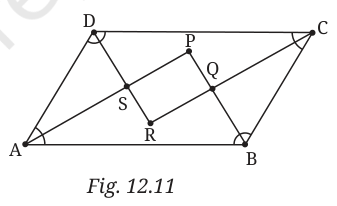
In parallelogram ABCD, ∠A + ∠B = 180°, so ½∠A + ½∠B = 90°. In the triangle formed by AB and the bisectors of ∠A and ∠B, the third angle, at their meeting point, is 180° − 90° = 90°. The same holds for every pair of adjacent angles (B and C, C and D, D and A). So the quadrilateral PQRS formed by the four intersection points has all four angles equal to 90°: it is a rectangle.
Answer
Why AB ≠ BC? If AB = BC, the parallelogram is a rhombus. Its angle bisectors are its diagonals, and all four meet at a single point (the centre), so no rectangle is formed.
Exercise Set 12.3
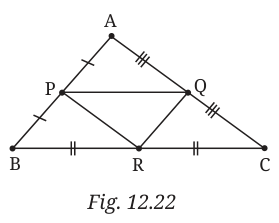
(i) By the Midpoint Theorem: PQ = ½BC = BR = RC, QR = ½AB = AP = PB, PR = ½AC = AQ = QC.
Answer
ΔPQR ≅ ΔQPA (SSS: PQ = QP, QR = PA, RP = AQ).
The other two: ΔRBP (QR = PB, PQ = BR, RP common) and ΔCRQ (PQ = RC, RP = CQ, QR common). So ΔPQR ≅ ΔQPA ≅ ΔRBP ≅ ΔCRQ: the four small triangles are congruent.
(ii) Yes. Through each vertex of ΔPQR draw a line parallel to the opposite side: through P parallel to QR, through Q parallel to PR, through R parallel to PQ. These three lines meet in pairs at A, B, C (they are lines AB, AC and BC, by the Midpoint Theorem), giving back ΔABC.
M, N are midpoints of AB, AC, so MN ∥ BC (Midpoint Theorem). Let MN meet AD at X. In ΔABD, MX passes through the midpoint M of AB and is parallel to BD (part of BC). By Theorem 7 (converse of the Midpoint Theorem), X is the midpoint of AD. So MN bisects AD.
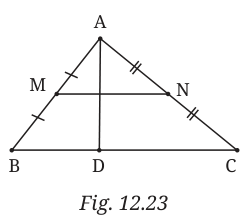
Answer
Let E be the midpoint of AD.
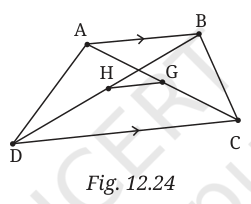
Answer
In ΔDAC: E and G are midpoints of DA and AC, so EG ∥ DC.
In ΔADB: E and H are midpoints of AD and DB, so EH ∥ AB.
Since AB ∥ DC, both EG and EH are lines through E parallel to AB. There is only one such line, so E, G, H are collinear and GH ∥ AB (∥ DC).
Why AB ≠ CD? If AB = CD (with AB ∥ DC), ABCD is a parallelogram, its diagonals bisect each other, and G = H – there is no segment GH.
(i) By Theorem 9, PQRS is a parallelogram. PR and QS are its diagonals, and the diagonals of a parallelogram bisect each other.
(ii) By the Midpoint Theorem, PQ = ½AC and QR = ½BD. If AC = BD, then PQ = QR, so the parallelogram PQRS is a rhombus, and the diagonals of a rhombus are perpendicular: PR ⊥ QS.
Answer
Converse: true. If PR ⊥ QS, the parallelogram PQRS has perpendicular diagonals, so it is a rhombus (12.2 Q3(ii)). Then PQ = QR, i.e. ½AC = ½BD, so AC = BD.
(i) Reconstruction: Copy the position of A relative to PQRS (e.g. copy ΔSAP onto S and P, so that A′S = AS and A′P = AP, on the same side). Then:
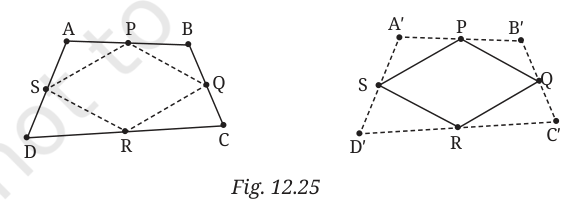
Answer
• extend A′P beyond P to B′ with PB′ = PA′ (P is the midpoint of A′B′);
• extend B′Q beyond Q to C′ with QC′ = QB′;
• extend C′R beyond R to D′ with RD′ = RC′.
Then A′B′C′D′ is the required copy, and S turns out to be the midpoint of D′A′.
(ii) Why it works: each step is a half-turn (rotation through 180°) about a midpoint. A half-turn about P followed by one about Q moves every point by twice the vector PQ; then half-turns about R and S move it by twice the vector RS. In the parallelogram PQRS the vectors PQ and RS are equal and opposite, so the four half-turns bring A′ back exactly onto itself. Hence S is the midpoint of D′A′ (S, A′, D′ are collinear). Because A′ was placed exactly as A is relative to PQRS, each later vertex lands where B, C, D are (e.g. ΔPAQ-type triangles are congruent at every step, as in ΔSDR ≅ ΔSD′R), so A′B′C′D′ ≅ ABCD.
(iii) If PQRS is a square: PQ = QR
⇒ ½AC = ½BD
⇒ AC = BD. Also PQ ∥ AC and QR ∥ BD, and PQ ⊥ QR, so AC ⊥ BD.
Converse: If AC = BD and AC ⊥ BD, then PQ = QR (rhombus) and PQ ⊥ QR (a right angle), so PQRS is a square.
Exercise Set 12.4
Each interior angle of a regular pentagon is (5 − 2) × 180°/5 = 108°. At any vertex of a tiling, the angles meeting there must add up to exactly 360°. With 108° angles: 3 × 10⁸° = 324° leaves a gap, and 4 × 10⁸° = 432° overlaps. 360 is not a multiple of 108. (If a vertex lay on the side of another pentagon, the angles there would have to add to 180°, also impossible.) Hence regular pentagons cannot tile the plane.
Answer
Draw any dart (non-convex 4-gon) DART. Method 1: rotate a copy by 180° about the midpoint of each edge, and keep doing this for every new copy. Around each vertex the four angles of DART (one reflex) meet once and add to 360°, so copies fit without gaps. Method 2: draw the grid of Varignon parallelograms of DART and place copies of DART on alternate parallelograms; the gaps are again copies of DART. Either works; Method 1 (half-turns about midpoints) is usually easier to carry out by hand. (Personal preference.)
Answer
End-of-Chapter Exercises
Take any triangle and a copy rotated 180° about the midpoint of one side. Together they form a parallelogram (opposite sides equal – Theorem 2). Copies of this parallelogram tile the plane like a slanted grid (as in the introduction). Cutting every parallelogram along that diagonal gives a tiling by copies of the triangle.
Answer
The drawn line starts on one ruled line and ends on another ruled line four spaces higher. Its midpoint is where it crosses the ruled line exactly in the middle, two spaces from each end.
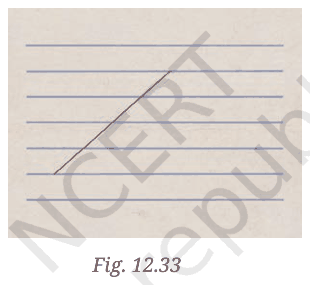
Answer
Justification: Equally spaced parallel lines cut equal pieces on any transversal. Join the ends to form triangles or trapezia: by the converse of the Midpoint Theorem (and End-of-Chapter Q7(i)), a line parallel to the others through the midpoint of one side bisects the other side. So the four pieces of the drawn line between consecutive ruled lines are equal, and the middle ruled line splits it into 2 + 2 equal pieces.
Let AB and CD intersect at E. The angle of the quadrilateral at A is ∠DAB = ∠DAE, at D is ∠ADC = ∠ADE, at B is ∠ABC = ∠EBC and at C is ∠BCD = ∠BCE. So:
Answer
∠A + ∠D = 180° − ∠AED (angles of ΔAED)
∠B + ∠C = 180° − ∠BEC (angles of ΔBEC)
Since ∠AED = ∠BEC (vertically opposite), ∠A + ∠B + ∠C + ∠D = 360° − 2∠AED < 360°.
Sum = 2°: choose ∠AED = 179°. Draw two lines through E meeting at an angle of 1° (so the angle between ray EA and ray ED is 179°). Put A and B on one line and D and C on the other, on opposite sides of E. Then the sum is 360° − 358° = 2°. (The quadrilateral is a very thin "bow-tie".)
Let the diagonals of ABCD meet at O. Then OA = OC and OB = OD. Since DP = BQ: OP = OD − DP = OB − BQ = OQ. So in APCQ the diagonals AC and PQ bisect each other at O, and APCQ is a parallelogram (Theorem 4).
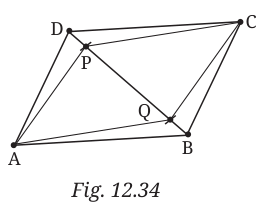
Answer
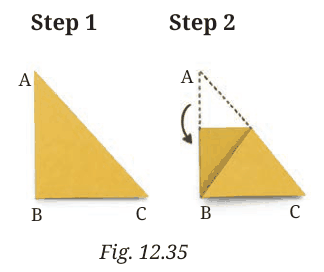
In Fig. 12.35 the right angle is at B (AB ⊥ BC). Folding A onto B makes the crease the perpendicular bisector of AB: it passes through the midpoint M of AB and is perpendicular to AB. Since BC is also perpendicular to AB, the crease is parallel to BC. By Theorem 7, the line through the midpoint M of AB parallel to BC bisects AC. So the crease meets AC at its midpoint (and that part of the crease is half of BC).
Answer
(i) Let medians AP, BQ, CR meet at the centroid M (P, Q, R midpoints of BC, CA, AB). Take ΔMPB and turn it through 180° about P. Then B goes to C (PB = PC) and M goes to M′ with P the midpoint of MM′. The angles at P add up to ∠MPC + ∠MPB = 180°, so M, P, M′ are collinear and ΔMPC together with the turned piece forms the single triangle MCM′.
Answer
Its sides: MM′ = 2MP = AM (centroid: AM = 2MP), CM′ = BM, MC = CM. So it has sides AM, BM, CM, i.e. ⅔ of the three medians.
Doing the same with pairs (MQC, MQA) and (MRA, MRB) gives two more triangles with the same sides AM, BM, CM (2MQ = BM, 2MR = CM). So the 6 pieces make 3 congruent triangles (SSS), each with sides ⅔m_a, ⅔m_b, ⅔m_c (m_a, m_b, m_c are the medians).
(ii)* Repeat with one assembled triangle T, whose sides are x = ⅔m_a, y = ⅔m_b, z = ⅔m_c. Its pieces form triangles with sides equal to ⅔ of T's medians. Using the median-length formula m² = (2(other side)² + 2(other side)² − (own side)²)/4 (it follows from the Baudhāyana–Pythagoras theorem), the median of T to side x is
m_x² = (2y² + 2z² − x²)/4 = (4/9)(2m_b² + 2m_c² − m_a²)/4.
Since m_a² = (2b² + 2c² − a²)/4 etc., 2m_b² + 2m_c² − m_a² = 9a²/4. So m_x² = a²/4, i.e. m_x = a/2. Similarly m_y = b/2, m_z = c/2.
The new triangles have sides ⅔ × a/2 = a/3, b/3, c/3, i.e. AB/3, BC/3, AC/3.
(iii) Cut along median AP: ΔAPC and ΔAPB. Cut ΔAPB along its median PN (N the midpoint of AB). Turn ΔPNB through 180° about N: B goes onto A and P goes to P′, with P, N, P′ in a line. With ΔPNA it forms ΔPAP′ with sides AP, AP′ = BP = PC and PP′ = 2PN = AC (Midpoint Theorem: PN = ½AC). So ΔPAP′ ≅ ΔAPC (SSS). The triangle is cut and reassembled into 2 congruent triangles.
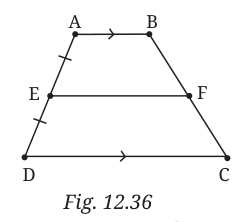
(i) Let EF (∥ AB ∥ DC) meet diagonal AC at G. In ΔADC, E is the midpoint of AD and EG ∥ DC, so G is the midpoint of AC and EG = ½DC (Theorem 7). In ΔCAB, G is the midpoint of CA and GF ∥ AB, so F is the midpoint of CB and GF = ½AB. Hence F is the midpoint of BC and EF = EG + GF = (AB + CD)/2.
Answer
(ii) Way 1 (midpoint M of BD): In ΔABD, E and M are midpoints of AD and BD, so EM ∥ AB. In ΔBCD, M and F are midpoints of BD and BC, so MF ∥ DC ∥ AB. EM and MF are both parallel to AB through M, so they are the same line, and EF ∥ AB.
Way 2: the line through E parallel to AB meets BC at its midpoint (by (i)), which is F. There is only one line through E and F, so EF ∥ AB.
Way 2 is shorter, once (i) is known.
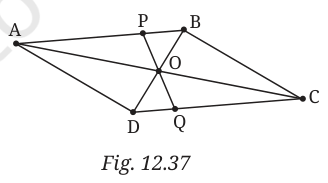
In ΔOAP and ΔOCQ: OA = OC (diagonals bisect each other), ∠OAP = ∠OCQ (alternate angles, AB ∥ DC), ∠AOP = ∠COQ (vertically opposite). By ASA, ΔOAP ≅ ΔOCQ, so OP = OQ: O is the midpoint of PQ. (This is probably the simplest proof. Another: the half-turn about O maps the parallelogram onto itself, sending line AB to line CD and P to Q.)
Answer
Question 9*
By Q7, EF ∥ AD ∥ BC and EF = (3 + 5)/2 = 4 cm. E and F are midpoints, so EF is halfway between AD and BC: each trapezium has height h/2.
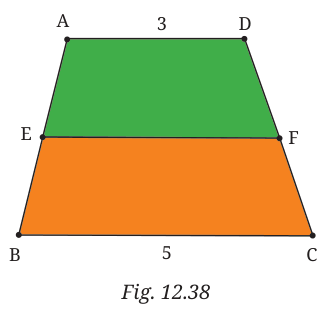
Area(AEFD) = ½(3 + 4)(h/2), Area(EBCF) = ½(4 + 5)(h/2). Ratio = 7 : 9.
(i) Four points can be joined in a closed path in 3 different ways: ABCD, ABDC, ACBD (each quadrilateral can be traced 8 ways, and 4! = 24, so 24/8 = 3).
(ii) Case 1: none of the points lies inside the triangle of the other three (convex position): 1 convex and 2 self-intersecting quadrilaterals.
Answer
Case 2: one point lies inside the triangle of the other three: all 3 quadrilaterals are non-convex (dent at the inner point); 0 self-intersecting, 0 convex.
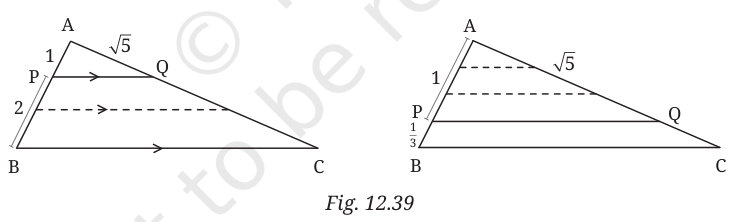
AP = 1, AQ = √5, PQ ∥ BC.
Answer
(i) PB = 2: divide AB into 3 equal parts of length 1 (A–P–X–B) and draw a line through X parallel to BC. Equally spaced parallel lines cut AC into equal parts (by Theorem 7 and Q7(i)), so AC is divided into 3 parts each equal to AQ = √5. Hence QC = 2√5.
(ii) PB = ⅓: divide AP into 3 parts of length ⅓; then AB has 4 equal parts of ⅓. Parallels through the division points cut AC into 4 equal parts, and AQ covers 3 of them, so each part is √5/3. QC = √5/3.
(iii) PB = ⅔: use parts of length ⅓. AP has 3 parts and PB has 2 parts; AC is cut into 5 equal parts, AQ = 3 parts
⇒ each = √5/3. QC = 2√5/3.
(iv) If AP/PB = m/n (whole numbers), divide AB into m + n equal parts (AP has m parts, PB has n parts). Lines through the division points parallel to BC cut AC into m + n equal parts (equally spaced parallels cut equal pieces on any transversal), with m parts in AQ and n parts in QC. Hence AQ/QC = m/n = AP/PB.
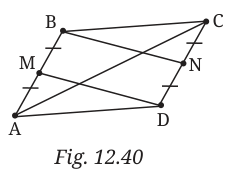
(i) MB = ½AB = ½DC = DN and MB ∥ DN, so MBND is a parallelogram (Theorem 5) and DM ∥ BN. Let DM and BN meet AC at X and Y.
Answer
In ΔABY: M is the midpoint of AB and MX ∥ BY, so X is the midpoint of AY: AX = XY.
In ΔCDX: N is the midpoint of CD and NY ∥ DX, so Y is the midpoint of CX: XY = YC.
So AX = XY = YC: DM and BN trisect AC.
(ii) Way 1 (from (i)): make PQ the diagonal of a parallelogram: take any point B off PQ, and complete parallelogram PBQD (D = reflection of B in the midpoint of PQ). Mark the midpoints M of PB and N of QD and join DM and BN; they cut PQ at its trisection points.
Way 2 (Q11): draw any ray from P and mark three equal steps P₁, P₂, P₃ along it. Join P₃Q and draw lines through P₁ and P₂ parallel to P₃Q; they meet PQ at the trisection points.
Way 3 (Centroid Theorem): make PQ a median: draw any line through Q and mark B and C on it with QB = QC, giving ΔPBC with median PQ. Draw a second median (from B to the midpoint of PC); it meets PQ at the centroid G with QG = ⅓PQ. The midpoint of PG is the other trisection point.
(i) Yes, the theorem still holds. The proof only uses the Midpoint Theorem in the triangles ABC, ADC, BCD and BAD: PQ ∥ AC ∥ SR and QR ∥ BD ∥ PS (with PQ = SR = ½AC). None of this depends on the quadrilateral being convex or non-self-intersecting.
Answer
(ii) The "parallelogram" collapses to a segment when PQ and QR lie along the same line, i.e. when AC and BD are parallel. This happens for a self-intersecting quadrilateral whose diagonal lines AC and BD are parallel. Then all four midpoints are collinear.
(iii)* Yes. Each of the four triangles is planar, so the Midpoint Theorem still gives PQ ∥ AC ∥ SR and PQ = SR = ½AC. Two parallel lines lie in one plane, so P, Q, R, S are coplanar and PQRS is a (planar) parallelogram even when ABCD is not planar.
No. Example: in a square ABCD of side 3, take P, Q, R, S one unit from A, B, C, D along AB, BC, CD, DA respectively. By symmetry (quarter-turn about the centre), PQRS is a square – a parallelogram – but P, Q, R, S are not midpoints. (Even simpler: in any parallelogram ABCD, any points P on AB and R on CD symmetric about the centre, with Q and S chosen similarly, give a parallelogram PQRS.)
Answer
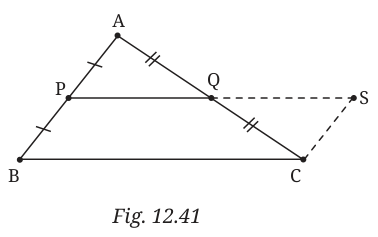
(i) Extend PQ beyond Q to S with QS = PQ. Then ΔAPQ ≅ ΔCSQ (SAS: AQ = CQ, PQ = SQ, ∠AQP = ∠CQS vertically opposite). So CS = AP = PB, and ∠QCS = ∠QAP gives CS ∥ AB (alternate angles), i.e. CS ∥ PB. By Theorem 5, PBCS is a parallelogram. So PS ∥ BC and PS = BC, hence PQ ∥ BC and PQ = ½PS = ½BC.
Answer
(ii) Converse: P is the midpoint of AB, PQ ∥ BC, and Q is on AC. Extend PQ to S with PS = BC (on the side of Q). Then PBCS is a parallelogram (PS ∥ BC and PS = BC), so CS ∥ AB and CS = PB = AP. In ΔAPQ and ΔCSQ: AP = CS, ∠PAQ = ∠SCQ and ∠APQ = ∠CSQ (alternate angles). So they are congruent (ASA), giving AQ = QC and PQ = QS = ½BC.
Question 16*
Property (Grade 8) | Converse | True? |
A rhombus has perpendicular diagonals | A quadrilateral with perpendicular diagonals is a rhombus | False (a kite) |
The diagonals of a rhombus are perpendicular bisectors of each other | If the diagonals are perpendicular bisectors of each other, it is a rhombus | True (12.2 Q3(ii)) |
The diagonals of a rhombus bisect its angles | If the diagonals bisect the angles, it is a rhombus | True (12.2 Q3(i)) |
The diagonals of a rectangle are equal | A quadrilateral with equal diagonals is a rectangle | False (isosceles trapezium) |
The diagonals of a rectangle are equal and bisect each other | If the diagonals are equal and bisect each other, it is a rectangle | True |
The diagonals of a square are equal, perpendicular and bisect each other | If so, the quadrilateral is a square | True |
All angles of a rectangle are 90° | A quadrilateral with all angles 90° is a rectangle | True |
Question 17*
Think of diagonal AC as a hinge, with ΔABC and ΔADC rotating about it. Their angles at B and D do not change. When the two triangles are not in one plane, the angle ∠DAB is less than ∠DAC + ∠CAB (the "fold" makes the angle between AB and AD smaller than when the triangles lie flat and open), and similarly ∠BCD < ∠BCA + ∠ACD. So
∠A + ∠B + ∠C + ∠D < (∠CAB + ∠B + ∠BCA) + (∠CAD + ∠D + ∠DCA) = 180° + 180° = 360°.
As we rotate one triangle towards folding onto the other, ∠A and ∠C keep shrinking. Sum = 2°: take two congruent, very thin triangles ABC and ADC with ∠B = ∠D = 0.9°, and fold them about AC until B and D are close together. Then ∠A and ∠C become tiny, and we can stop when ∠A + ∠C = 0.2°, giving a total of 2°.
Question 18*
(i) Sliding the cutout along line EO by the distance EO moves every point of SOME by the same amount in the same direction (a translation). For each vertex X and its image X′, the segments XX′ are equal and parallel, so SOO′S′, OMM′O′, MEE′M′ and ESS′E′ are parallelograms (Theorem 5). Hence the sides of S′O′M′E′ are equal and parallel to those of SOME, and the two 4-gons match exactly. It is a translated copy.
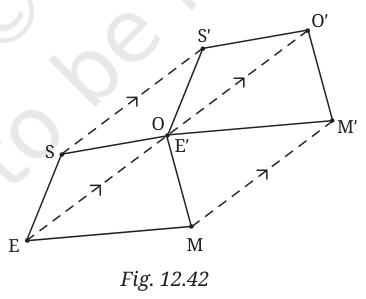
(ii) Repeat this translation along each diagonal in both directions to place the 9 copies. The leftover spaces are again copies of SOME (rotated by 180°), completing the tiling.
Question 19*
(i) Draw a segment of length c; draw circles of radii a and b from its ends. They meet (giving a triangle) exactly when a + b > c.
(ii) A 4-gon with sides 2, 5, 11 and x exists only if the longest side is shorter than the sum of the other three.
x = 100: 100 < 2 + 5 + 11 = 18? No.
x = 10: longest side 11 < 2 + 5 + 10 = 17. Yes.
x = 1: 11 < 2 + 5 + 1 = 8? No.
Possible values: 4 < x < 18.
(iii) A 4-gon with sides a, b, c, d exists if and only if the largest is less than the sum of the other three (equivalently, each side is less than the sum of the other three).
Question 20*
(i) A diagonal is a segment joining two vertices that are not adjacent.
n | 3 | 4 | 5 | 6 | 7 | 8 |
Diagonals | 0 | 2 | 5 | 9 | 14 | 20 |
(ii) Formula: n(n − 3)/2. Each vertex joins the n − 3 other vertices that are not itself or its two neighbours, and each diagonal is counted twice (once from each end).
Going from n to n + 1 sides adds n − 1 diagonals: the new vertex gets n − 2 diagonals, and the old side between its two neighbours becomes a diagonal. Check: 2 + 3 = 5, 5 + 4 = 9, 9 + 5 = 14, 14 + 6 = 20.
Question 21*
Sums: n = 5: 540°, n = 6: 720°, n = 7: 900°, n = 8: 1080°. Formula: (n − 2) × 180°.
Proof (convex case): draw the n − 3 diagonals from one vertex; they split the n-gon into n − 2 triangles whose angles together make up exactly the angles of the polygon, so the sum is (n − 2) × 180°. (For a non-convex polygon, one can always find a diagonal lying inside it; cutting along it splits it into two smaller polygons, and the result follows step by step from smaller cases.)
Question 22*
(i) "In ΔABC, P is on AB and Q is on AC. If PQ ∥ BC and PQ = ½BC, then P is the midpoint of AB and Q is the midpoint of AC." True. Proof: extend PQ to R with PR = BC. Then PBCR is a parallelogram (PR ∥ BC and PR = BC), so CR ∥ AB and CR = PB. QR = PR − PQ = ½BC = PQ. ΔAPQ ≅ ΔCRQ (ASA: PQ = RQ, ∠APQ = ∠CRQ alternate, ∠AQP = ∠CQR vertically opposite). So AP = CR = PB and AQ = QC.
(ii) Converse of the second sentence: "If PQ ∥ BC, then Q is the midpoint of AC" – this is Theorem 7. In named form: If (P MID) and (PRLL), then (Q MID) and (HALF).
(iii) Pairs of assumptions: {P MID, Q MID} is the theorem itself; {PRLL, HALF} is (i); {P MID, PRLL} is Theorem 7, and {Q MID, PRLL} is the same with P and Q swapped; {Q MID, HALF} is {P MID, HALF} with P and Q swapped. So only "If P is the midpoint of AB and PQ = ½BC, must Q be the midpoint of AC and PQ ∥ BC?" remains.
Answer: not necessarily. The circle with centre P and radius ½BC can meet AC at two points – one is the midpoint, the other is not. Example: A(0, 0), B(8, 4), C(10, 0). P = (4, 2), ½BC = √5. Both Q = (5, 0) (the midpoint) and Q′ = (3, 0) on AC are at distance √5 from P, but PQ′ is not parallel to BC.
Question 23*
What must be proved: (1) every point of the plane is covered by some copy (no gaps), and (2) no two copies overlap except along edges. Key idea for Method 1: the half-turn about the midpoint of a side swaps the two endpoints of that side, so neighbouring copies share full edges. Around every vertex, the four angles 1, 2, 3, 4 of the 4-gon appear once each, adding to 360°, so the copies close up exactly around each vertex. Also, the combination of two half-turns is a translation, so the whole pattern is the original copy and its half-turned copy repeated by translations along a parallelogram grid (the Varignon grid of Method 2). Translations of a grid cover the plane exactly, which proves the tiling. Method 3 (Q18) is the same translation structure seen directly.
Question 24*
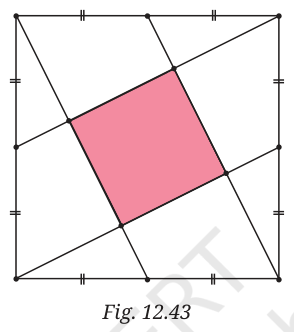
Each line joins a vertex of the square to the midpoint of a side (the pinwheel figure). The four right triangles cut off can each be turned about a midpoint to form, together with the four corner pieces, four squares congruent to the shaded one. So the large square consists of 5 equal squares, and the shaded part is 1/5. (Check with side 2: each line has length √5 and the shaded square has side 2/√5, so its area is 4/5, which is 1/5 of 4.)
Extra Practice Questions
1. In ΔABC, D, E, F are midpoints of BC, CA, AB, and AB = 8 cm, BC = 10 cm, CA = 6 cm. Find the perimeter of ΔDEF. (4 + 5 + 3) = 12 cm
2. The angles of a quadrilateral are in the ratio 3 : 5 : 9 : 13. Find them. 36°, 60°, 108°, 156°
3. Show that the line joining the midpoints of the parallel sides of a parallelogram passes through the intersection of its diagonals. The segment joining them and the diagonals all bisect each other at the centre O (Q8).