
NCERT Solutions Class 9 Maths (Ganita Manjari) Chapter 7 – The Mathematics of Maybe: Introduction to Probability
Circle of Learning • New NCERT textbook "Ganita Manjari" (2026-27) • Think and Reflect, Exercise Sets 7.1–7.4, End-of-Chapter Exercises – step-by-step solutions
Think and Reflect
Why is tossing a coin to decide which team bats first considered fair?
Answer
The result of a fair toss cannot be predicted or controlled by anyone, and heads and tails are equally likely (probability ½ each). So each captain has exactly the same chance of winning the toss – no team gets an advantage.
2. Ask a friend to predict the toss of a ₹1 coin. Your friend knows the result will be heads or tails but cannot know which. All possible results are known, yet each single toss is unpredictable – that is randomness.
3. A die shows 4 eight times in a row. Is the next 4 less likely? No. If the die is fair, each roll is independent: P(4) on the next roll is still 1/6 ≈ 0.167. Probability describes what happens in the long run, not what the next roll will be. (Believing otherwise is the Gambler's Fallacy.)
4. Sample space detail (rain). The sample space must match the question. {Rain, No Rain} is enough to ask "Will it rain?", but to study how much it rains we need {No Rain, Drizzle, Light Rain, Heavy Rain}.
Probability of one head and one tail when a coin is tossed twice?
Answer
S = {HH, HT, TH, TT}. Favourable outcomes: HT and TH. P = 2/4 = ½ = 0.5.
Exercise Set 7.1
Rank each event from 0 (impossible) to 1 (certain) and give reasons.
Answer
Event | Label | Reason |
(i) The next Monday will come after Sunday | Certain (probability 1) | The order of the days of the week never changes. |
(ii) It will snow in Mumbai in July | Impossible (probability ≈ 0) | Mumbai is a hot, coastal, tropical city at sea level, and July is the monsoon; snow has never been recorded there. |
(iii) An elephant will walk through your classroom today | Impossible / extremely unlikely (very close to 0) | There is no reason for an elephant to be at school, and it would not even fit through a classroom door. |
(iv) You will greet at least one friend at school tomorrow | More likely (close to 1) | You normally meet friends every school day, but it is not certain – you could be ill, or it could be a holiday. |
Exercise Set 7.2
A sample of 30 sweets: 10 red, 8 green, 7 yellow, 5 blue.
(i) P(green) = 8/30 = 4/15 ≈ 0.267.
(ii) Estimated yellow sweets in a bag of 600 = (7/30) × 600 = 140.
Answer
Sample of 40 students: Science 14, Arts 11, Sports 9, Debate 6. The school has 800 students.
(i) P(Arts) = 11/40 = 0.275.
(ii) Sports Club in the whole school ≈ (9/40) × 800 = 180 students.
Answer
Toss a coin 20 times and record the results.
Answer
(This is an activity – your numbers will vary.) Sample record: Heads 11 times, Tails 9 times.
(i) Heads: 11 (ii) Tails: 9
(iii) Experimental P(heads) = number of heads ÷ 20 = 11/20 = 0.55 (use your own count).
(iv) On the next toss, P(tails) = ½. The coin has no memory, so the earlier tosses do not change this.
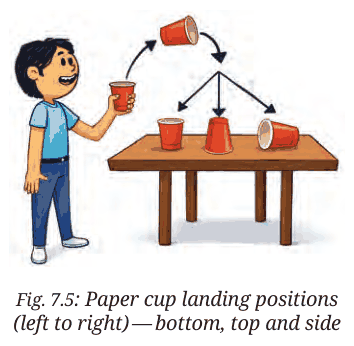
Toss a paper cup 100 times; record whether it lands on its bottom, top or side. Assign probabilities.
Answer
Experimental probability of each position = (number of times it landed that way) ÷ 100. A typical result: side 70, top 22, bottom 8, giving P(side) = 0.70, P(top) = 0.22, P(bottom) = 0.08. The three probabilities always add up to 1. (The outcomes are clearly not equally likely – the cup usually lands on its side – so experiment is the only way to find these probabilities.)
Answer
Probability of an even number on a fair die?
Even outcomes: {2, 4, 6} = 3 out of 6. P = 3/6 = ½.
A die is rolled 12 times and shows 3 three times.
(i) Experimental P(3) = 3/12 = ¼ = 0.25.
(ii) Theoretical P(3) = 1/6 ≈ 0.167.
Answer
(iii) They differ because 12 rolls is a very small number of trials, and chance variation is large in small samples. As we roll 60, 600, 6000 times, the experimental probability should get closer and closer to 1/6 (the Law of Large Numbers). For example, in 6000 rolls we would expect a 3 about 1000 times.
Exercise Set 7.3
Number of outcomes when a 6-sided die is rolled? S = {1, 2, 3, 4, 5, 6}, so n(S) = 6.
Answer
Write the sample space.
Answer
(i) Rolling a die and tossing a coin:
S = {1H, 2H, 3H, 4H, 5H, 6H, 1T, 2T, 3T, 4T, 5T, 6T} – 12 outcomes.
(ii) A random integer between −5 and +5:
S = {−5, −4, −3, −2, −1, 0, 1, 2, 3, 4, 5} – 11 outcomes (if −5 and 5 are included). If "between" is taken strictly, S = {−4, −3, …, 3, 4} – 9 outcomes.
(iii) A box with 5 green and 7 red balls, one drawn:
By colour, S = {Green, Red}. These are not equally likely (P(G) = 5/12, P(R) = 7/12). Listing every ball separately gives an equally likely sample space: S = {G₁, G₂, G₃, G₄, G₅, R₁, R₂, …, R₇} – 12 outcomes.
Snacks: Samosa, Pakora, Bhaji; drinks: Chai, Lassi.
(i) S = {(Samosa, Chai), (Samosa, Lassi), (Pakora, Chai), (Pakora, Lassi), (Bhaji, Chai), (Bhaji, Lassi)} – 3 × 2 = 6 outcomes.
(ii) Event "Samosa as the snack" = {(Samosa, Chai), (Samosa, Lassi)}.
Answer
Exercise Set 7.4
Basket A: 1 apple, 2 oranges. Basket B: 1 banana, 1 mango. One fruit from each.
Answer
(i) Tree diagram:
Start
⇒ Apple (1/3)
⇒ Banana (½) / Mango (½)
Start
⇒ Orange₁ (1/3)
⇒ Banana (½) / Mango (½)
Start
⇒ Orange₂ (1/3)
⇒ Banana (½) / Mango (½)
(ii) S = {(Apple, Banana), (Apple, Mango), (Orange₁, Banana), (Orange₁, Mango), (Orange₂, Banana), (Orange₂, Mango)} – 6 equally likely outcomes. (If the two oranges are not told apart, the pairs are AB, AM, OB, OM, with OB and OM each twice as likely.)
(iii) P(apple and banana) = 1/6 (= 1/3 × ½) ≈ 0.167.
A box has 3 red, 4 black and 2 green pens. You pick one and put it back, then your friend picks one.
Answer
(i) Possible outcomes (you, friend): RR, RB, RG, BR, BB, BG, GR, GB, GG – 9 colour pairs.
Tree: first branch R (3/9), B (4/9), G (2/9); from each, a second branch R (3/9), B (4/9), G (2/9).
(ii) P(same colour) = P(RR) + P(BB) + P(GG) = (3/9)² + (4/9)² + (2/9)² = (9 + 16 + 4)/81 = 29/81 ≈ 0.358.
End-of-Chapter Exercises
(i) The probability of an impossible event is 0.
(ii) The set of all possible outcomes of a random experiment is called the sample space.
(iii) The probability of an event that is certain to happen is 1.
(iv) Tossing a fair coin has a probability of ½ for getting heads.
Answer
The number of students who like football is 15 (the frequency), and the relative frequency is 15/50 = 3/10 = 0.3.
Answer
Answer
Which experiments have equally likely outcomes?
(i) Car starts / does not start – Not equally likely: a car in good condition usually starts.
(ii) Tossing a fair coin – Equally likely: H and T each have probability ½ (symmetry).
(iii) Rolling a fair die – Equally likely: each face has probability 1/6.
(iv) Choosing a marble from 3 red and 7 blue – the colours are not equally likely: P(red) = 0.3, P(blue) = 0.7 (each individual marble is equally likely, but not each colour).
(v) Boy or girl – Nearly but not exactly equally likely; birth records show slightly more boys than girls are born (about 51 : 49).
(i) Two coins: S = {HH, HT, TH, TT}. At least one head = {HH, HT, TH}. P = 3/4.
(ii) S = {1, 2, …, 10}. Even = {2, 4, 6, 8, 10}. P = 5/10 = ½.
(iii) S = {1, 2, 3, 4, 5, 6}. Greater than 4 = {5, 6}. P = 2/6 = 1/3.
(iv) S = {R₁, R₂, R₃, B₁, B₂, G}. Not red = {B₁, B₂, G}. P = 3/6 = ½.
(v) Three coins: S = {HHH, HHT, HTH, THH, HTT, THT, TTH, TTT}. Exactly two heads = {HHT, HTH, THH}. P = 3/8.
Answer
S = {Strawberry, Lemon, Mint}. P(strawberry) = 1/3.
Answer
Answer
Outfits from 2 shirts and 3 pants
Shirt \ Pants | Jeans | Khakis | Shorts |
Red | Red–Jeans | Red–Khakis | Red–Shorts |
Blue | Blue–Jeans | Blue–Khakis | Blue–Shorts |
Total = 2 × 3 = 6 outfits.
Tyres (1000 cases): < 4000 km: 20; 4001–9000: 210; 9001–14000: 325; > 14000: 445.
(i) P(less than 4000 km) = 20/1000 = 0.02
(ii) P(between 4000 and 14000 km) = (210 + 325)/1000 = 0.535
(iii) P(more than 14000 km) = 445/1000 = 0.445
Answer
(Check: 0.02 + 0.535 + 0.445 = 1.)
Cards P, E, A, C, E.
(i) P, E or C: P, E, C, E = 4 cards. P = 4/5.
(ii) Not E: P, A, C = 3 cards. P = 3/5.
Answer
Question 9*
A spinner with numbers 1 to 8, equally likely.
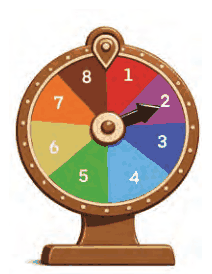
(i) P(8) = 1/8
(ii) Odd {1, 3, 5, 7}: P = 4/8 = ½
(iii) Greater than 2 {3, …, 8}: P = 6/8 = 3/4
(iv) Less than 9: all 8 numbers – P = 1 (certain)
(v) Multiple of 3 {3, 6}: P = 2/8 = 1/4
Question 10*
4 red and 5 blue balls; one is drawn and laid aside, then a second is drawn.
Tree diagram
First draw: R (4/9) or B (5/9).
After R: R (3/8) or B (5/8) → RR = 4/9 × 3/8 = 12/72 = 1/6; RB = 4/9 × 5/8 = 20/72 = 5/18.
After B: R (4/8) or B (4/8) → BR = 5/9 × 4/8 = 20/72 = 5/18; BB = 5/9 × 4/8 = 20/72 = 5/18.
(Check: 12 + 20 + 20 + 20 = 72, so the total is 1.)
(i) P(red then blue) = 5/18 ≈ 0.278
(ii) P(2 blue) = 5/18 ≈ 0.278
Question 11*
A pair of dice is thrown. Give an event with probability 0 and one with probability 1.
Probability 0: "the sum of the numbers is 13" (or "the sum is 1") – the sum can only be from 2 to 12.
Probability 1: "the sum is between 2 and 12 (inclusive)" or "each die shows a number less than 7" – this always happens.
Question 12*
(i) Two dice; sum is a prime greater than 5. The sample space has 6 × 6 = 36 ordered pairs (1,1), (1,2), …, (6,6). Primes possible above 5: 7 and 11.
Sum 7: (1,6), (2,5), (3,4), (4,3), (5,2), (6,1) – 6 ways. Sum 11: (5,6), (6,5) – 2 ways.
P = 8/36 = 2/9.
(ii) 4 red, 3 green, 2 blue; two drawn without replacement; different colours. Number of possible pairs of balls = 9 × 8 ÷ 2 = 36.
Same-colour pairs: red 4×3÷2 = 6, green 3, blue 1 – total 10.
P(different colours) = (36 − 10)/36 = 26/36 = 13/18 ≈ 0.722.
(iii) Three coins; first is H and exactly two heads. S has 8 outcomes. Favourable: {HHT, HTH}. P = 2/8 = 1/4.
(iv) Four-digit numbers from 1, 2, 3, 4 without repetition; probability of even. Total = 4 × 3 × 2 × 1 = 24 numbers. Even numbers end in 2 or 4: for each last digit, the other 3 digits can be arranged in 6 ways – 12 numbers. P = 12/24 = ½.
(v) 3 questions, 4 options each, guessing; exactly 2 correct. Total answer patterns = 4³ = 64. Choose which question is wrong (3 ways) and which wrong option is picked (3 ways): 3 × 3 = 9 favourable patterns. P = 9/64 ≈ 0.141.
Question 13*
A box has balls numbered 1 to 4.
(i) With replacement: the tree has 4 first branches, each with 4 second branches.
S = {11, 12, 13, 14, 21, 22, 23, 24, 31, 32, 33, 34, 41, 42, 43, 44}.
(ii) Without replacement: each first branch has only 3 second branches (the first ball cannot repeat).
S = {12, 13, 14, 21, 23, 24, 31, 32, 34, 41, 42, 43}.
(iii) Sizes: 16 (with replacement) and 12 (without replacement).
Question 14*
Toss a coin and draw a card numbered 1–6
S = {H1, H2, H3, H4, H5, H6, T1, T2, T3, T4, T5, T6} – 12 elements.
Question 15*
Three coins; the number of heads is recorded. Which list is the sample space?
Answer
The number of heads can be 0, 1, 2 or 3, so the sample space is (iv) {0, 1, 2, 3}.
(i) {1, 2, 3} fails – it leaves out 0 (TTT).
(ii) {0, 1, 2} fails – it leaves out 3 (HHH).
(iii) {0, 1, 2, 3, 4} fails – 4 heads is impossible with 3 coins; a sample space should list exactly the possible outcomes.
Question 16*
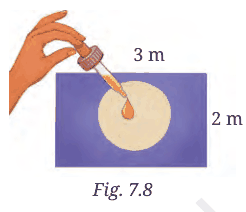
A die (or a drop of dye) falls at random on a 3 m × 2 m rectangle. Probability that it lands inside the circle of diameter 1 m?
Answer
For a random point, probability = favourable area ÷ total area.
Circle area = π(0.5)² = π/4 ≈ 0.785 m². Rectangle area = 6 m².
P = (π/4)/6 = π/24 ≈ 0.131 (= 11/84 using π = 22/7).
Extra Practice Questions
1. A card is drawn from a well-shuffled deck of 52. Find P(a king). 4/52 = 1/13
2. Two dice are rolled. Find P(doublet). 6/36 = 1/6
3. A coin is tossed 200 times and shows heads 112 times. Experimental P(tails)? 88/200 = 0.44
4. Can P(E) = 1.2? Why? No – probability always lies between 0 and 1.