
Circle of Learning • New NCERT textbook "Ganita Manjari" (2026-27) • Think and Reflect, Exercise Sets 6.1–6.3, End-of-Chapter Exercises – step-by-step solutions (π = 22/7 unless stated otherwise)
Think and Reflect (Running Tracks and π)
The school has a 200 m track instead of a 400 m track. Do we need a smaller stagger for the same 4 × 100 m relay?
Answer
No – in fact a larger one. The stagger only makes up for the extra distance run on the curves by the outer lanes. If a lane's radius is larger by w (the lane width), the extra distance on curves turning through a total angle of 360° is 2π(r + w) − 2πr = 2πw – it does not depend on the radius r, i.e. on the size of the track! A 4 × 100 m race is one lap of a 400 m track (curves total 360°) but two laps of a 200 m track (curves total 720°), so on the 200 m track the runners go round twice as much curve and need about twice the stagger (if they stay in their lanes).
2. What is the connection between the perimeter of a circle and the 400 m track? The curved ends of the track are semicircles. To know how far each runner goes, and hence the stagger, we need the length of a semicircle, i.e. the circumference of a circle.
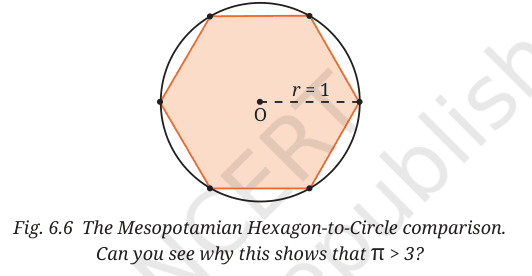
3. (Fig. 6.6) Why does the inscribed hexagon show π > 3? A regular hexagon in a circle of radius 1 is made of 6 equilateral triangles, so its perimeter is 6 × 1 = 6. The circle goes around outside the hexagon and is longer: 2π > 6, so π > 3.
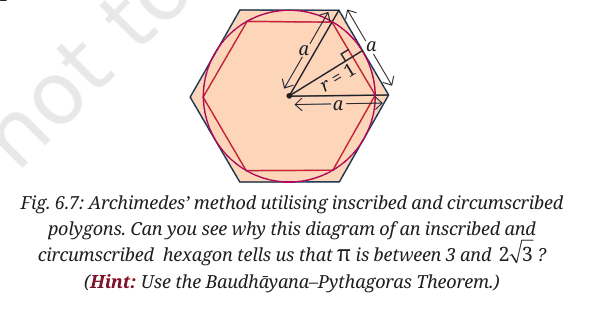
4. (Fig. 6.7) Why do the inscribed and circumscribed hexagons show 3 < π < 2√3? For the circumscribed hexagon the radius (1) is the height of each equilateral triangle of side a. By Baudhāyana–Pythagoras, a² = (a/2)² + 1
⇒ a = 2/√3. Its perimeter is 6a = 12/√3 = 4√3. The circle lies between the two hexagons, so 6 < 2π < 4√3, i.e. 3 < π < 2√3 ≈ 3.46.
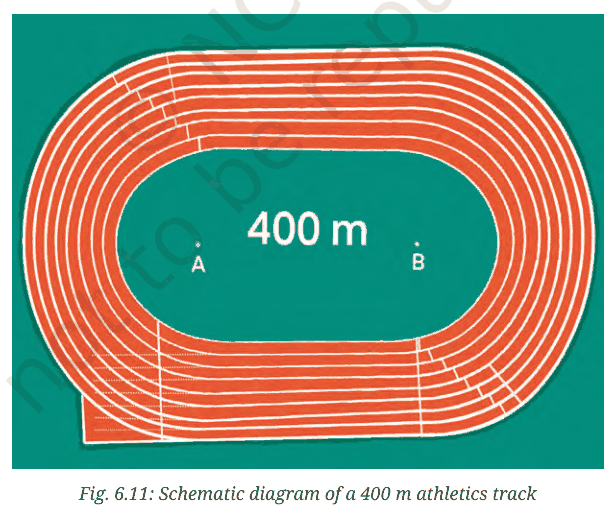
(Fig. 6.11) Difference in radius between lanes 1 and 2? Stagger for lane 2? Equal stagger between lanes 2 and 3?
Answer
The radius increases by one lane width, 1.22 m. In one lap the curves make one full circle, so the extra distance in lane 2 is 2π × 1.22 ≈ 2 × 3.1416 × 1.22 ≈ 7.67 m – this is the stagger. Because every lane is 1.22 m wider than the one inside it, the same stagger (≈ 7.67 m) is needed between lanes 2 and 3, and between every pair of adjacent lanes. (In real tracks, lane 1 is measured 0.30 m from the kerb and other lanes 0.20 m from their inner line, which changes the first stagger slightly.)
Exercise Set 6.1
Answer
The perimeter of a circle is 44 cm. What is its radius?
2πr = 44 ⇒ 2 × (22/7) × r = 44 ⇒ r = 7 cm.
Circumference (3 significant figures) for radius (i) 7 cm (ii) 10 cm (iii) 12 cm.
Answer
(i) 2 × 22/7 × 7 = 44.0 cm (ii) 2 × 22/7 × 10 = 62.857… ≈ 62.9 cm (iii) 2 × 22/7 × 12 = 75.428… ≈ 75.4 cm
Arc length: (i) r = 3.5 cm, 60° (ii) r = 6.3 m, 120°.
Answer
Arc = 2πr × θ/360°.
(i) 2 × 22/7 × 3.5 × 60/360 = 22 × 1/6 = 11/3 ≈ 3.67 cm
(ii) 2 × 22/7 × 6.3 × 120/360 = 39.6 × 1/3 = 13.2 m
Perimeter of a sector of radius 14 cm and angle 75°.
Answer
Arc = 2 × 22/7 × 14 × 75/360 = 88 × 5/24 = 55/3 ≈ 18.33 cm. Perimeter = 14 + 14 + 18.33 = 46.33 cm (= 139/3 cm).
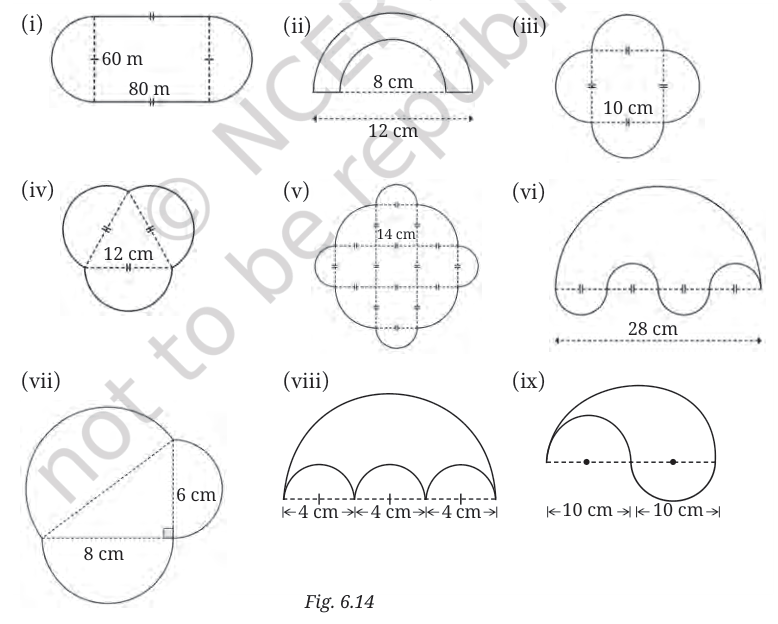
Find the perimeters of the shapes in Fig. 6.14.
Answer
(i) Track shape: two straight sides of 80 m and two semicircles of diameter 60 m (together one circle). Perimeter = 2 × 80 + π × 60 = 160 + 188.57 = 348.57 m.
(ii) Semicircular ring: outer semicircle diameter 12 cm, inner semicircle diameter 8 cm, and two flat ends of (12 − 8)/2 = 2 cm each. Perimeter = π × 6 + π × 4 + 2 + 2 = 10π + 4 = 31.43 + 4 = 35.43 cm.
(iii) A square of side 10 cm with a semicircle on each side; only the four semicircles form the boundary = 2 full circles of diameter 10 cm. Perimeter = 2 × π × 10 = 62.86 cm.
(iv) Equilateral triangle of side 12 cm with a semicircle on each side as diameter (the circles on two sides cross at the vertex). Boundary = 3 semicircles of diameter 12 cm = 3 × π × 6 = 18π = 56.57 cm.
(v) A plus-shaped grid of five 14 cm squares. Boundary = 4 small semicircles of diameter 14 cm (= 2 circles of radius 7: 2 × 44 = 88 cm) + 4 quarter circles of radius 14 cm at the corners (= 1 circle of radius 14: 88 cm). Perimeter = 176 cm.
(vi) A big semicircle of diameter 28 cm and four small semicircles of diameter 28/4 = 7 cm along the base. Perimeter = π × 14 + 4 × (π × 3.5) = 14π + 14π = 28π = 88 cm.
(vii) Right triangle with legs 8 cm and 6 cm, so hypotenuse = √(64 + 36) = 10 cm; a semicircle on each side. Perimeter = π(4 + 3 + 5) = 12π = 37.71 cm.
(viii) A big semicircle of diameter 12 cm and three small semicircles of diameter 4 cm. Perimeter = π × 6 + 3 × (π × 2) = 12π = 37.71 cm.
(ix) A big semicircle of diameter 20 cm, plus two semicircles of diameter 10 cm (one above the line on the left, one below on the right). Perimeter = π × 10 + π × 5 + π × 5 = 20π = 62.86 cm.
A car tyre has diameter 56 cm. (i) Distance for one revolution? (ii) Revolutions in 10 km?
(i) Circumference = π × 56 = 22/7 × 56 = 176 cm.
(ii) 10 km = 10,00,000 cm. Revolutions = 10,00,000 ÷ 176 ≈ 5682 (5681.8).
Answer
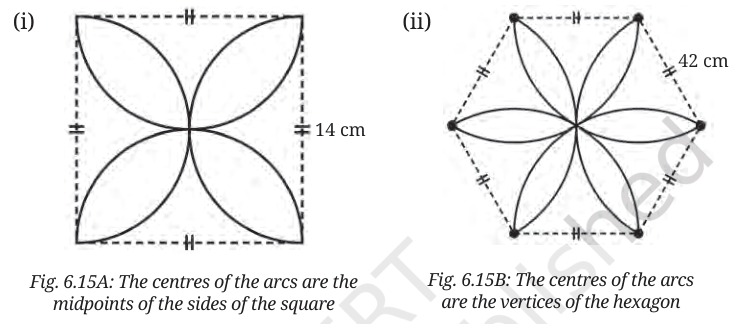
Find the total perimeter of all the petals.
Answer
(i) Fig. 6.15A (square of side 14 cm, arcs centred at the midpoints of the sides): each arc is a semicircle of radius 7 cm from one corner, through the centre, to the next corner. There are 4 such semicircles. Total = 4 × π × 7 = 28π = 88 cm.
(ii) Fig. 6.15B (regular hexagon of side 42 cm, arcs centred at the vertices): the centre O of the hexagon is 42 cm from every vertex. An arc centred at vertex U passes through the neighbouring vertex V and O, and ΔUVO is equilateral, so each arc is a 60° arc of radius 42 cm: length = 2π × 42 × 60/360 = 44 cm. Each of the 6 petals has 2 such arcs: total = 12 × 44 = 528 cm.
The perimeters of two circles are in the ratio 5 : 4. Ratio of radii?
Answer
2πr₁ : 2πr₂ = r₁ : r₂ = 5 : 4.
Think and Reflect (Parallelograms and Triangles)
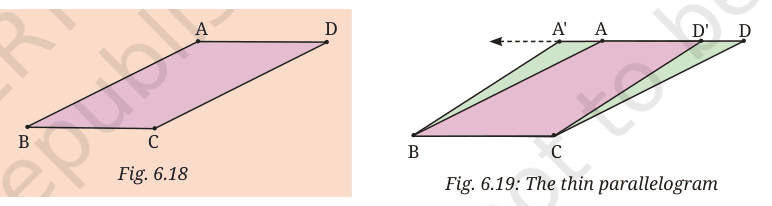
1. The 'thin' parallelogram (Fig. 6.18). Use the hint (Fig. 6.19): slide the top side along its own line (cut off a triangle at one end and add a congruent one at the other). This keeps the base and the height the same, so the area does not change. Repeat until the foot of the perpendicular falls on the top side; then the cut-and-paste into a rectangle works, and area = base × height.
2. Can we find the area of a parallelogram from its side lengths alone? No. With sides a and b fixed, changing the angle between them changes the height: the area is largest (= ab) when the angle is 90° (a rectangle), and gets closer and closer to 0 as the parallelogram is squashed flat. So we also need an angle or the height.
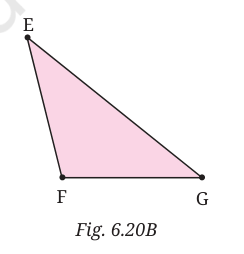
3. Obtuse-angled triangle (Fig. 6.20B). Extend the base GF beyond F to the foot I of the perpendicular from E, with FI = x. Then ΔEFG = ΔEIG − ΔEIF = ½(b + x)h − ½xh = ½bh. The formula still holds.
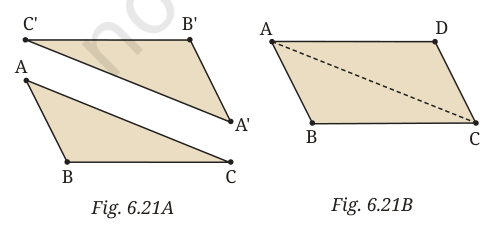
4. Why do two copies of a triangle make a parallelogram (Fig. 6.21)? Rotating the copy through 180° makes alternate angles equal (e.g. ∠B′C′A′ = ∠BCA), so opposite sides are parallel. Hence the shape is a parallelogram of area bh, and the triangle has area ½bh.
5. Can ΔABD be cut by straight cuts and rearranged into ΔACD (equal areas)? Yes. For example, cut each triangle along its mid-line (parallel to the base) and turn the small top triangle about a midpoint to get a parallelogram of the same base and half the height; two parallelograms of equal base and height can be cut and rearranged into each other. Try to find the least number of pieces yourself.
6. Two polygons of equal area – can one always be cut and rearranged into the other? Try it: a square and a rectangle of equal area, two different triangles, a triangle and a square – it works each time. Conjecture: any two polygons with equal area can be cut into finitely many polygonal pieces that rearrange from one to the other. (This is a true theorem, the Wallace–Bolyai–Gerwien theorem.)
Rectangles with perimeter 40 units.
Answer
(1) l + b = 20, so there are infinitely many such rectangles (any l between 0 and 20).
(2) Area = l(20 − l) is largest when l = b = 10: the 10 × 10 square, area 100 sq. units.
(3) There is no smallest: making one side very small (e.g. 19.99 × 0.01) makes the area as close to 0 as we like, but never 0. It may be surprising that the same perimeter can enclose very different areas.
Think and Reflect (Squaring a Triangle)
How would you construct a square with the same area as a given triangle?
Answer
Step 1: Turn the triangle into a rectangle of equal area – a rectangle with the same base b and half the height, h/2 (area ½bh). Step 2: Square this rectangle using Baudhāyana's construction (Fig. 6.30), which gives a square of side √(b × h/2).
Exercise Set 6.2
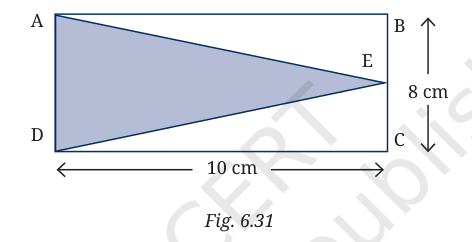
Find the area of triangle ADE in Fig. 6.31 (rectangle ABCD, 10 cm × 8 cm, E on BC).
Answer
Take AD = 8 cm as the base. E lies on BC, which is parallel to AD and 10 cm away, so the height is 10 cm. Area = ½ × 8 × 10 = 40 cm² (half the rectangle).
Parallel sides 40 cm and 20 cm; the non-parallel sides are each 26 cm. Find the area.
Answer
Dropping perpendiculars from the ends of the shorter side leaves (40 − 20)/2 = 10 cm on each side. Height = √(26² − 10²) = √576 = 24 cm. Area = ½(40 + 20) × 24 = 720 cm².
Two sides are 8 cm and 11 cm, perimeter 32 cm. Find the area.
Answer
Third side = 32 − 19 = 13 cm; s = 16. Area = √[16 × (16 − 8)(16 − 11)(16 − 13)] = √(16 × 8 × 5 × 3) = √1920 = 8√30 ≈ 43.8 cm².
Sides in ratio 3 : 5 : 7, perimeter 300 m. Find the area.
Answer
Sides: 60 m, 100 m, 140 m; s = 150. Area = √(150 × 90 × 50 × 10) = √67,50,000 = 1500√3 ≈ 2598 m².
One diagonal of a rhombus is twice the other; area 128 cm². Find the shorter diagonal.
Answer
Area = ½ × d × 2d = d² = 128
⇒ d = √128 = 8√2 ≈ 11.31 cm.
ABCD is a parallelogram; P and Q are on AB. Find area(ΔPCD) : area(ΔQCD).
Answer
Both triangles have base CD, and P, Q lie on AB, which is parallel to CD, so both have the same height. Ratio = 1 : 1 (each is half the parallelogram).
O is any point on diagonal PR of parallelogram PQRS. Prove area(ΔPSO) = area(ΔPQO).
Answer
Let the diagonals meet at M; M is the midpoint of SQ. In ΔPSQ, PM is a median, so area(PSM) = area(PQM). In ΔOSQ, OM is a median, so area(OSM) = area(OQM). Adding (or subtracting, depending on which side of M the point O is): area(PSO) = area(PQO).
(Another way: S and Q are equally far from line PR, so the two triangles with common base PO have equal heights.)
Joining the midpoints of the sides of a 4-gon in order gives a parallelogram with half the area of the 4-gon. Prove it.
Answer
Let P, Q, R, S be the midpoints of AB, BC, CD, DA of 4-gon ABCD.
In ΔABD, DP is a median, so area(APD) = ½ area(ABD). In ΔAPD, PS is a median, so area(APS) = ½ area(APD) = ¼ area(ABD).
Similarly area(CRQ) = ¼ area(CBD). Adding: area(APS) + area(CRQ) = ¼[area(ABD) + area(CBD)] = ¼ area(ABCD).
In the same way, using diagonal AC: area(BPQ) + area(DRS) = ¼ area(ABCD).
The four corner triangles together are ½ area(ABCD), so area(PQRS) = ½ area(ABCD).
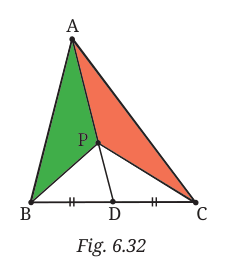
D is the midpoint of BC, P is any point on median AD. Show area(ΔABP) = area(ΔACP).
Answer
AD is a median of ΔABC: area(ABD) = area(ACD). PD is a median of ΔPBC: area(PBD) = area(PCD). Subtracting: area(ABP) = area(ABD) − area(PBD) = area(ACD) − area(PCD) = area(ACP).
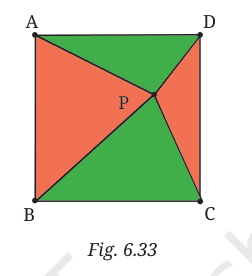
P is a point inside square ABCD of side a. Ratio of red (ΔPAB + ΔPCD) to green (ΔPBC + ΔPDA)?
Answer
Let the distances of P from AB and CD be h₁ and h₂; since AB ∥ CD, h₁ + h₂ = a. Red area = ½a h₁ + ½a h₂ = ½a². Similarly the green area = ½a². Ratio = 1 : 1, wherever P is.
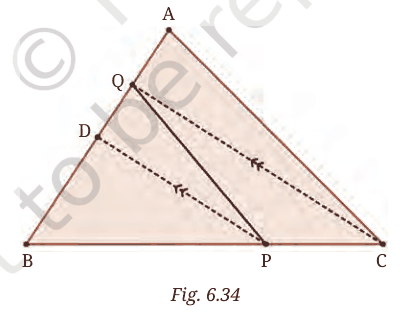
D is the midpoint of AB, P is on BC, and Q is on AB with CQ ∥ PD. Prove area(ΔBPQ) = ½ area(ΔABC).
Answer
ΔDPQ and ΔDPC have the same base DP and their third vertices Q and C lie on a line parallel to DP, so they have equal heights: area(DPQ) = area(DPC).
area(BPQ) = area(BPD) + area(DPQ) = area(BPD) + area(DPC) = area(BCD).
CD is a median of ΔABC, so area(BCD) = ½ area(ABC). Hence area(BPQ) = ½ area(ABC).
Think and Reflect (Circular Shapes)
Why were humans so fond of circular shapes? Practical reasons: a wheel rolls smoothly; a circle encloses the most area for a given length of boundary (fewer materials for walls, huts, fences); round pots and towers are strong and easy to make; every point on the edge is the same distance from the centre (good for gatherings, wells, fireplaces). There were also cultural and aesthetic reasons – the circle is perfectly symmetric and was seen in the sun and moon, so it was used in art, temples, dance, calendars and symbols.
Exercise Set 6.3
Area of a sector of radius 7 cm and angle 60°.
Answer
22/7 × 49 × 60/360 = 154/6 = 77/3 ≈ 25.67 cm².
Area of a quadrant of a circle with circumference 44 cm.
Answer
r = 7 cm. Area of circle = 154 cm². Quadrant = 154/4 = 38.5 cm².
Answer
The minute hand is 7 cm long. Area swept in 10 minutes?
In 10 minutes it turns 360° × 10/60 = 60°. Area = 22/7 × 49 × 60/360 = 25.67 cm².
A chord of a circle of radius 10 cm subtends 90° at the centre. Area of (i) minor sector (ii) major sector? (π = 3.14)
Answer
(i) 3.14 × 100 × 90/360 = 78.5 cm² (ii) 3.14 × 100 × 270/360 = 235.5 cm²
A chord of a circle of radius 15 cm subtends 60° at the centre. Areas of the minor and major segments? (π = 3.14, √3 = 1.73)
Answer
Sector = 3.14 × 225 × 60/360 = 117.75 cm². The triangle formed with the centre is equilateral (two radii, angle 60°): area = (√3/4) × 15² = 1.73 × 225/4 = 97.31 cm².
Minor segment = 117.75 − 97.31 = 20.44 cm².
Circle = 3.14 × 225 = 706.5 cm². Major segment = 706.5 − 20.44 = 686.06 cm².
Two non-overlapping wipers, blade 28 cm, each sweeping 120°. Total area cleaned per sweep?
Answer
One wiper = 22/7 × 28 × 28 × 120/360 = 2464/3 ≈ 821.33 cm². Two wipers = 4928/3 ≈ 1642.67 cm².
Question 7*
A chord subtends 60° at the centre of a circle of radius r. Show the minor segment has area r²(π/6 − √3/4).
Sector = πr² × 60/360 = πr²/6. The triangle formed by the chord and the two radii is equilateral with side r: area = (√3/4)r². Segment = πr²/6 − (√3/4)r² = r²(π/6 − √3/4).
Question 8*
An equilateral triangle is inscribed in a circle of radius r. Show area(triangle) : area(circle) = 3√3/(4π) ≈ 0.413.
Joining the centre to the vertices gives 3 triangles, each with two sides r and angle 120°. The side of the triangle is r√3 (the perpendicular from the centre to a side is r/2, so half-side = √(r² − r²/4) = (√3/2)r). Area = (√3/4)(r√3)² = 3√3 r²/4. Ratio = (3√3 r²/4)/(πr²) = 3√3/(4π) ≈ 0.413.
Question 9*
A square is inscribed in a circle of radius r. Show the ratio is 2/π ≈ 0.637.
The diagonal of the square is a diameter, 2r. Area of square = ½ × diagonal² = ½ × 4r² = 2r². Ratio = 2r²/(πr²) = 2/π ≈ 0.637.
Question 10*
A regular hexagon is inscribed in a circle of radius r. Show the ratio is 3√3/(2π) ≈ 0.827. Why is it twice the answer to Q8?
Answer
The hexagon is made of 6 equilateral triangles of side r: area = 6 × (√3/4)r² = 3√3 r²/2. Ratio = 3√3/(2π) ≈ 0.827.
Why twice: Join alternate vertices A, C, E of hexagon ABCDEF to get the inscribed equilateral triangle. The hexagon = ΔACE + ΔABC + ΔCDE + ΔEFA. Each of OABC, OCDE, OEFA is a rhombus, cut by its diagonal into two equal triangles, so ΔABC = ΔOAC, etc. Hence the three outer triangles together equal ΔACE, and the hexagon is exactly twice the triangle.
End-of-Chapter Exercises
Draw area models for (a + b)(a − b) = a² − b² and (a + b + c)² = a² + b² + c² + 2ab + 2bc + 2ca.
Answer
(a + b)(a − b): Draw a square of side a and cut a small square of side b from one corner; the remaining L-shape has area a² − b². Cut the L along the line continuing the inner edge into two rectangles: a × (a − b) and b × (a − b). Place them end to end to get one rectangle of length a + b and width a − b. So (a + b)(a − b) = a² − b².
(a + b + c)²: Draw a square of side a + b + c and divide each side into a, b, c. The 3 × 3 grid has squares a², b², c² on the diagonal and two rectangles each of area ab, bc and ca. Total = a² + b² + c² + 2ab + 2bc + 2ca.
An isosceles triangle has perimeter 40 cm and equal sides 15 cm. Find its area.
Answer
Base = 40 − 30 = 10 cm. Height = √(15² − 5²) = √200 = 10√2 cm. Area = ½ × 10 × 10√2 = 50√2 ≈ 70.71 cm².
An isosceles triangle has base 10 cm and area 60 cm². Find the equal sides.
Answer
½ × 10 × h = 60
⇒ h = 12 cm. Equal side = √(12² + 5²) = 13 cm.
A right triangle has area 54 cm² and one leg 12 cm. Find its perimeter.
Answer
½ × 12 × b = 54
⇒ b = 9 cm. Hypotenuse = √(144 + 81) = 15 cm. Perimeter = 12 + 9 + 15 = 36 cm.
Sides in ratio 2 : 3 : 4, perimeter 45 cm. Find the area.
Answer
Sides 10, 15, 20 cm; s = 22.5. Area = √(22.5 × 12.5 × 7.5 × 2.5) = 75√15/4 ≈ 72.62 cm².
Sides 7, 24, 25 cm. Find the area in two ways.
Answer
Way 1: 7² + 24² = 49 + 576 = 625 = 25², so the triangle is right-angled; area = ½ × 7 × 24 = 84 cm².
Way 2 (Heron): s = 28; area = √(28 × 21 × 4 × 3) = √7056 = 84 cm².
A bicycle wheel of diameter 60 cm rotates 100 times. Distance travelled?
Answer
One turn = π × 60 = 188.57 cm. 100 turns = 18857 cm ≈ 188.57 m.
Area of a quadrant of a circle of circumference 66 cm.
Answer
2 × 22/7 × r = 66
⇒ r = 10.5 cm. Circle = 22/7 × 10.5² = 346.5 cm². Quadrant = 86.625 cm².
A car wheel has outer radius 28 cm. Distance in one turn, and turns in 1 km?
Answer
One turn = 2 × 22/7 × 28 = 176 cm. 1 km = 1,00,000 cm; turns = 1,00,000 ÷ 176 ≈ 568 (568.2).
Question 10*
Two rectangles have the same area and the same perimeter. Must they be congruent?
Answer
Yes. If the sides are l and b, then l + b = P/2 and lb = A are fixed. Then (l − b)² = (l + b)² − 4lb is fixed too, so l − b (taking l ≥ b) is fixed. Knowing l + b and l − b fixes l and b. So both rectangles have the same sides and are congruent.
Using area of parallelogram = base × height and Fig. 6.42, show the area of a trapezium is ½(a + b)h.
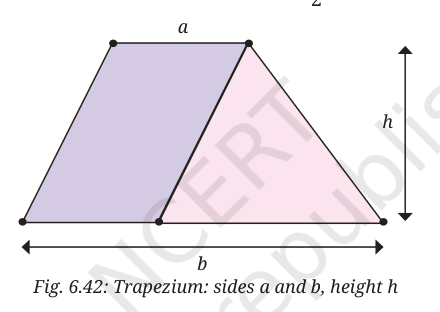
Answer
Through one end of the top side a, draw a line parallel to the opposite slanted side. This splits the trapezium into a parallelogram with base a and height h, and a triangle with base b − a and height h.
Area = ah + ½(b − a)h = ½(2a + b − a)h = ½(a + b)h.
Divide a trapezium into two triangles to get the same formula.
Answer
Draw a diagonal. One triangle has base a, the other has base b, and both have height h (the distance between the parallel sides). Area = ½ah + ½bh = ½(a + b)h.
Use two identical trapezia to make a parallelogram and get the formula.
Answer
Turn a copy of the trapezium through 180° and place it next to the original so that a slanted side of one matches the same slanted side of the other. The top and bottom now each have length a + b and are parallel, so the shape is a parallelogram of base (a + b) and height h. Two trapezia = (a + b)h, so one trapezium = ½(a + b)h.
Show that the area of a kite is half the product of its diagonals: (i) using algebra (ii) using geometry.
Answer
Let the kite be ABCD with AB = AD and CB = CD. The diagonal AC (length d₁) is the line of symmetry and is the perpendicular bisector of BD (length d₂).
(i) Algebra: AC splits the kite into ΔABC and ΔADC, each with base d₁ and height d₂/2. Area = 2 × ½ × d₁ × d₂/2 = ½d₁d₂.
(ii) Geometry: Draw the rectangle d₁ × d₂ around the kite, with sides parallel to the diagonals. The diagonals divide the rectangle into 4 smaller rectangles; each one is cut in half by a side of the kite, with one half inside the kite. So the kite is exactly half the rectangle: ½d₁d₂.
(i) Area(PQRS) = 2a × 2b = 4ab = 4 × area(ABCD). Yes – 4 copies fit, in a 2 × 2 arrangement.
Answer
(ii) By Heron's formula, doubling every side doubles s and each of s − a, s − b, s − c, so the product under the root becomes 16 times and the area 4 times. Yes – join the midpoints of the sides of ΔPQR: this gives 4 triangles, each with sides a, b, c (three upright and one upside-down).
(iii) Tripling every side multiplies the product under the root by 81, so the area becomes 9 times. Yes – divide each side of ΔPQR into 3 equal parts and draw lines parallel to the sides; this gives 9 small triangles (6 upright, 3 upside-down), each congruent to ΔABC.
Question 16*
Fig. 6.43: What fraction of the triangle is shaded?
One side is divided into 2 equal parts and the other side (from the same top vertex T) into 3 equal parts. Let the area of the triangle be 1. The triangle from T containing the shaded part, cut off at the 2/3 point of the second side, has area 2/3 (same height, 2/3 of the base). From it remove the small triangle at T with sides ½ and ⅓ of the original sides: its area = ½ × ⅓ = 1/6. Shaded = 2/3 − 1/6 = 1/2.
Fig. 6.44: What fraction of the square is shaded?
Each line joins a vertex to the midpoint of a side. Each of the four right triangles cut off outside the central square can be turned about a midpoint to fill a square congruent to the central one. So the large square is made of 5 equal squares, and the shaded part is 1/5. (Check with side 2: each joining line has length √5 and the central square has side 2/√5, area 4/5 = 1/5 of 4.)
Fig. 6.45 and Fig. 6.46: What fraction of each rectangle is covered by the circles?
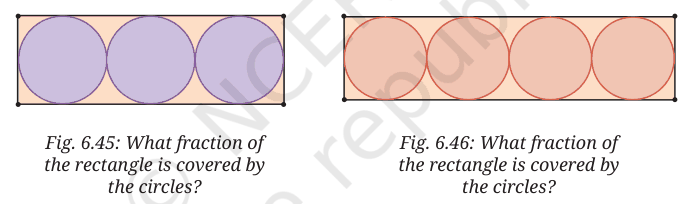
Answer
Let each circle have diameter d. Fig. 6.45: rectangle 3d × d, circles 3 × π(d/2)²
⇒ fraction = (3πd²/4)/(3d²) = π/4 ≈ 0.785. Fig. 6.46: rectangle 4d × d, 4 circles
⇒ fraction again π/4.
Conjecture: however many equal circles are fitted in a row in a rectangle like this, they cover π/4 (about 78.5%) of the rectangle. For 10, 20 or 50 circles we get the same answer.
Answer
Proof: n circles of diameter d fit in an nd × d rectangle. Fraction = n × πd²/4 ÷ (nd × d) = π/4, which does not depend on n.
Question 19*
Nine identical rectangles form a large rectangle of area 72 cm² (Fig. 6.47). Find the perimeter of each small rectangle.
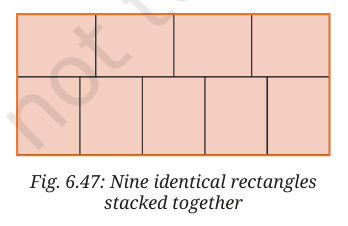
Let each small rectangle be L × W (L > W). The top row has 4 rectangles lying flat (lengths along the top) and the bottom row has 5 standing upright (widths along the bottom), so 4L = 5W.
Area: 9LW = 72 ⇒ LW = 8. With L = 5W/4: 5W²/4 = 8 ⇒ W² = 6.4 ⇒ W = 4√10/5 ≈ 2.53 cm and L = √10 ≈ 3.16 cm.
Perimeter = 2(L + W) = 2 × (9/5)√10 = 3.6√10 ≈ 11.38 cm.
(Check: the big rectangle is 4L × (L + W) = 4√10 × 1.8√10 = 72 cm².)
Question 20*
Fig. 6.48: Lines from a vertex to the points of trisection of the opposite side. Show the blue and red triangles have equal areas; dissect one into the other.
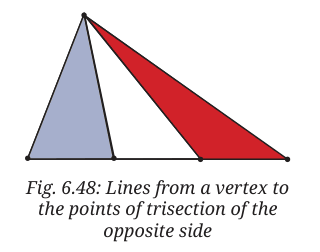
Both triangles have the same apex, so the same height h, and their bases are each one-third of the opposite side, so equal. Area of each = ½ × (base/3) × h – they are equal.
Dissection: Cut each triangle along its mid-line (joining the midpoints of the two slanted sides) and turn the small top triangle about a midpoint: each becomes a parallelogram with the same base and half the height. These two parallelograms have equal bases and equal heights, so one can be cut by a straight cut into a triangle and a trapezium and rearranged into the other. Combining the steps cuts the blue triangle into a few pieces that cover the red one.
Question 21*
Fig. 6.49: Show that regions A and B have equal area.
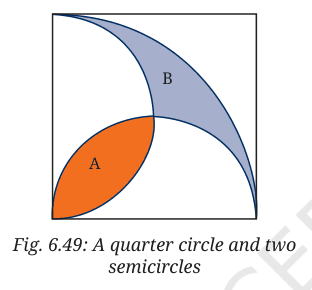
Let the side of the square be s. Quarter circle area = πs²/4. Each semicircle has radius s/2: area = ½π(s/2)² = πs²/8, so the two together are πs²/4.
The two semicircles lie inside the quarter circle and overlap in region A. So:
quarter circle = (semicircle 1 + semicircle 2 − A) + B
πs²/4 = πs²/4 − A + B ⇒ A = B.
Question 22*
Fig. 6.50: four semicircles inside a square of side 2 units make a 4-petalled flower. Find its perimeter and area.
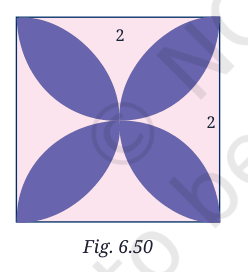
Perimeter: The flower's boundary is made of the 4 semicircles of radius 1: 4 × π × 1 = 4π ≈ 12.57 units.
Area: Each petal lies in a 1 × 1 quarter of the square, between two quarter circles of radius 1. Petal = 2 × (quarter circle) − (unit square) = 2 × π/4 − 1 = π/2 − 1. Four petals: 4(π/2 − 1) = 2π − 4 ≈ 2.28 sq. units.
Question 23*
Fig. 6.51: Chord BC of the larger circle touches the smaller circle at A; BC = l. Show the ring area is ¼πl².
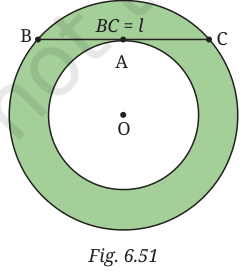
Let the radii be R (big) and r (small). OA ⊥ BC (radius to the point of contact), so A is the midpoint of BC and AB = l/2. In right ΔOAB: R² = r² + (l/2)², so R² − r² = l²/4.
Ring area = πR² − πr² = π(R² − r²) = ¼πl². (Remarkably it does not depend on the radii!)
Question 24*
Fig. 6.52: Semicircles on all sides of a right-angled triangle. Show Area(A) + Area(B) = Area(C).
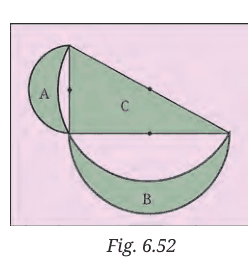
Here C is the triangle, and A and B are the crescents (lunes) outside the semicircle on the hypotenuse, which passes through the right-angle vertex.
With legs a, b and hypotenuse c (a² + b² = c²), the semicircle areas are πa²/8, πb²/8, πc²/8, so (semicircle on a) + (semicircle on b) = (semicircle on c).
The leg semicircles = A + B + (the two segments of the big semicircle cut off by the legs). The big semicircle = C + (the same two segments). Cancelling the segments: A + B = C. (These are the 'lunes of Hippocrates'.)
Question 25*
Fig. 6.53: Two circles of radius r pass through each other's centres. Find the area of the region common to both (the shaded lens).
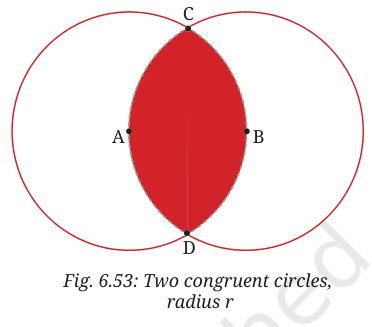
The centres A, B and the meeting point C form an equilateral triangle, so ∠CAD = ∠CBD = 120° (as in Example 1).
Half the lens is a 120° segment: sector − triangle = πr²/3 − ½ × r × r × sin 120° = πr²/3 − (√3/4)r².
Lens = 2 × that = (2π/3 − √3/2) r² ≈ 1.23 r².
(The whole region covered by the two circles is 2πr² − lens = (4π/3 + √3/2) r² ≈ 5.05 r².)
Question 26*
Fig. 6.54: Show that the area of the rectangle is 2(A + C)(B + C)/C.
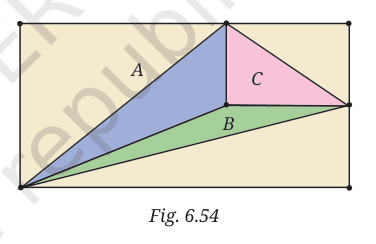
Let the rectangle have width w and height h with the bottom-left corner at O. The top vertex P is at distance p from the left side, the right vertex Q is at distance q above the bottom, and R is the right-angled corner of triangle C (PR vertical, RQ horizontal).
C = ½(w − p)(h − q).
A = ½ × PR × (distance of O from PR) = ½(h − q)p.
B = ½ × RQ × (distance of O from RQ) = ½(w − p)q.
So A + C = ½(h − q)w and B + C = ½(w − p)h.
(A + C)(B + C) = ¼wh(h − q)(w − p) = ¼wh × 2C = ½wh × C.
Hence area of rectangle = wh = 2(A + C)(B + C)/C.
Question 27*
Fig. 6.55: Show that the two shaded regions are equal.
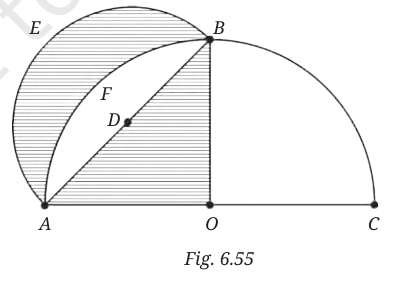
O is the centre of the semicircle ABC with radius r, OB ⊥ AC, so arc AFB is a quarter circle. Arc AEB is a semicircle on chord AB (centre D, the midpoint of AB). The shaded regions are the crescent between arcs AEB and AFB, and the triangle AOB.
AB² = r² + r² = 2r², so the semicircle on AB has area ½π(AB/2)² = ½π × 2r²/4 = πr²/4 – the same as the quarter circle AOB.
Semicircle AEB = crescent + segment AFB; quarter circle AOB = ΔAOB + segment AFB. Since the two are equal, crescent = ΔAOB.
Extra Practice Questions
1. Find the area of a circle whose circumference is 88 cm. r = 14 cm; area = 616 cm²
2. Find the area of a triangle with sides 13, 14, 15 cm. s = 21; √(21 × 8 × 7 × 6) = 84 cm²
3. A sector of radius 21 cm has an arc of 22 cm. Find the sector angle. 2π × 21 × θ/360 = 22 ⇒ θ = 60°
4. Use Brahmagupta's formula for a cyclic 4-gon with sides 3, 4, 5, 6. s = 9; √(6 × 5 × 4 × 3) = √360 ≈ 18.97 sq. units