
NCERT Solutions Class 9 Maths (Ganita Manjari) Chapter 5 – I'm Up and Down, and Round and Round
Circle of Learning • New NCERT textbook "Ganita Manjari" (2026-27) • Think and Reflect, Exercise Sets 5.1–5.6, End-of-Chapter Exercises – step-by-step solutions
Think and Reflect (Finding the Centre)
Jamuna has a circular piece of paper and wants to locate its centre. What did Amina tell her?
Answer
Fold the circle exactly in half so the edges overlap and make a crease (this crease is a diameter). Open it, fold it in half again in a different direction and crease. Both creases are diameters, and every diameter passes through the centre, so the point where the two creases cross is the centre.
Think and Reflect (Symmetries and Locus)
What are the rotational symmetries of a square? How many lines of reflection symmetry does it have? A regular pentagon? A regular hexagon?
Answer
Shape | Rotations that leave it unchanged | Lines of symmetry |
Square | 90°, 180°, 270°, 360° (order 4) | 4 |
Regular pentagon | 72°, 144°, 216°, 288°, 360° (order 5) | 5 |
Regular hexagon | 60°, 120°, 180°, 240°, 300°, 360° (order 6) | 6 |
(A circle, by contrast, has rotational symmetry for every angle and infinitely many lines of symmetry.)
What is the length of the longest chord in a circle of radius 5 units? Is there a smallest chord?
Answer
The longest chord is the diameter = 2 × 5 = 10 units. There is no smallest chord: as a chord is moved away from the centre it keeps getting shorter, and we can always find a chord shorter than any given one (its length can be as close to 0 as we like).
What is the locus of points equidistant from two given points A and B?
Answer
The locus is the perpendicular bisector of AB. We already know every point equidistant from A and B lies on it. Conversely, take any point P on the perpendicular bisector, with M the midpoint of AB. In ΔPMA and ΔPMB: AM = BM, ∠PMA = ∠PMB = 90°, PM is common. By SAS, ΔPMA ≅ ΔPMB, so PA = PB. Hence every point on the perpendicular bisector is equidistant from A and B.
Think and Reflect (Circles Through Two Points)
1. How many circles pass through two points on a plane? Infinitely many – every point on the perpendicular bisector of AB can be a centre.
2. Are there circles of all radii through A and B? Smallest? Largest? No. The radius can never be less than half of AB. The smallest radius is AB/2 (centre at the midpoint of AB, AB a diameter). There is no largest circle – the radius can be made as large as we like.
3. Moving away from AB along the perpendicular bisector, do the radii increase or decrease? They increase (radius² = (AB/2)² + (distance of centre from AB)²).
4. Will the circle look more curved or less curved? Less curved – bigger circles look flatter near A and B.
How many squares can be drawn with A and B on the boundary? With A and B as corners?
Answer
With A and B anywhere on the boundary: infinitely many.
With A and B as corners: 3 – two squares having AB as a side (one on each side of AB) and one square having AB as a diagonal.
Exercise Set 5.1
Draw ΔABC with AB = 5 cm, ∠A = 70°, ∠B = 60°. Draw its circumcircle. Is the centre inside or outside the triangle?
Answer
Steps: draw AB = 5 cm; make 70° at A and 60° at B; the arms meet at C. Draw the perpendicular bisectors of AB and BC; they meet at O. With centre O and radius OA, draw the circle – it passes through A, B and C.
∠C = 180° − 70° − 60° = 50°. All angles are acute, so the circumcentre lies inside the triangle.
Draw ΔABC with AB = 5 cm, ∠A = 100°, AC = 4 cm. Draw its circumcircle. Is the centre inside or outside?
Answer
Construct as before (SAS triangle), then find O as the intersection of the perpendicular bisectors. ∠A = 100° is obtuse, so the circumcentre lies outside the triangle (beyond side BC, opposite A).
Draw ΔABC with AB = 6 cm, BC = 7 cm, CA = 7 cm. Draw the circumcircle, centre O. Measure OA, OB, OC.
Answer
After construction, OA = OB = OC (they are radii). Calculated value: R = abc/(4 × area). Area = ½ × 6 × √(7² − 3²) = 3√40 ≈ 18.97 cm², so R = (6 × 7 × 7)/(4 × 18.97) ≈ 3.9 cm. Your measurements should all be about 3.9 cm (equal to each other).
What is the least possible radius of a circle through two points A and B?
Answer
AB/2 – when the centre is the midpoint of AB and AB is a diameter. (Any other centre on the perpendicular bisector is farther from A.)
Think, Draw and Infer
A, B, C are collinear. Can you find P with PA = PB = PC?
Answer
No. P would have to lie on the perpendicular bisector of AB and on the perpendicular bisector of BC. Both bisectors are perpendicular to the same line ABC, so they are parallel (and distinct, since the midpoints of AB and BC are different points). Parallel lines never meet, so no such P exists. Hence no circle passes through three collinear points, and so no line can cut a circle in three distinct points (a line meets a circle in at most two points).
Can there be other triangles congruent to ΔABC with the same circumcircle?
Answer
Yes, infinitely many. Rotate ΔABC about the circumcentre through any angle (or reflect it in any diameter): the circle maps onto itself and the image is a congruent triangle inscribed in the same circle.
Exercise Set 5.2
Show that the triangle formed by a chord and the centre is isosceles.
Answer
Let AB be a chord of a circle with centre O. OA and OB are both radii, so OA = OB. Hence ΔOAB has two equal sides and is isosceles (and ∠OAB = ∠OBA).
Show that if two such isosceles triangles have equal base lengths, they are congruent.
Answer
Let ΔOAB and ΔODE be formed by chords AB and DE with AB = DE. Then OA = OD (radii), OB = OE (radii) and AB = DE (given). By SSS, ΔOAB ≅ ΔODE.
Exercise Set 5.3
Why does the perpendicular from the centre to a chord bisect the chord? (Use Fig. 5.12: ∠CMA = ∠CMB = 90°.)
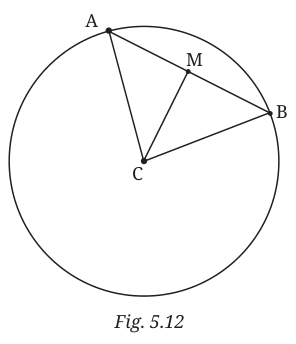
Answer
In ΔCMA and ΔCMB: ∠CMA = ∠CMB = 90°; hypotenuse CA = CB (radii); CM is common. By RHS, ΔCMA ≅ ΔCMB, so AM = BM, i.e. the perpendicular bisects the chord.
An isosceles ΔABC is inscribed in a circle with AB = AC. Show that the altitude from A to BC passes through the centre.
Answer
Let O be the centre. OB = OC (radii), so O lies on the perpendicular bisector of BC. Also AB = AC, so A lies on the perpendicular bisector of BC. In an isosceles triangle, the altitude from A falls on the midpoint of BC, so the altitude from A is the perpendicular bisector of BC. Since O lies on that line, the altitude from A passes through the centre.
Two parallel chords of 6 cm and 8 cm are on opposite sides of the centre of a circle of radius 5 cm. Find the distance between their midpoints.
Answer
The perpendicular from the centre bisects each chord, and for parallel chords both midpoints lie on the same line through the centre.
Chord 6 cm: distance from centre = √(5² − 3²) = 4 cm.
Chord 8 cm: distance from centre = √(5² − 4²) = 3 cm.
Opposite sides
⇒ distance between midpoints = 4 + 3 = 7 cm.
Exercise Set 5.4
Use the Baudhāyana–Pythagoras theorem to show why Theorem 6 (equal chords are equidistant from the centre) is true.
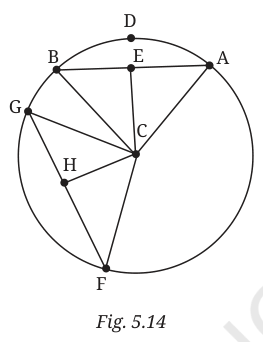
Answer
In Fig. 5.14, CE ⊥ AB and CH ⊥ FG, and E, H are midpoints. Let r be the radius.
In right ΔCEA: CE² = CA² − AE² = r² − (AB/2)².
In right ΔCHF: CH² = CF² − FH² = r² − (FG/2)².
Since AB = FG, the right-hand sides are equal, so CE² = CH² and CE = CH.
In Fig. 5.15, CE ⊥ AB, CH ⊥ GF and CE = CH. Show that AB = GF.
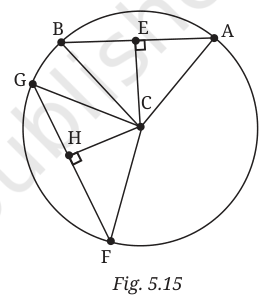
Answer
In ΔCEA and ΔCHF: ∠CEA = ∠CHF = 90°; CA = CF (radii); CE = CH (given). By RHS, ΔCEA ≅ ΔCHF, so AE = FH. The perpendicular from the centre bisects a chord (Theorem 5), so AB = 2AE and GF = 2FH. Hence AB = GF.
Solve the previous question using the Baudhāyana–Pythagoras theorem.
Answer
AE² = CA² − CE² = r² − CE² and FH² = CF² − CH² = r² − CH². As CE = CH, AE² = FH², so AE = FH. Therefore AB = 2AE = 2FH = GF.
Exercise Set 5.5
Find the length of a chord of a circle of radius 7 cm at a perpendicular distance of 6 cm from the centre.
Answer
Half-chord = √(7² − 6²) = √13 cm. Chord = 2√13 cm ≈ 7.21 cm.
Explain why: if the distance of a chord from the centre is d and the radius is r, the chord length is 2√(r² − d²).
Answer
Drop the perpendicular from the centre O to the chord AB, meeting it at M. OM = d, OA = r, and M is the midpoint of AB (Theorem 5). In right ΔOMA, AM² = OA² − OM² = r² − d², so AM = √(r² − d²). Hence AB = 2AM = 2√(r² − d²).
Question 3*
If the distance of chord AB from the centre is twice that of chord CD, can we conclude that CD = 2AB?
Answer
No. Chord length = 2√(r² − d²) is not inversely proportional to d. Example: r = 5 cm, CD at distance 1 cm, AB at distance 2 cm. Then CD = 2√24 ≈ 9.80 cm and AB = 2√21 ≈ 9.17 cm, so CD is nowhere near 2AB. All we can conclude (Theorem 8) is that CD is longer than AB.
Exercise (Fig. 5.19 – Major and Minor Arcs)
Measure the angles subtended by arcs AKB and CLD at the centre O. Are they minor or major arcs?
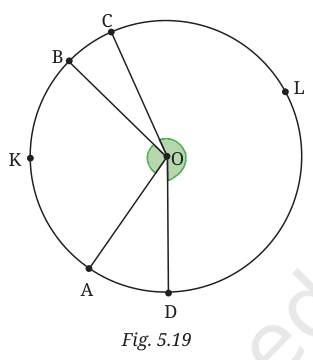
Answer
Measure the angle swept at O going from OA to OB through K, and from OC to OD through L.
Arc AKB (the short arc on the left, through K): the angle at O is about 100° – less than 180°, so AKB is a minor arc.
Arc CLD (from C over the right side through L down to D – the shaded angle): the angle at O is about 200° – more than 180°, so CLD is a major arc.
(Your measured values may differ slightly; the classification is what matters.)
Exercise Set 5.6
In a circle with centre O, ∠AOB = 60° and the radius is 12 cm. Find chord AB.
Answer
OA = OB = 12 cm, so ΔOAB is isosceles with ∠OAB = ∠OBA = (180° − 60°)/2 = 60°. All angles are 60°, so the triangle is equilateral and AB = 12 cm.
A and B are two points on a circle with centre O.
Answer
(i) Are there points X, Y on the circle, on the same side of AB, with ∠AXB ≠ ∠AYB?
Answer
No. X and Y on the same side of AB lie on the same arc, and angles subtended by an arc at points of the circle outside it are all equal (each is half the angle at the centre). So ∠AXB = ∠AYB always.
(ii) If ∠AXB = ∠AYB, must X and Y lie on the same side?
Answer
Not necessarily. If X and Y are on opposite sides, AXBY is a cyclic quadrilateral, so ∠AXB + ∠AYB = 180°. They can then be equal only when both are 90°, i.e. when AB is a diameter. So the statement is true except when AB is a diameter.
(iii) If ∠AXB = ∠AYB (X and Y on the same side of AB), does the circle through A, B and X also pass through Y?
Answer
Yes. This is exactly Theorem 10: if segment AB subtends equal angles at two points on the same side of it, the four points are concyclic. (If X and Y are on opposite sides of AB this need not hold.)
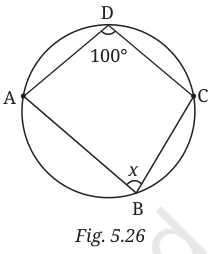
Find x in Fig. 5.26.
Answer
ABCD is a cyclic quadrilateral with ∠D = 100° and ∠B = x, which are opposite angles. So x + 100° = 180°
⇒ x = 80°.
Exercise (Cyclic Quadrilateral)
A cyclic quadrilateral has ∠A = 80°, ∠B = 110°, ∠C = 100°, ∠D = 70°. Can it be drawn?
Answer
∠A + ∠C = 80° + 100° = 180° and ∠B + ∠D = 110° + 70° = 180°. Opposite angles are supplementary (and the total is 360°), so yes, such a cyclic quadrilateral can be drawn (Theorem 12).
End-of-Chapter Exercises
A chord is 5 cm from the centre of a circle of radius 13 cm. Find the chord length.
Answer
Half-chord = √(13² − 5²) = √144 = 12 cm. Chord = 24 cm.
An arc subtends 70° at the centre. What angle does it subtend at a point on the circle?
Answer
At any point on the circle outside the arc, the angle is half: 35°. (At a point on the arc itself the angle would be 180° − 35° = 145°.)
Diameter 26 cm, chord 24 cm. Find the distance of the chord from the centre.
Answer
r = 13 cm, half-chord = 12 cm. Distance = √(13² − 12²) = √25 = 5 cm.
Radius 15 cm, distance of chord from centre 9 cm. Find the chord length.
Answer
Half-chord = √(15² − 9²) = √144 = 12 cm. Chord = 24 cm.
Prove that the perpendicular bisector of a chord passes through the centre.
Answer
Let AB be a chord with centre O. OA = OB (radii), so O is equidistant from A and B. The locus of points equidistant from A and B is the perpendicular bisector of AB. Hence O lies on the perpendicular bisector of AB.
AB is a diameter and C is on the circle. Find ∠ACB.
Answer
∠ACB = 90°. Arc AB (not containing C) subtends a straight angle, 180°, at the centre, and the angle at C is half of it (Theorem 9). Alternatively: OA = OB = OC, so ΔOAC and ΔOBC are isosceles; if their base angles are a and b, then 2a + 2b = 180°, so ∠ACB = a + b = 90°.
ABCD is cyclic. ∠A = 75°, ∠B = 110°. Find ∠C and ∠D.
Answer
∠C = 180° − 75° = 105°; ∠D = 180° − 110° = 70°.
PQRS is cyclic with ∠P = (2x + 10)° and ∠R = (3x − 20)°. Find x, ∠P and ∠R.
Answer
∠P + ∠R = 180°
⇒ 5x − 10 = 180
⇒ x = 38. ∠P = 86°, ∠R = 94°.
A chord of 16 cm is 6 cm from the centre. Find the radius.
Answer
r = √(8² + 6²) = √100 = 10 cm.
A cyclic quadrilateral has sides 5, 5, 12, 12 units. Find its area.
Answer
Let AB = BC = 5 and CD = DA = 12. ΔABD ≅ ΔCBD (SSS, BD common), so ∠A = ∠C. But ∠A + ∠C = 180° (cyclic), so ∠A = ∠C = 90°.
Area = 2 × (½ × 5 × 12) = 60 square units.
(If the sides are in the order 5, 12, 5, 12 the figure is a 5 × 12 rectangle – again area 60. Check by Brahmagupta's formula: s = 17, area = √[(17−5)(17−5)(17−12)(17−12)] = √3600 = 60.)
Question 11*
Without drawing the circumcircle, how can we tell whether its centre lies inside or outside a cyclic quadrilateral?
Answer
Look at each side and the angle it subtends at the other vertices (e.g. side AB and ∠ACB = ∠ADB). The centre O is on the same side of chord AB as C and D exactly when this angle is acute (the central angle 2∠ACB is then less than 180°). If it is 90°, AB is a diameter and O lies on AB; if it is obtuse, O is on the other side of AB.
So: the centre lies inside the quadrilateral if and only if each side subtends an acute angle at the opposite vertices, i.e. the angles ∠ACB, ∠BDC, ∠CAD and ∠DBA (angles between a side and a diagonal) are all less than 90°. This is easily checked with a protractor; if any one is obtuse, the centre is outside.
Question 12*
Two equal chords intersect. Show that the segments of one equal the corresponding segments of the other.
Let equal chords AB and CD meet at P, with centre O. Let M and N be the feet of the perpendiculars from O on AB and CD; they are the midpoints (Theorem 5), and OM = ON (equal chords are equidistant, Theorem 6).
In right ΔOMP and ΔONP: OM = ON, OP common, right angles at M and N. By RHS, ΔOMP ≅ ΔONP, so PM = PN.
Label so that A and C are on the far side of the midpoints from P. Then AP = AM + MP = CN + NP = CP (AM = CN, both half of equal chords), and PB = AB − AP = CD − CP = PD. Hence AP = CP and PB = PD.
Question 13*
Draw a circle in which a chord of 6 cm is at a distance of 3 cm from the centre.
Radius = √(3² + 3²) = 3√2 ≈ 4.24 cm.
Construction: Draw AB = 6 cm. Draw its perpendicular bisector, meeting AB at M. Mark O on it with MO = 3 cm. Then ΔOAB is a right isosceles triangle (∠AOB = 90°). With centre O and radius OA, draw the circle.
(Using the hint: it is the circumcircle of a triangle ABP with ∠APB = 45° – the angle at the circle is half of ∠AOB = 90°. E.g. the triangle with AB = 6 cm and apex P on the bisector at height 3 + 3√2 cm.)
Question 14*
Show that the rectangle is the only parallelogram that can be inscribed in a circle.
If parallelogram ABCD is cyclic, then ∠A + ∠C = 180°. In a parallelogram, ∠A = ∠C. So 2∠A = 180° ⇒ ∠A = 90°. A parallelogram with a right angle is a rectangle. Conversely, every rectangle is cyclic since its opposite angles add to 180° (Theorem 12).
Question 15*
Show that if a rectangle is inscribed in a circle, its diagonals meet at the centre.
Let ABCD be the rectangle. ∠ABC = 90°, so the arc AC (not containing B) subtends 2 × 90° = 180° at the centre: AC is a diameter. Similarly ∠BCD = 90° makes BD a diameter. Two diameters meet only at the centre, so the diagonals intersect at the centre.
Question 16*
What shape do the midpoints of all chords of a fixed length form?
Answer
Equal chords are equidistant from the centre. The midpoint M of each chord is the foot of the perpendicular from O, so OM = √(r² − (l/2)²), the same for every such chord. Hence the midpoints lie on a circle concentric with the given circle, with radius √(r² − l²/4).
Question 17*
Chords AB and AC are congruent. Why does the centre lie on the bisector of ∠BAC?
Answer
In ΔOAB and ΔOAC: OB = OC (radii), OA common, AB = AC (given). By SSS, ΔOAB ≅ ΔOAC, so ∠OAB = ∠OAC. Thus AO bisects ∠BAC, i.e. O lies on the angle bisector. (Also: equal chords are equidistant from O, and points equidistant from the arms of an angle lie on its bisector.)
Parallel chords of 10 cm and 24 cm are on the same side of the centre, 7 cm apart. Find the radius.
Answer
Let distances from the centre be d₁ (10 cm chord) and d₂ (24 cm chord). The longer chord is nearer, so d₁ − d₂ = 7.
r² = 5² + d₁² = 12² + d₂²
⇒ d₁² − d₂² = 144 − 25 = 119
⇒ (d₁ − d₂)(d₁ + d₂) = 119
⇒ d₁ + d₂ = 17.
So d₁ = 12, d₂ = 5, and r² = 25 + 144 = 169
⇒ r = 13 cm.
Question 19*
A regular hexagon is inscribed in a circle of radius r. Find the side and the distance of each side from the centre.
Each side subtends 360°/6 = 60° at the centre, so each triangle formed with the centre is equilateral: side = r. Distance of a side from the centre = √(r² − (r/2)²) = (√3/2) r.
MNOP is inscribed in a circle and MN is a diameter. What can you say about ∠MOP and ∠MNP?
Answer
Both angles are subtended by chord MP, at points N and O which lie on the same arc (same side of MP). Angles in the same segment are equal, so ∠MOP = ∠MNP. Also, since MN is a diameter, ∠MON = ∠MPN = 90° (angles in a semicircle).
Why is an exterior angle of a cyclic quadrilateral equal to the interior opposite angle (∠CDE = ∠ABC)?
Answer
∠CDE + ∠ADC = 180° (linear pair) and ∠ABC + ∠ADC = 180° (opposite angles of a cyclic quadrilateral). Hence ∠CDE = ∠ABC.
Question 22*
Justify: no chord of a circle is longer than its diameter.
Let AB be any chord, O the centre, r the radius. By the triangle inequality AB ≤ OA + OB = 2r, with equality only when O lies on AB, i.e. AB is a diameter. (Also, chord = 2√(r² − d²) ≤ 2r, with equality when d = 0.)
Question 23*
A is a point inside a circle with centre O. Show the shortest chord through A is perpendicular to OA.
For any chord through A, let d be its distance from O. Its length is 2√(r² − d²), which is smallest when d is largest. The distance d is the length of the perpendicular from O to the chord, and the perpendicular is never longer than OA (OA is a hypotenuse or the perpendicular itself), so d ≤ OA. The greatest value d = OA happens exactly when OA itself is perpendicular to the chord. Hence the chord through A perpendicular to OA is the shortest.
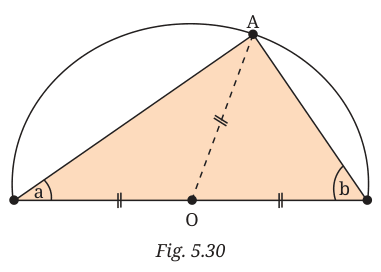
Use Fig. 5.30 to justify that the angle in a semicircle is 90°.
Answer
O is the midpoint of the diameter and OA is a radius, so all three marked segments are equal radii. The left triangle is isosceles, so its base angles are both a; the right triangle is isosceles, so its base angles are both b. In the big triangle the angles are a, b and (a + b) at A. So a + b + (a + b) = 180°
⇒ a + b = 90°. Thus the angle at A is 90°.
Question 25*
Chords CC′ and DD′ are perpendicular to diameter AB. Prove that the segment MM′ joining the midpoints of CD and C′D′ is perpendicular to AB.
Take AB along the x-axis with the centre at the origin. Since CC′ ⊥ AB and the diameter bisects it, C = (c, h) and C′ = (c, −h). Similarly D = (d, k), D′ = (d, −k).
M = ((c + d)/2, (h + k)/2) and M′ = ((c + d)/2, −(h + k)/2).
M and M′ have the same x-coordinate, so MM′ is a vertical line, i.e. perpendicular to AB. (Geometrically: AB is a line of symmetry, reflecting C to C′ and D to D′, so it reflects M to M′.)
Question 26*
Use Fig. 5.31 to justify that opposite angles of a cyclic quadrilateral add up to 180°.
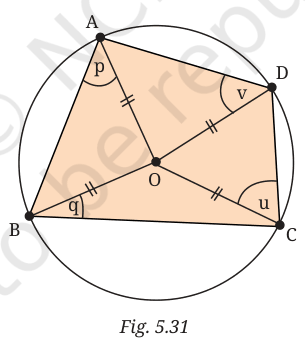
OA = OB = OC = OD (radii), so the four triangles OAB, OBC, OCD, ODA are isosceles. Let their base angles be w (in ΔOAB), x (ΔOBC), y (ΔOCD), z (ΔODA). Then ∠A = w + z, ∠B = w + x, ∠C = x + y, ∠D = y + z.
The sum of angles of ABCD is 360°: 2(w + x + y + z) = 360° ⇒ w + x + y + z = 180°.
So ∠A + ∠C = (w + z) + (x + y) = 180°, and likewise ∠B + ∠D = 180°.
Extra Practice Questions
1. An arc subtends 120° at the centre. Find the angle it subtends at a point on the remaining part of the circle. 60°
2. Find the radius of a circle in which a chord of 30 cm is 8 cm from the centre. √(15² + 8²) = 17 cm
3. In cyclic quadrilateral ABCD, ∠A = 3∠C. Find ∠A and ∠C. 4∠C = 180° ⇒ ∠C = 45°, ∠A = 135°
4. Can a rhombus that is not a square be cyclic? No – opposite angles of a rhombus are equal, so cyclic ⇒ each 90° ⇒ square.