
Circle of Learning • New NCERT textbook "Ganita Manjari" Part II (2026-27) • Think and Reflect, Exercise Sets 13.1–13.5, End-of-Chapter Exercises – step-by-step solutions (all answers verified by substitution)
Exercise Set 13.1
Write a linear equation with a = 3, b = 0, c = −1/5.
Answer
3x + 0·y − 1/5 = 0, i.e. 3x − 1/5 = 0 (or, clearing fractions, 15x − 1 = 0).
Equation | Standard form | Coefficient of x | Coefficient of y | Constant |
y − 15 = √2x | √2x − y + 15 = 0 | √2 | −1 | 15 |
3y − 2x = 0 | −2x + 3y + 0 = 0 | −2 | 3 | 0 |
5x = 3y | 5x − 3y + 0 = 0 | 5 | −3 | 0 |
x = 8 | x + 0·y − 8 = 0 | 1 | 0 | −8 |
3y = 1 | 0·x + 3y − 1 = 0 | 0 | 3 | −1 |
Answer
(Multiplying a standard form by −1 is also correct, e.g. 2x − 3y = 0 for the second row, with all signs changed.)
(i) The notebook costs twice as much as the pen, so t = 2 × p. Charlie (t = 2p) is correct. Meera's p = 2t would mean the pen costs twice the notebook.
(ii) Yes, x + y = 176 correctly shows that the two batsmen's runs add up to 176 (with x and y whole numbers from 0 to 176).
Answer
Think and Reflect (Solutions of 3x + 2y = 12)
(1, 9/2): 3 + 9 = 12 ✓ – a solution. (0, 6): 0 + 12 = 12 ✓ – a solution. (4, 1): 12 + 2 = 14 ✗ – not a solution. (1/2, 21/4): 3/2 + 21/2 = 12 ✓ – a solution.
Other solutions: (2, 3), (4, 0), (−2, 9), … There are infinitely many: choose any x and solve for y.
Think and Reflect (Ranju, Meena, Farhan, Toshi)
Yes, we agree. If c = 0 the equation is ax + by = 0, and x = 0, y = 0 gives a·0 + b·0 = 0, which is true. So (0, 0) is always a solution: the line passes through the origin, whatever a and b are (not both zero). Conversely, if a line passes through the origin, putting (0, 0) into ax + by + c = 0 gives c = 0.
Exercise Set 13.2
5(4) − 6(3) = 20 − 18 = 2 = RHS. So (4, 3) is a solution, because it makes the equation true.
Answer
(i) 7x − 3y = 21: x = 0 ⇒ y = −7; y = 0 ⇒ x = 3. Solutions (0, −7), (3, 0) (also (6, 7)).
(ii) 2x + 3y = 5: (1, 1) and (4, −1) (also (5/2, 0)).
Answer
Substitute (2, −1): 2m(2) + 3(−1) = 7 ⇒ 4m = 10 ⇒ m = 5/2.
Answer
4(2) + n(−1) = −10
⇒ 8 − n = −10
⇒ n = 18.
Equation | Solution 1 (quadrant) | Solution 2 (quadrant) |
(i) 5x + 3y = 7 | (2, −1) – IV | (−1, 4) – II |
(ii) 5x − 3y = 7 | (2, 1) – I | (−1, −4) – III |
(iii) −5x + 3y = 7 | (1, 4) – I | (−2, −1) – III |
(iv) −5x − 3y = 7 | (−2, 1) – II | (1, −4) – IV |
Answer
Check (i): 10 − 3 = 7 ✓ and −5 + 12 = 7 ✓, and similarly for the others. Plotting the two points and joining them gives each line.
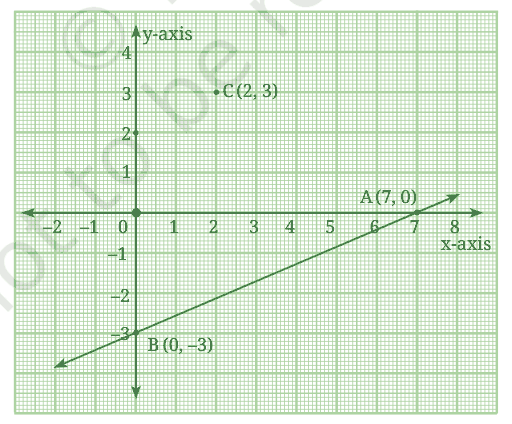
3(2) − 7(3) = 6 − 21 = −15 ≠ 21. So C(2, 3) does not satisfy the equation and does not lie on the line (the graph through A(7, 0) and B(0, −3) clearly misses it). No – a point not on the line can never satisfy the equation, because the line is made up of exactly the points that satisfy it.
Answer
(i) False – it has infinitely many solutions.
(ii) False – only when c = 0; e.g. x + y = 2 does not pass through (0, 0).
(iii) False – e.g. (1, 1) is a rational solution of x + y = 2.
(iv) True – x = 3 can be written as x + 0·y − 3 = 0 (a vertical line).
(v) True – any x gives a matching y = (7 − 2x)/3.
(vi) False – 2(1) + 3(2) = 8 ≠ 7.
Answer
(i) 6x + 8y = 14 is just 2 × (3x + 4y = 7). If (p, q) satisfies 3p + 4q = 7, multiplying by 2 gives 6p + 8q = 14. Conversely, if 6p + 8q = 14, dividing by 2 gives 3p + 4q = 7. So both have the same set of solutions (the same line).
Answer
(ii) If ap + bq = c, then multiplying by k gives kap + kbq = kc. If kap + kbq = kc and k ≠ 0, dividing by k gives ap + bq = c. So the solution sets are identical. (k ≠ 0 is needed: with k = 0 the second equation becomes 0 = 0.)
Think and Reflect (Slope)
Line AB through A(2, 0) with slope 3/2: y = (3/2)(x − 2).
1. x = 8 ⇒ y = (3/2)(6) = 9: the point is (8, 9).
2. y = 6 ⇒ x − 2 = 4 ⇒ x = 6: the point is (6, 6).
Verify the slope of y = −5x + 3 using A(0, 3), B(1, −2), C(−1, 8): slope AB = (−2 − 3)/(1 − 0) = −5; slope AC = (8 − 3)/(−1 − 0) = −5; slope BC = (8 − (−2))/(−1 − 1) = 10/(−2) = −5 ✓.
Exercise Set 13.3
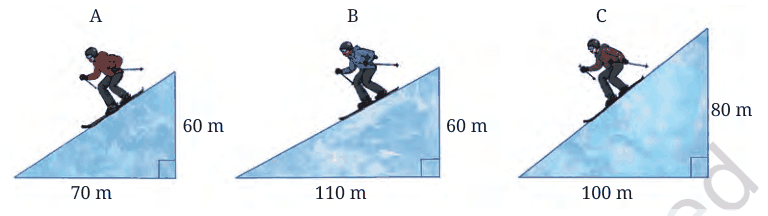
Slope = rise/run. A: 60/70 ≈ 0.86; B: 60/110 ≈ 0.55; C: 80/100 = 0.8.
Answer
From least to greatest steepness: B, C, A.
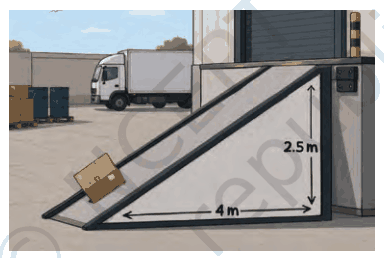
Slope = 2.5/4 = 0.625 = 5/8.
Answer
(i) Line l is horizontal: slope 0.
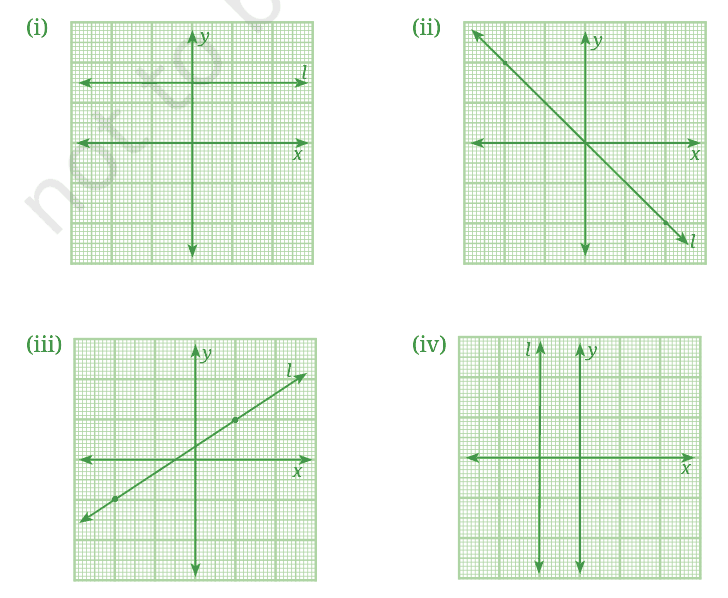
(ii) l passes through (−2, 2) and (2, −2) (counting big squares): slope = (−2 − 2)/(2 − (−2)) = −1.
(iii) l passes through (−2, −1) and (1, 1): slope = (1 − (−1))/(1 − (−2)) = 2/3.
(iv) l is vertical: the run is 0, so the slope is undefined.
Answer
Slope 1/12 means 12 cm of horizontal length for every 1 cm of rise. For 18 cm of rise: 18 × 12 = 216 cm (2.16 m).
Answer
Think and Reflect (Pairs of Equations)
Paratha and dahi: p + 2d = 90 and 2p + 7d = 260. Doubling the first gives 2p + 4d = 180; subtracting from the second: 3d = 80 ⇒ d = 80/3 ≈ ₹26.67 and p = 90 − 160/3 = 110/3 ≈ ₹36.67. (Check: 2 × 110/3 + 7 × 80/3 = 780/3 = 260 ✓.)
Rakesh's puzzle: x + y = 25, x − y = 11 ⇒ 2x = 36 ⇒ x = 18, y = 7.
Science exhibition: 2x + 3y = 600, 3x + 2y = 700. Adding: 5(x + y) = 1300 ⇒ x + y = 260; subtracting: x − y = 100. So adult ₹180, child ₹80. A solution answers the problem because it is the only pair of prices that makes both groups' bills correct.
Exercise Set 13.4
1. 2x + 3y = 850 and 4x + y = 1100. (Solving: x = 245, y = 120 – ticket ₹245, snack box ₹120.)
2. x + 6y = 122 and x + 8y = 160. (Solving: y = 19, x = 8 – fixed charge ₹8, ₹19 per km.)
3. x + y = 200 and 150x + 100y = 25000 (or 3x + 2y = 500). (Solving: x = 100 adults, y = 100 children.)
Think and Reflect (Shapes Puzzle)
Rows: T + R + R + T = 28; Hexagon + R + Hexagon + R = 30; C + T + C + C = 18; C + R + C + C = 20. Columns 2, 3, 4 total 30, 23 and 22.
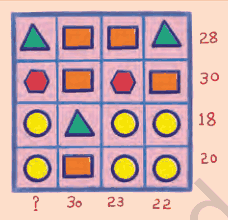
From row 1: T + R = 14. Column 4 (T, R, C, C): T + R + 2C = 22 ⇒ C = 4. Row 3: T + 3C = 18 ⇒ T = 6, so R = 8. Row 2: 2H + 2R = 30 ⇒ H (hexagon) = 7.
Checks: row 4 = 8 + 12 = 20 ✓, column 2 = 3(8) + 6 = 30 ✓, column 3 = 8 + 7 + 8 = 23 ✓.
The missing total of column 1 (T, H, C, C) = 6 + 7 + 4 + 4 = 21.
Think and Reflect (Methods)
1. Example 7 with y = ½(3 − x): substituting into 7x − 15y = 2 gives 7x − 7.5(3 − x) = 2 ⇒ 14.5x = 24.5 ⇒ x = 49/29, y = ½(3 − 49/29) = 19/29. Yes, the same solution, as it must be, since there is only one solution.
2. Example 9 by eliminating x: multiply 9x − 4y = 2000 by 7 and 7x − 3y = 2000 by 9: 63x − 28y = 14000 and 63x − 27y = 18000. Subtracting: y = 4000, then x = 2000. By substitution: from (1), y = (9x − 2000)/4; put into (2): 7x − 3(9x − 2000)/4 = 2000 ⇒ 28x − 27x + 6000 = 8000 ⇒ x = 2000.
Pros and cons: substitution is easy when one variable has coefficient 1 (like x + 2y = 3), but it leads to fractions otherwise. Elimination is neat when the coefficients can be matched by multiplying, and it avoids fractions, but it needs more multiplication.
3. Does a pair always have a unique solution? No – if both variables cancel together during elimination, there are either infinitely many solutions (0 = 0) or none (0 = a non-zero number).
4. 10x − 5y = 20 and 4x − 2y = 8: both are 2x − y = 4 (multiplied by 5 and by 2), so there are infinitely many solutions. More examples: x + y = 2 and 3x + 3y = 6; x − 2y = 1 and 2x − 4y = 2; 5x + y = 3 and 10x + 2y = 6. Rule: a₁/a₂ = b₁/b₂ = c₁/c₂.
5. What if one of a₂, b₂, c₂ is zero? Use the form "a₁ = ka₂, b₁ = kb₂, c₁ = kc₂ for some k ≠ 0" instead of fractions. If, say, c₂ = 0, then the equations are the same line exactly when c₁ = 0 as well and a₁/a₂ = b₁/b₂.
6. Always unique or infinitely many? No – there can also be no solution.
7. No-solution examples: x + y = 1 and x + y = 2; 2x − y = 3 and 4x − 2y = 7; x + 3y = 4 and 2x + 6y = 9. Rule: a₁/a₂ = b₁/b₂ ≠ c₁/c₂.
8. Are the converses true? Yes. The three conditions (a₁/a₂ ≠ b₁/b₂; equal ratios with equal c-ratio; equal ratios with a different c-ratio) cover every possibility and never overlap. So, for example, if a pair has a unique solution, it cannot be in case 2 or 3, so a₁/a₂ ≠ b₁/b₂.
9. Other methods: the graphical method (where the lines meet); "comparison" (write y in terms of x from both equations and equate them); adding and subtracting the equations when coefficients are swapped (as in Mahāvīrāchārya's problem); and the cross-multiplication formula (Grade 10).
Think and Reflect (Graphical Method)
Number of solutions: (i) lines intersect at one point → unique solution (that point); (ii) parallel lines → no solution; (iii) coincident lines → infinitely many solutions.
Pair 1 (2x + y = 6, x − y = 2): intersecting, solution (8/3, 2/3). Pair 2 (x + y = 4, 2x + 2y = 8): coincident. Pair 3 (3x − 2y = 6, 6x − 4y = 12): coincident. Pair 4 (x − 2y = 4, 2x − 4y = 6): parallel, no solution.
Lines with equal slope are parallel: take y = mx + d₁ and y = mx + d₂ with d₁ ≠ d₂. A common point would need mx + d₁ = mx + d₂, i.e. d₁ = d₂ – impossible. So the lines never meet: they are parallel. (If d₁ = d₂, they are the same line.)
Exercise Set 13.5
(i) x + y = 5, x − y = −21 ⇒ 2x = −16 ⇒ x = −8, y = 13.
(ii) x − y = 26, x = 3y ⇒ 2y = 26 ⇒ y = 13, x = 39. (If instead the smaller number is three times the larger, y = 3x gives −13 and −39.)
(iii) 7x + 6y = 8880, 3x + 5y = 4000. Multiply by 5 and 6: 35x + 30y = 44400, 18x + 30y = 24000 ⇒ 17x = 20400 ⇒ x = 1200, y = (4000 − 3600)/5 = 80. Bat ₹1200, ball ₹80.
(iv) x + 10y = 155, x + 15y = 220 ⇒ 5y = 65 ⇒ y = 13, x = 25. Fixed charge ₹25, ₹13 per km. For 25 km: 25 + 25 × 13 = ₹350.
Answer
(v) Let the fraction be x/y. (x + 2)/(y + 2) = 9/11
⇒ 11x − 9y = −4; (x + 3)/(y + 3) = 5/6
⇒ 6x − 5y = −3. Multiply by 5 and 9: 55x − 45y = −20 and 54x − 45y = −27
⇒ x = 7, y = 9. Fraction = 7/9.
(vi) (x + 1)/(y − 1) = 1
⇒ x − y = −2; x/(y + 1) = ½
⇒ 2x − y = 1. Subtracting: x = 3, y = 5. Fraction = 3/5.
(vii) Let Nuri be N and Sonu S now. N − 5 = 3(S − 5)
⇒ N − 3S = −10; N + 10 = 2(S + 10)
⇒ N − 2S = 10. Subtracting: S = 20, N = 50. Nuri 50 years, Sonu 20 years.
(viii) Tens digit x, units digit y: x + y = 9 and 9(10x + y) = 2(10y + x)
⇒ 88x = 11y
⇒ y = 8x. So 9x = 9
⇒ x = 1, y = 8. Number = 18 (9 × 18 = 162 = 2 × 81 ✓).
(ix) x notes of ₹50 and y notes of ₹100: x + y = 25, 50x + 100y = 2000
⇒ x + 2y = 40
⇒ y = 15, x = 10. 10 notes of ₹50 and 15 notes of ₹100.
(x) Fixed charge x (first three days), y per extra day: x + 4y = 27 (7 days), x + 2y = 21 (5 days)
⇒ 2y = 6
⇒ y = 3, x = 15. Fixed charge ₹15, ₹3 per extra day.
Boys x, girls y: x + y = 10 and y = x + 4 (i.e. x − y = −4).
Answer
Points: x + y = 10
⇒ (0, 10), (10, 0), (5, 5); y = x + 4
⇒ (0, 4), (2, 6), (3, 7).
The lines meet at (3, 7): 3 boys and 7 girls.
(i) 5/7 ≠ −4/6 ⇒ intersecting lines.
(ii) 9/18 = 3/6 = 12/24 = ½ ⇒ coincident lines.
(iii) 6/2 = −3/−1 = 3, but 10/9 ≠ 3 ⇒ parallel lines.
Answer
(i) x + y = 5, 2x + 2y = 10: ratios 1/2 = 1/2 = 5/10 ⇒ coincident – infinitely many solutions, e.g. (0, 5), (2, 3), (5, 0) – every point on the line.
(ii) x − y = 8, 3x − 3y = 16: 1/3 = 1/3 but 8/16 = ½ ⇒ parallel – no solution.
(iii) 2x + y = 6, 4x − 2y = 4: 2/4 ≠ 1/(−2) ⇒ unique. Points: (0, 6), (3, 0) and (0, −2), (1, 0). The lines meet at (2, 2).
(iv) 2x − 2y = 2, 4x − 4y = 5: 2/4 = 2/4 but 2/5 ≠ ½ ⇒ parallel – no solution.
Answer
l + w = 36 and l = w + 4 ⇒ 2w + 4 = 36 ⇒ w = 16. Length 20 m, width 16 m.
Answer
(i) Intersecting: any equation with a different ratio of x and y coefficients, e.g. 3x − 2y − 7 = 0 (2/3 ≠ 3/(−2)).
(ii) Parallel: same x : y ratio, different constant, e.g. 4x + 6y − 5 = 0.
(iii) Coincident: a multiple of the whole equation, e.g. 4x + 6y − 16 = 0.
Answer
9x + 7y = 107 and 7x + 9y = 101.
Answer
Add: 16x + 16y = 208 ⇒ x + y = 13.
Subtract: 2x − 2y = 6 ⇒ x − y = 3.
So x = 8, y = 5: a citron costs 8 and a wood-apple costs 5. (Check: 72 + 35 = 107 ✓, 56 + 45 = 101 ✓.) This trick works because the coefficients are swapped between the two equations.
5x + 7y = 50 and 7x + 5y = 46. Adding: 12(x + y) = 96 ⇒ x + y = 8. Subtracting: 2y − 2x = 4 ⇒ y − x = 2. So x = 3, y = 5: pencil ₹3, pen ₹5.
Answer
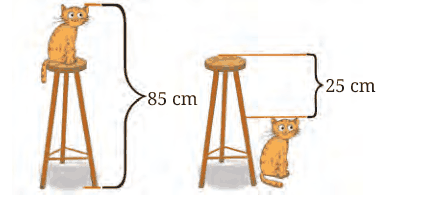
Let the stool be h cm and the cat c cm tall. Cat on the stool: h + c = 85. Cat on the floor, 25 cm below the top of the stool: h − c = 25. Adding: 2h = 110 ⇒ h = 55 cm (and the cat is 30 cm).
Answer
End-of-Chapter Exercises
(i) Slope = rise/run between (0, 0) and (2, 6) = (6 − 0)/(2 − 0) = 3.
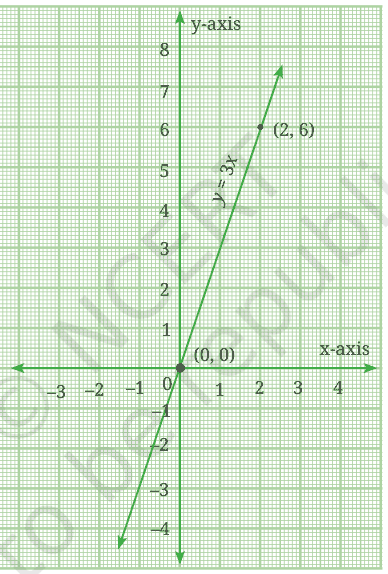
(ii) The y-intercept is 0: the line passes through the origin. For the tank, this means the water level is 0 cm at the start (time 0).
(iii) (a) y = 3 × 5 = 15 cm. (b) 3x = 21 ⇒ x = 7 minutes.
(iv) For x = 4 the line gives y = 12, not 10. So (4, 10) is not on the line.
(v) On x = 3 the line y = 3x gives y = 9, so the intersection is (3, 9) – substitute x = 3 into y = 3x.
Answer
(i) Plot some points (C, F): (0, 32), (100, 212), (−40, −40), (10, 50) and join them with a straight line (slope 9/5, F-intercept 32).
(ii) F = (9/5)(30) + 32 = 54 + 32 = 86 °F.
(iii) 95 = (9/5)C + 32 ⇒ (9/5)C = 63 ⇒ C = 35 °C.
(iv) 0 °C = 32 °F; 0 °F: 0 = (9/5)C + 32 ⇒ C = −160/9 ≈ −17.8 °C.
(v) Put F = C: C = (9/5)C + 32 ⇒ −(4/5)C = 32 ⇒ C = −40. Yes: −40° is the same in both scales.
Answer
2x + y = 6: points (0, 6), (3, 0), (1, 4). 2x − y − 2 = 0: points (0, −2), (1, 0), (3, 4). The lines meet at (2, 2): x = 2, y = 2. (Check: 4 + 2 = 6 ✓, 4 − 2 − 2 = 0 ✓.)
Answer
Method: read two clear grid points on each line on the cover. Find each line's equation (slope = rise/run, then y = mx + d using one point). Solve the two equations together by elimination or substitution, and check that the point matches where the lines cross in the picture. (The cover artwork is not part of the chapter PDF, so read the points from your printed book.)
Answer
At the x-intercept y = 0: 0 = mx + c ⇒ x = −c/m (for m ≠ 0). The line meets the x-axis at (−c/m, 0). (If m = 0 and c ≠ 0, the line is horizontal and has no x-intercept.)
Answer
For t minutes: Plan A = 50 + 0.20t, Plan B = 30 + 0.30t.
Answer
Equal when 50 + 0.2t = 30 + 0.3t
⇒ 0.1t = 20
⇒ t = 200 minutes (both cost ₹90).
Plan A is cheaper for more than 200 minutes a month; Plan B is cheaper for less than 200 minutes.
(i) Infinitely many – all the parallel lines y = mx + d for different d.
(ii) Exactly one – among those parallel lines, only one passes through the given point (d is fixed by the point).
Answer
A unique solution needs a₁/a₂ ≠ b₁/b₂: 4/2 ≠ p/2 ⇒ p ≠ 4. (Any value of p except 4.)
Answer
Standard forms: (a + b)x − 2by − (5a + 2b + 1) = 0 and 3x − y − 14 = 0. Infinitely many solutions need
Answer
(a + b)/3 = (−2b)/(−1) = (5a + 2b + 1)/14.
From the first two: a + b = 6b
⇒ a = 5b. From the last two: 2b × 14 = 5a + 2b + 1
⇒ 28b = 25b + 2b + 1
⇒ b = 1. So a = 5, b = 1. (Check: 6/3 = 2/1 = 28/14 = 2 ✓.)
Coincident lines need 1/(k − 1) = 2/(k + 1) = 3/(k + 3).
Answer
From the first two: k + 1 = 2k − 2
⇒ k = 3. Check: 1/2 = 2/4 = 3/6 ✓. k = 3.
(i) The corner points of Robot 1's path are (3k, 4k), on the line y = (4/3)x. Robot 2's are (10 + j, 2j), on the line y = 2(x − 10) = 2x − 20. Solving: (4/3)x = 2x − 20 ⇒ (2/3)x = 20 ⇒ x = 30, y = 40. The paths meet at (30, 40), which is a corner point of both (k = 10, j = 20).
Answer
(Note: if you trace the actual zig-zag "right, then up" steps, the two step-paths first touch a little earlier, at (24, 28), which is also a corner point of both.)
(ii) Robot 1: from (3, 0), slope 5/5 = 1
⇒ y = x − 3. Robot 2: from (7, 0), slope −3/5
⇒ y = −(3/5)(x − 7). The two lines would meet at x − 3 = −(3/5)x + 21/5
⇒ x = 4.5, y = 1.5. But Robot 2 only moves to the right of x = 7, and for x ≥ 7 Robot 1 is above the x-axis while Robot 2 is below it. So the paths do not intersect (the crossing point (4.5, 1.5) lies behind Robot 2's start).
Question 12*
First reading 2:a; 15 minutes later 3:b, so a + 15 = 60 + b ⇒ a − b = 45. Also a = 6b ⇒ 5b = 45 ⇒ b = 9, a = 54. He first looked at 2:54, so the second time was 3:09.
Question 13*
Tens digit x, units digit y: x + y = 15 and (10y + x) − (10x + y) = 9 ⇒ y − x = 1. So x = 7, y = 8: the number is 78 (87 − 78 = 9 ✓).
Question 14*
Opposite angles of a cyclic quadrilateral add to 180°:
∠A + ∠C: (x + 7) + (3y + 23) = 180 ⇒ x + 3y = 150.
∠B + ∠D: (y + 8) + (4x + 12) = 180 ⇒ 4x + y = 160.
From the first, x = 150 − 3y; then 600 − 12y + y = 160 ⇒ y = 40, x = 30.
∠A = 37°, ∠B = 48°, ∠C = 143°, ∠D = 132° (37 + 143 = 180 ✓, 48 + 132 = 180 ✓).
Question 15*
Let speed v km/h and time t h, distance vt.
(v + 6)(t − 6) = vt ⇒ 6t − 6v = 36 ⇒ t − v = 6.
(v − 4)(t + 6) = vt ⇒ 6v − 4t = 24 ⇒ 3v − 2t = 12.
Put t = v + 6: 3v − 2v − 12 = 12 ⇒ v = 24, t = 30. Speed 24 km/h, distance 24 × 30 = 720 km.
Question 16*
Let the father be F and the children's total S. Now: F = S. After 20 years each of the 4 children is 20 years older: S + 80 = 2(F + 20). With S = F: F + 80 = 2F + 40 ⇒ F = 40 years.
Extra Practice Questions
1. Find the slope of the line through (1, −2) and (4, 7). (7 + 2)/(4 − 1) = 3
2. Solve 3x + 2y = 11, 2x − y = 5. Multiply the second by 2 and add: 7x = 21 ⇒ x = 3, y = 1
3. For what k are kx + 3y = 5 and 6x + 9y = 7 parallel? k/6 = 3/9 ⇒ k = 2 (and 5/7 ≠ 1/3 ✓)