
Circle of Learning • New NCERT textbook "Ganita Manjari" Part II (2026-27) • Think and Reflect, Examples, Exercise Set 9.1 – step-by-step solutions
Think and Reflect (Converse of the Isosceles Triangle Theorem)
Is it true that if two angles of a triangle are equal, the sides opposite them are equal? Prove it.
Answer
Yes. In ΔABC let ∠B = ∠C. Draw the altitude AD from A to BC. In ΔABD and ΔACD: ∠B = ∠C (given), ∠ADB = ∠ADC = 90°, and AD is common. By AAS congruence, ΔABD ≅ ΔACD, so AB = AC.
Examples from the Chapter
Fermat numbers. 2^(2⁵) + 1 = 2³² + 1 = 4294967297 = 641 × 6700417, so it is composite – a counterexample to Fermat's claim.
Example 2. P: "multiple of 6 ⇒ multiple of 3" is true: 6k = 3(2k). Q: "multiple of 3 ⇒ multiple of 6" is false: counterexample 9 (or 3, 15).
Example 3. Both are true. The discussion argument proves Q (odd number of factors ⇒ square). P is proved by noting that a square n = f × f has exactly one repeating factor pair (f, f), while every other factor pairs with a different partner. So the number of factors is even + 1 = odd.
Example 4. P: "same area ⇒ congruent" is false. Counterexample: a right triangle with legs 3 and 4 (area 6) and a triangle with base 6 and height 2 (area 6) are not congruent. Q: "congruent ⇒ same area" is true: congruent triangles can be placed exactly on top of each other, so they cover the same region.
Both a proposition and its converse false
• "If a number is prime, then it is odd" – false (2). Converse: "If a number is odd, then it is prime" – false (9).
• "If a quadrilateral has equal diagonals, then it is a rhombus" – false (a non-square rectangle). Converse: "If a quadrilateral is a rhombus, then it has equal diagonals" – false (a rhombus with angles 60° and 120°).
Example 5 (converse of Baudhāyana–Pythagoras). In right ΔXYZ with legs a and b, XY² = a² + b² = c², so XY = c. Then ΔABC and ΔXYZ have sides a, b, c each, so ΔABC ≅ ΔXYZ (SSS). Hence ∠C = ∠Z = 90°, and ΔABC is right-angled. The converse is true.
Think and Reflect (More Examples)
1. Real life – proposition true, converse false
• "If you live in Delhi, then you live in India." Converse "If you live in India, then you live in Delhi" is false (counterexample: someone in Chennai).
• "If an animal is a cow, then it has four legs." Converse false: a dog has four legs.
• "If it is a mango, then it is a fruit." Converse false: an apple.
2. Geometry and number theory
• "If a quadrilateral is a square, then it is a rectangle." Converse false: a 4 × 2 rectangle.
• "If a quadrilateral is a rhombus, then its diagonals are perpendicular." Converse false: a kite.
• "If two angles are vertically opposite, then they are equal." Converse false: two base angles of an isosceles triangle are equal but not vertically opposite.
• "If n is divisible by 4, then n is even." Converse false: 6.
• "If n is a prime greater than 2, then n is odd." Converse false: 15.
Exercise Set 9.1
For each item: the converse, whether each statement is true, and a justification or counterexample.
P: If two lines are parallel, then the corresponding angles formed by a transversal are equal. – True (the corresponding angles property of parallel lines).
Answer
Converse: If the corresponding angles formed by a transversal are equal, then the two lines are parallel. – True. If the lines were not parallel, they would meet and form a triangle with the transversal, in which an exterior angle would equal an interior opposite angle – impossible, since the exterior angle equals the sum of the two interior opposite angles.
P: If a quadrilateral is a square, then all its angles are equal. – True (all are 90°).
Answer
Converse: If all angles of a quadrilateral are equal, then it is a square. – False. Counterexample: a 4 cm × 2 cm rectangle has all angles 90° but is not a square.
Question 3*
P: If AB = AC, then IE = IF. – True. If AB = AC, then ∠B = ∠C, so ∠IBC = ∠ICB and IB = IC. Also ∠FBI = ∠ECI (half of equal angles) and ∠BIF = ∠CIE (vertically opposite). By ASA, ΔBIF ≅ ΔCIE, so IF = IE.
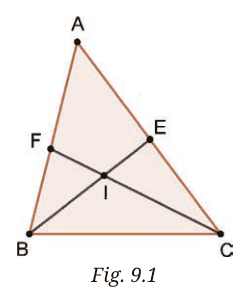
Converse: If IE = IF, then AB = AC. – False. Counterexample: take ∠A = 60°, ∠B = 80°, ∠C = 40° (AB ≠ AC). Then ∠BIC = 90° + ½∠A = 120°, so ∠FIE = 120° and ∠A + ∠FIE = 180°. Hence A, F, I, E lie on a circle. AI bisects ∠A, so the chords IF and IE subtend equal angles (30°) at A, and therefore IF = IE. (A numerical check confirms that IE and IF come out equal in this triangle.) So IE = IF happens either when AB = AC or when ∠A = 60°.
P: If x = y, then a + x = a + y. – True (adding the same number to equal numbers gives equal results).
Answer
Converse: If a + x = a + y, then x = y. – True (subtract a from both sides). Both are used when solving equations.
P: If a and b are perfect squares, then ab is a perfect square. – True: a = m², b = n² ⇒ ab = (mn)².
Answer
Converse: If ab is a perfect square, then a and b are perfect squares. – False. Counterexample: a = 2, b = 8, ab = 16 = 4².
P: If x = y, then x² = y². – True.
Answer
Converse: If x² = y², then x = y. – False. Counterexample: x = 3, y = −3 (both squares are 9).
P: If x = y, then x³ = y³. – True.
Answer
Converse: If x³ = y³, then x = y. – True for real numbers. x³ − y³ = (x − y)(x² + xy + y²), and x² + xy + y² = (x + y/2)² + ¾y² is positive unless x = y = 0. So x³ = y³ forces x − y = 0. (Also, cubing keeps order: a bigger number has a bigger cube.)
P: If n is divisible by 24, then it is divisible by both 4 and 6. – True: 24k = 4(6k) = 6(4k).
Answer
Converse: If n is divisible by both 4 and 6, then it is divisible by 24. – False. Counterexample: 12 (also 36). The LCM of 4 and 6 is 12, not 24.
P: If n is divisible by 60, then it is divisible by 5 and 12. – True: 60k = 5(12k) = 12(5k).
Answer
Converse: If n is divisible by 5 and 12, then it is divisible by 60. – True, because 5 and 12 have no common factor, so their LCM is 5 × 12 = 60. Every common multiple of 5 and 12 is a multiple of 60.
P: If n is the square of a prime, then it has exactly 3 factors. – True: n = p² has factors 1, p, p² only.
Answer
Converse: If n has exactly 3 factors, then n is the square of a prime. – True. An odd number of factors means n is a perfect square, n = m² (Example 3), and 1, m, m² are three factors. If m had any other factor d (1 < d < m), then d would also be a factor of n, giving more than 3. So m is prime.
P: If n is a product of two unequal primes, then it has exactly 4 divisors. – True: n = pq has divisors 1, p, q, pq.
Answer
Converse: If n has exactly 4 divisors, then it is a product of two unequal primes. – False. Counterexample: 8 = 2³ has divisors 1, 2, 4, 8 (also 27).
P: If n and n + 3 have no common factor (other than 1), then n is not a multiple of 3. – True: if 3 divided n, it would also divide n + 3, giving a common factor 3.
Answer
Converse: If n is not a multiple of 3, then n and n + 3 have no common factor (other than 1). – True. Any common factor d divides (n + 3) − n = 3, so d = 1 or 3. Since 3 does not divide n, d = 1.
Answer
Counterexamples
(i) 4n² + 1: n = 1, 2, 3 give 5, 17, 37 (prime), but n = 4 gives 65 = 5 × 13.
(ii) n² + n + 11: n = 1 to 9 give primes, but n = 10 gives 121 = 11 × 11.
(iii) 4ⁿ + 3: n = 1, 2, 3 give 7, 19, 67 (prime), but n = 4 gives 259 = 7 × 37. (Also n = 0 gives 4.)
(i) n = 11 is prime, but 2¹¹ − 1 = 2047 = 23 × 89.
(ii) n = 6 is even, but 2⁶ + 1 = 65 = 5 × 13. (n = 2, 4 give 5, 17, which are prime.)
Answer
(i) If n is divisible by 8, then n = 8k = 2(4k) = 4(2k), so it is divisible by both 2 and 4.
Answer
(ii) No. The converse is false: 12 is divisible by 2 and by 4 but not by 8 (also 4, 20, 28). Divisibility by 4 already includes divisibility by 2, so this checks only for 4. To test for 8, check whether the number formed by the last three digits is divisible by 8.
If a number is divisible by 3, then the sum of its digits is a multiple of 3.
Answer
If the sum of the digits of a number is a multiple of 3, then the number is divisible by 3.
Both statements are true, so the two conditions imply each other: a number is divisible by 3 if and only if its digit sum is a multiple of 3.
(i) Property: "If a quadrilateral is of type Q, then it has equal diagonals."
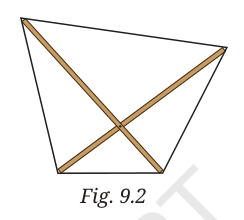
(a) Yes, the sticks must be of equal length. Every type-Q quadrilateral has equal diagonals, so unequal sticks can never give type Q.
Answer
(b) Yes, it may matter. The property only tells us what every type-Q quadrilateral has; it does not say that equal diagonals are enough. Many quadrilaterals have equal diagonals (e.g. rectangles and isosceles trapezia), and Q may have other requirements. For example, if Q were "square", the sticks would have to bisect each other at right angles.
(ii) Property: "If a quadrilateral has equal diagonals, then it is of type Q."
(a) Using equal sticks is enough to guarantee type Q, so we should use equal sticks. (This property says nothing about quadrilaterals with unequal diagonals, so unequal sticks might or might not give Q – we cannot be sure.)
(b) No, it does not matter how equal sticks are put together (as long as they cross to form a quadrilateral): any quadrilateral with equal diagonals is of type Q.
Extra Practice Questions
1. Write the converse of "If a triangle is equilateral, then all its angles are 60°". Is it true? "If all angles of a triangle are 60°, then it is equilateral" – true (equal angles ⇒ equal opposite sides).
2. Give a counterexample: "Every number ending in 7 is prime." 27 = 3 × 9 (also 57, 77).
3. "If n² is even, then n is even." Is the converse true? Converse: "If n is even, then n² is even" – true (n = 2k ⇒ n² = 4k²).