
NCERT Solutions Class 9 Maths (Ganita Manjari Part II) Chapter 14 – Math of Space: Surface Area and Volume
Circle of Learning • New NCERT textbook "Ganita Manjari" Part II (2026-27) • Think and Reflect, Exercise Sets 14.1–14.4, Guesstimates, End-of-Chapter Exercises – step-by-step solutions (π = 22/7 or 3.14 as stated)
Think and Reflect (Cuboid and Cube)
Why does volume = area of base × height? Think of the cuboid as a stack of very thin rectangular sheets (like a pack of cards), each of area l × w. The volume is the total of all the sheets, i.e. (area of one sheet) × (how high the stack is) = lw × h. A unit-cube picture gives the same result: l × w unit cubes cover the base in one layer, and there are h layers.
Cube of side a: total surface area = 6a²; volume = a³. (Put l = w = h = a in 2(lw + wh + hl) and lwh.)
Exercise Set 14.1
a³ = 64 ⇒ a = 4 cm. TSA = 6a² = 6 × 16 = 96 cm².
Answer
2 m = 200 cm. Along each edge, 200 ÷ 20 = 10 small cubes, so the box holds 10 × 10 × 10 = 1000 cubes.
Answer
Along the edges: 40 ÷ 2 = 20, 25 ÷ 1.25 = 20, 10 ÷ 1 = 10. Number of boxes = 20 × 20 × 10 = 4000. (Check: 10000 m³ ÷ 2.5 m³ = 4000.)
Answer
Side of each cube = ∛125 = 5 cm. Joining them gives a 10 cm × 5 cm × 5 cm cuboid. TSA = 2(10 × 5 + 5 × 5 + 10 × 5) = 2(125) = 250 cm².
Answer
Original cube: SA = 6 × 4² = 96 cm². It is cut into 4³ = 64 cubes, each with SA 6 cm², total 384 cm².
Answer
Ratio = 96 : 384 = 1 : 4. The volume stays the same, but the total surface area becomes 4 times. (This is why small cells or crushed sugar dissolve or exchange heat faster.)
lw = 6, wh = 15, lh = 10. Multiplying: (lwh)² = 6 × 15 × 10 = 900, so V = 30 cm³. (The edges are 2 cm, 3 cm, 5 cm.)
Answer
Question 7*
The 5 cm cube gives 125 small cubes.
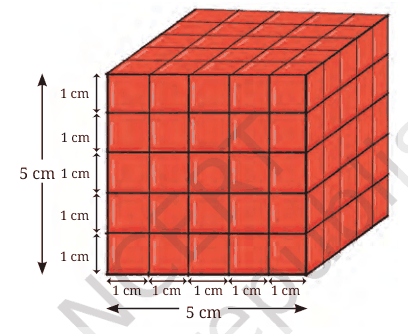
(i) Three faces painted – the corner cubes: 8.
(ii) Two faces painted – on the edges but not corners: 12 edges × (5 − 2) = 36.
(iii) One face painted – inside each face: 6 faces × (5 − 2)² = 54.
(iv) No face painted – the inner 3 × 3 × 3 cube: 27.
Check: 8 + 36 + 54 + 27 = 125 ✓.
Question 8*
TSA = 2(ab + bc + ca) = 100 ⇒ ab + bc + ca = 50, with whole numbers a ≤ b ≤ c.
Adding a² to both sides: (a + b)(a + c) = 50 + a².
Since 3a² ≤ ab + bc + ca = 50, a can only be 1, 2, 3 or 4.
• a = 1: (b + 1)(c + 1) = 51 = 3 × 17 ⇒ b = 2, c = 16.
• a = 2: (b + 2)(c + 2) = 54, with b + 2 ≥ 4: 54 = 6 × 9 ⇒ b = 4, c = 7.
• a = 3: (b + 3)(c + 3) = 59, which is prime – no solution.
• a = 4: (b + 4)(c + 4) = 66, with both factors ≥ 8 – impossible (66 = 6 × 11).
(i) Yes, there is more than one. (ii) Exactly two: 1 × 2 × 16 and 2 × 4 × 7 (in cm). (iii) The argument above checks every possible value of a, so these are all of them.
Think and Reflect (Swimming Pool)
Volume A = 8 × 50 × 20 = 8000 ft³ ≈ 2,26,400 litres. Volume B = 6 × 100 × 15 = 9000 ft³ ≈ 2,54,700 litres.
Points to consider: safety (depth – shallower is safer for students), the space available on campus (B needs a 100 ft long plot), water needed and cost of filling and cleaning (B needs about 28,000 litres more), use (a 100 ft length is good for racing laps; a 50 × 20 ft pool suits teaching), and the cost of tiling (the surface area to be tiled). Sample choice: B is safer (6 ft deep) and better for laps, if the school has the space and water. Otherwise A is more compact and uses less water but is deeper, so it needs more supervision.
Exercise Set 14.2
Let A have radius r and height h, so B has radius 2r and height h/2.
Answer
CSA: 2πrh : 2π(2r)(h/2) = 2πrh : 2πrh = 1 : 1.
Volume: πr²h : π(4r²)(h/2) = 1 : 2 = 1 : 2.
(a) V₁ : V₂ = (r₁/r₂)² × (h₁/h₂) = (4/9)(3/2) = 2/3 ⇒ 2 : 3.
(b) CSA₁ : CSA₂ = (r₁/r₂)(h₁/h₂) = (2/3)(3/2) = 1 : 1.
Answer
The largest cylinder stands on one face: radius r/2 and height r. Volume = π(r/2)² × r = πr³/4 cm³ (about 78.5% of the cube).
Answer
Question 4*
New volume = π(1.1r)² × h(1 − x/100) = πr²h ⇒ 1.21(1 − x/100) = 1 ⇒ 1 − x/100 = 100/121 ⇒ x = 2100/121 ≈ 17.36.
(i) Volume of cube = 12³ = 1728 cm³.
(ii) Volume of one rod = (22/7) × 2² × 12 = 1056/7 ≈ 150.86 cm³.
(iii) 1728 ÷ 150.86 ≈ 11.45, so 11 complete rods.
Answer
Exercise Set 14.3
r = 12 m, l = 21 m. TSA = πr(l + r) = (22/7) × 12 × 33 ≈ 1244.57 m² (1243.44 m² with π = 3.14).
Answer
CSA = πrl = (22/7) × 7 × 10 = 220 cm².
Answer
l = √(16² + 12²) = 20 cm. CSA = 3.14 × 12 × 20 = 753.6 cm². TSA = 753.6 + 3.14 × 144 = 753.6 + 452.16 = 1205.76 cm².
Answer
(1/3) × 3.14 × r² × 15 = 1570 ⇒ 15.7r² = 1570 ⇒ r² = 100 ⇒ r = 10 cm.
Answer
(i) πrl = 308 ⇒ (22/7) × r × 14 = 308 ⇒ 44r = 308 ⇒ r = 7 cm.
(ii) TSA = 308 + (22/7) × 49 = 308 + 154 = 462 cm².
Answer
l = √(7² + 24²) = 25 cm. One cap = πrl = (22/7) × 7 × 25 = 550 cm². Ten caps: 5500 cm².
Answer
Question 7*
l = √(8² + 6²) = 10 m. CSA = 3.14 × 6 × 10 = 188.4 m². Length of 3 m-wide tarpaulin = 188.4 ÷ 3 = 62.8 m. Adding 20 cm for margins: 63 m.
Rotating about the 8 cm side gives a cone with h = 8 cm, r = 6 cm, l = 10 cm.
Answer
Volume = (1/3)π × 36 × 8 = 96π ≈ 301.44 cm³. CSA = π × 6 × 10 = 60π ≈ 188.4 cm².
Question 9*
The water forms a smaller cone similar to the cup, with half the height and half the radius. Its volume = (1/3)π(r/2)²(h/2) = (1/8) × (1/3)πr²h. So the water fills only 1/8 of the cup.
Think and Reflect (Volume of a Sphere)
Link between V = (1/3) × 4πr² × r and the cone formula: divide the surface of the sphere into a huge number of tiny pieces and join each to the centre. This splits the ball into many thin cones, each of height r. The volume of each is (1/3) × (base area) × r. Adding all of them: V = (1/3) × r × (total base area) = (1/3) × r × 4πr² = (4/3)πr³.
Exercise Set 14.4
SA = 4πr² = 4 × (22/7) × 0.49 = 6.16 cm².
Answer
Question 2*
Same metal, so weight ∝ volume ∝ r³. 5920/740 = 8 = (R/r)³ ⇒ R/r = 2. The smaller radius is 2.5 cm, so the larger radius is 5 cm.
Surface area ∝ (diameter)². Moon : Earth = (1/4)² = 1 : 16.
Answer
(i) CSA = 2πr² = 2 × (22/7) × 441 = 2772 cm². (ii) TSA = 3πr² = 4158 cm².
Answer
Box volume = 16 × 8 × 8 = 1024 cm³. (Diameter 4 cm, so 4 × 2 × 2 = 16 spheres fit exactly.)
Answer
Volume of 16 spheres = 16 × (4/3)π × 8 = 512π/3 ≈ 536.2 cm³.
Liquid = 1024 − 536.2 ≈ 488 cm³.
New volume = (4/3)π(1.1r)³ = 1.331 × (4/3)πr³. The increase is 0.331, i.e. 33.1%.
Answer
Question 7*
(1 + x/100)³ = 1.728 = 1.2³ ⇒ 1 + x/100 = 1.2 ⇒ x = 20.
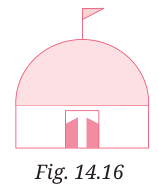
2πr = 35.2 ⇒ r = 35.2 × 7/44 = 5.6 m. Curved surface = 2πr² = 2 × (22/7) × 31.36 = 197.12 m² = 19,71,200 cm².
Answer
Cost = (19,71,200 ÷ 100) × ₹10 = ₹1,97,120.
Guesstimates in the Text
Example 6 – other packings: placing balls in a simple square grid (config A) uses only about 52% of the space. Staggered packings (balls sitting in the hollows of the layer below) use about 68% to 74% of the space. Upper bound ≈ 33,45,000 balls; with ~74% efficiency ≈ 33,45,000 × 0.74 ≈ 24–25 lakh balls, and with ~68% ≈ 22–23 lakh – noticeably more than 16,87,500.
End-of-Chapter Exercises
Guesstimate answers depend on assumptions; the reasoning is what matters.
Container = 10 × 15 × 20 = 3000 cm³. A scoop is roughly a sphere of radius 2.5 cm: (4/3)π(2.5)³ ≈ 65 cm³. Scoops ≈ 3000 ÷ 65 ≈ 45 (about 40–50, since scooping is not perfect).
Answer
(a + 1)³ − a³ = 3a² + 3a + 1 unit cubes. (Three slabs a × a × 1, three rods a × 1 × 1 and one corner cube.)
Answer
Question 3*
(i) A classroom of about 9 m × 7 m × 3.5 m ≈ 220 m³ = 2,20,000 litres. A person drinks about 2 L a day: 2 × 365 × 75 ≈ 55,000 L in a lifetime. That is only about ¼ of the room, so no.
(ii) Wall area ≈ perimeter 32 m × height 3.5 m ≈ 112 m², minus doors and windows ≈ 97 m². With 23 cm thick walls, the volume ≈ 22 m³. One brick with mortar ≈ 20 × 10 × 10 cm = 0.002 m³, so about 11,000 bricks (order of ten thousand).
(A) 50³ = 1,25,000 mm³; (B) 100 × 10³ = 1,00,000 mm³. Option A gives more chocolate.
Answer
About 8.1 billion people, standing crowded at about 4 people per m² (0.25 m² each): 8.1 × 10⁹ × 0.25 ≈ 2 × 10⁹ m² ≈ 2000 km² – a square about 45 km × 45 km, a little larger than the area of Delhi.
Answer
One glass = (22/7) × 3.5² × 12 = 462 cm³. For 1600 students: 462 × 1600 = 7,39,200 cm³ = 739.2 litres.
Answer
Sphere SA = 4π × 25 = 100π. Cone CSA = 100π/5 = 20π = π × 4 × l ⇒ l = 5 cm. Height = √(25 − 16) = 3 cm. Volume = (1/3)π × 16 × 3 = 16π ≈ 50.29 cm³.
Answer
Volume ratios equal the cubes of the radius ratios.
(i) Jupiter : Earth = (69900/6370)³ ≈ 10.97³ ≈ 1321.
(ii) Sun : Earth = (695700/6370)³ ≈ 109.2³ ≈ 13,03,000 (about 1.3 million).
Answer
The smallest enclosing cylinder has radius r and height 2r: volume = πr² × 2r = 2πr³. Sphere = (4/3)πr³ = (2/3) × 2πr³. So the sphere's volume is 2/3 of the cylinder's.
Answer
Question 10*
If the string is d higher everywhere: 2π(R + d) − 2πR = 1 ⇒ d = 1/(2π) ≈ 0.159 m ≈ 16 cm.
The radius R cancels, so the answer is the same ≈ 16 cm for the Moon, Jupiter and a volleyball. It is surprising because 1 m seems tiny compared with the Earth's 40,000 km equator, but the extra height depends only on the extra length, not on the size of the ball.
Question 11*
The square's corners are on a circle of radius r, so its diagonal is 2r and its area is ½ × (2r)² = 2r². Pyramid volume = (1/3) × 2r² × h. Cylinder = πr²h.
Ratio = (2r²h/3) : πr²h = 2 : 3π (≈ 0.21).
(i) (l + 1)wh − lwh = wh ⇒ (c) wh cubic units.
(ii) π(r + 1)²h − πr²h = π(2r + 1)h = 2πrh + πh ⇒ (e).
(iii)* (4/3)π[r³ − (r − 1)³] = (4/3)π(3r² − 3r + 1) cubic units – the volume decreases by this amount.
Answer
Question 13*
a = ∛V, so S = 6a² = 6V^(2/3).
Question 14*
a = √(S/6), so V = a³ = (S/6)^(3/2) = (S/6)√(S/6).
The water must rise 20 − 16 = 4 cm: extra volume = π × 4² × 4 = 64π cm³. Each marble = (4/3)π × 1³ = (4/3)π. Number = 64π ÷ (4/3)π = 48 marbles.
Answer
Sample estimate: the ink tube (refill) is a thin cylinder. Inner diameter ≈ 2 mm (r ≈ 0.1 cm), ink length ≈ 11 cm. Volume ≈ π × 0.1² × 11 ≈ 0.35 cm³ (about a third of a millilitre). Measure your own pen's refill.
Answer
(i) Dough = (4/3)π × 6³ ≈ 905 cm³. One chapati ≈ a disc of radius 8 cm and thickness 0.2 cm ≈ π × 64 × 0.2 ≈ 40 cm³. So about 22 chapatis.
Answer
(ii)* Sample: a coconut with inner radius ≈ 7 cm and flesh ≈ 1 cm thick. Each half is a hemispherical shell: (2/3)π(7³ − 6³) = (2/3)π × 127 ≈ 266 cm³, so the whole coconut has ≈ 530 cm³ of flesh. (Use your own measurements.)
(i) The book has about 160 pages (80 sheets) of about 20 cm × 27 cm ≈ 0.054 m². All 160 pages laid out ≈ 160 × 0.054 ≈ 8.6 m² (only 4.3 m² if the sheets are laid out). A classroom floor is about 50–60 m², so no.
Answer
(ii) Storeroom = 15 × 20 × 30 = 9000 ft³ ≈ 255 m³. Book ≈ 27 × 20 × 1 cm = 540 cm³. Maximum ≈ 255,000,000 ÷ 540 ≈ 4.7 lakh books (if stacked perfectly).
Question 19*
An average person's volume ≈ 0.07 m³ (about 70 litres, as our body density is close to water's). 8.1 × 10⁹ × 0.07 ≈ 5.7 × 10⁸ m³. Side = ∛(5.7 × 10⁸) ≈ 830 m – a cube less than 1 km on each side (if people were packed with no gaps; real packing would need a bigger cube, perhaps about 1 km).
Question 20*
(i) For a thin layer, volume ≈ surface area × thickness, so t ≈ V/(4πR²). (Exactly: t = ∛(R³ + 3V/(4π)) − R.)
(ii) t ≈ 1.38 × 10⁹ ÷ (4π × 6371²) ≈ 1.38 × 10⁹ ÷ 5.1 × 10⁸ ≈ 2.7 km.
Question 21*
One example: start with a cuboid 8 × 14 × 14 (V = 1568, S = 2(112 + 196 + 112) = 840). Change it to 1 × 28 × 28: V = 784 (halved), S = 2(28 + 784 + 28) = 1680 (doubled). (Found by searching whole-number dimensions; another pair is 9 × 10 × 12 → 1 × 6 × 90. Flattening a box increases surface area while reducing volume.)
Question 22 (Project)
Measure each room's length, breadth and height (or count tiles and steps), treat rooms as cuboids, compute l × w × h for each and add them up. Subtract big built-in solids if you wish. Present a table of rooms, dimensions, volumes and the total, with the assumptions you made. (Personal project.)
Extra Practice Questions
1. Find the volume of a sphere of diameter 42 cm. (4/3)(22/7)(21³) = 38,808 cm³
2. A cylinder and a cone have the same base and height. If the cylinder's volume is 360 cm³, find the cone's. 120 cm³
3. How many cubes of side 3 cm fit in a cuboid 9 × 12 × 15 cm? 3 × 4 × 5 = 60