
Circle of Learning • New NCERT textbook "Ganita Manjari" (2026-27) • Exercise Sets 3.1–3.5, Think and Reflect, End-of-Chapter Exercises – step-by-step solutions
Exercise Set 3.1
A merchant in Lothal receives 15 copper ingots for every 2 bags of spices. If he brings 12 bags, how many ingots will he leave with?
Answer
12 bags = 6 groups of 2 bags. Ingots = 6 × 15 = 90 ingots.
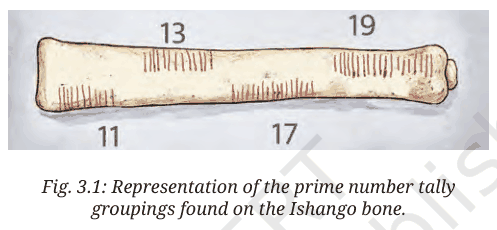
Ishango bone column: 11, 13, 17, 19. What do these numbers have in common? List the next three numbers that fit this pattern.
Answer
They are all prime numbers (the primes between 10 and 20). The next three primes are 23, 29 and 31.
Natural numbers are closed under addition. Are they closed under subtraction? Give examples.
Answer
No. The difference of two natural numbers is not always a natural number. Examples: 3 − 5 = −2 and 7 − 7 = 0; neither −2 nor 0 is a natural number. (Sometimes it works, e.g. 9 − 4 = 5, but closure needs it to work always.)
Each finger has 3 joints, and the thumb counts them. How many can you count on one hand? How does this relate to base-12 systems?
Answer
Using the thumb to touch the joints (segments) of the other four fingers: 4 fingers × 3 joints = 12. This is why counting in twelves (base 12, a "dozen") was natural in ancient times – it survives today in 12 months in a year, 12 hours on a clock face, 12 inches in a foot and selling items by the dozen. (Using both hands – counting 12s on one hand and marking each completed dozen with a finger of the other – one can count up to 60, linked to the base-60 system of minutes and seconds.)
Think and Reflect (Negative Numbers)
Why does a negative times a negative equal a positive?
If a negative number is a debt, multiplying by a negative number means removing debts. Removing four debts of ₹3 each makes you ₹12 better off: (−3) × (−4) = +12.
Exercise Set 3.2
The temperature in Ladakh is 4 °C at noon and drops by 15 °C by midnight. What is the midnight temperature?
Answer
4 − 15 = −11 °C
A trader takes a loan of ₹850, makes a profit of ₹1,200 the next day and a loss of ₹450 the following week. Write an equation and find his final standing.
Answer
(−850) + 1200 + (−450) = −100. He is still in debt of ₹100.
Calculate: (i) (−12) × 5 (ii) (−8) × (−7) (iii) 0 − (−14) (iv) (−20) ÷ 4
Answer
(i) −60 (ii) 56 (iii) 14 (iv) −5
Using a real-world example of debt, explain why subtracting a negative number is the same as adding a positive number (e.g. 10 − (−5) = 15).
Answer
Suppose you have ₹10 in cash but you also owe a friend ₹5 (a debt of −5). If the friend cancels (takes away) that debt, your situation improves by ₹5 – exactly as if someone gave you ₹5. Taking away a debt of 5 = gaining 5. So 10 − (−5) = 10 + 5 = 15.
Think and Reflect (Rational Numbers)
Why do we need q ≠ 0 in the definition of a rational number p/q?
Answer
Division by zero is not defined. If p/0 = r, then p = r × 0 = 0 for every r, which is impossible for p ≠ 0 and gives no single answer for p = 0. So p/q makes sense only when q ≠ 0.
While adding or subtracting rational numbers with different denominators, how do you make the denominators equal?
Answer
Find the LCM of the denominators and convert each fraction to an equivalent fraction with the LCM as denominator (multiply numerator and denominator by the same number). E.g. 1/4 + 1/6 = 3/12 + 2/12 = 5/12.
Verify the distributive law for rational numbers.
Answer
Take a = 1/2, b = 1/3, c = 1/4. a × (b + c) = 1/2 × 7/12 = 7/24. a × b + a × c = 1/6 + 1/8 = 4/24 + 3/24 = 7/24. Both are equal, so a(b + c) = ab + ac holds.
Exercise Set 3.3
Prove that the following are equal: (i) 2/3 and 4/6 (ii) 5/4 and 10/8 (iii) −3/5 and −6/10 (iv) 9/3 and 3
Answer
Two rationals a/b and c/d are equal if a × d = b × c (cross-multiplication), or if one is obtained from the other by multiplying numerator and denominator by the same number.
(i) 2 × 6 = 12 = 3 × 4 ✓ (also 4/6 = (2×2)/(3×2))
(ii) 5 × 8 = 40 = 4 × 10 ✓
(iii) (−3) × 10 = −30 = 5 × (−6) ✓
(iv) 9/3 = (3 × 3)/(3 × 1) = 3/1 = 3 ✓
Answer
Find the sum: (i) 2/5 + 3/10 (ii) 7/12 + 5/8 (iii) −4/7 + 3/14
(i) 4/10 + 3/10 = 7/10
(ii) LCM 24: 14/24 + 15/24 = 29/24
(iii) −8/14 + 3/14 = −5/14
Answer
Find the difference: (i) 5/6 − 1/4 (ii) 11/8 − 3/4 (iii) −7/9 − (−2/3)
(i) 10/12 − 3/12 = 7/12
(ii) 11/8 − 6/8 = 5/8
(iii) −7/9 + 6/9 = −1/9
Answer
Find the product: (i) 2/3 × 3/10 (ii) 7/11 × 5/8 (iii) −4/7 × 5/14
(i) 6/30 = 1/5 (ii) 35/88 (iii) −20/98 = −10/49
Answer
Find the quotient: (i) 2/3 ÷ 3/10 (ii) 7/11 ÷ 5/8 (iii) −4/7 ÷ 5/14
(i) 2/3 × 10/3 = 20/9
(ii) 7/11 × 8/5 = 56/55
(iii) −4/7 × 14/5 = −56/35 = −8/5
Show that (1/2 + 3/4) × 8/3 = 1/2 × 8/3 + 3/4 × 8/3.
Answer
LHS = (2/4 + 3/4) × 8/3 = 5/4 × 8/3 = 40/12 = 10/3.
RHS = 8/6 + 24/12 = 4/3 + 2 = 4/3 + 6/3 = 10/3.
LHS = RHS ✓ (distributive property).
Simplify using the distributive property: 7/9 × (6/7 − 3/4).
Answer
= 7/9 × 6/7 − 7/9 × 3/4 = 6/9 − 21/36 = 2/3 − 7/12 = 8/12 − 7/12 = 1/12
Find the rational number x such that (5/6)(x + 3/5) = (5/6)x + 1/2.
Answer
LHS = (5/6)x + (5/6)(3/5) = (5/6)x + 1/2, which is exactly the RHS.
So the equation is true for every rational number x – it is an identity (the distributive property), not an equation with one particular solution. For example, x = 0 gives 1/2 = 1/2 and x = 6 gives 11/2 = 11/2.
Think and Reflect (Number Line)
Represent 8/5 and −7/4 on a number line.
8/5 = 1 3/5: divide the gap between 1 and 2 into 5 equal parts and mark the 3rd point to the right of 1.
−7/4 = −1 3/4: divide the gap between −1 and −2 into 4 equal parts and mark the 3rd point to the left of −1.
Why is the average (a + b)/2 of two rationals always a rational between a and b? – see End-of-Chapter Question 15.
Exercise Set 3.4
Represent 2/3, −5/4 and 1 1/2 on a single number line.
Answer
- 2/3: divide 0 to 1 into 3 equal parts; mark the 2nd point.
- −5/4 = −1 1/4: divide −1 to −2 into 4 equal parts; mark the 1st point to the left of −1.
- 1 1/2: the midpoint of 1 and 2.
Order on the line: −5/4 < 0 < 2/3 < 1 1/2.
Find three distinct rationals strictly between −1/2 and 1/4.
Answer
Write them with denominator 8: −4/8 and 2/8. Three numbers between: −3/8, 0, 1/8 (also −1/4, −1/8, 1/8, etc.).
Simplify: (−1/4) + (5/12).
Answer
−3/12 + 5/12 = 2/12 = 1/6
A tailor has 15 3/4 m of silk. One kurta needs 2 1/4 m. How many kurtas can he make?
Answer
15 3/4 = 63/4 and 2 1/4 = 9/4. Number of kurtas = 63/4 ÷ 9/4 = 63/9 = 7 kurtas (no silk is left over).
Find three rational numbers between 3.1415 and 3.1416.
Answer
Write them as 3.14150 and 3.14160: 3.14151, 3.14155, 3.14159 (any such numbers).
Can you think of other ways to find a rational number between any two rational numbers?
Answer
- Common denominator method: write both with a large common denominator (e.g. multiply by 10/10) and pick numerators in between.
- Decimal method: write both as decimals and insert a decimal in between (e.g. between 0.5 and 0.6 take 0.55).
- Mediant method: for a/b < c/d (b, d positive), the number (a + c)/(b + d) always lies between them. E.g. between 1/3 and 1/2 lies 2/5.
- Weighted averages: (2a + b)/3, (a + 2b)/3, etc. also lie between a and b.
Think and Reflect (Irrational Numbers)
Can √2 be written as p/q? No – √2 is irrational (proved by contradiction in the chapter).
Prove that √3 is irrational using proof by contradiction. Will the same approach work for √5, √7 or √10?
Answer
Suppose √3 = p/q in lowest terms (p, q integers with no common factor, q ≠ 0). Then 3q² = p², so 3 divides p², and since 3 is prime, 3 divides p. Write p = 3k; then 3q² = 9k²
⇒ q² = 3k², so 3 divides q too. Now 3 divides both p and q – contradicting "lowest terms". Hence √3 is irrational.
Yes, the same approach works for √5 and √7 (use the prime 5 or 7), and for √10 (use the prime 2 or 5 dividing 10). It works for √n whenever n is not a perfect square. It fails for √4, √9, etc., which are integers.
Extend the construction to √3 and √5; generalise to √n.
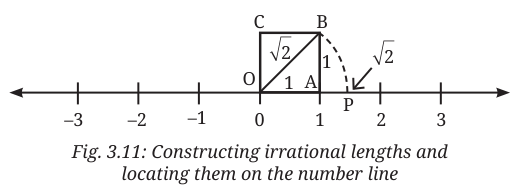
At the point √2 on the number line (point P), draw a perpendicular of length 1 unit; the hypotenuse from O is √(2 + 1) = √3. Mark it on the line with a compass. Repeat: from √3, a unit perpendicular gives √4 = 2, then √5, and so on. In general, from √n a unit perpendicular gives a hypotenuse √(n + 1). (Alternatively, √5 directly: OA = 2 units, AB = 1 unit perpendicular
⇒ OB = √5.)
Find the decimal expansions of 10/3 and 11/12. What do you observe?
Answer
10/3 = 3.333… = 3.3 – the digit 3 repeats from the first decimal place.
11/12 = 0.91666… = 0.916 – the digits 9 and 1 do not repeat, then 6 repeats forever.
Both are non-terminating repeating; the repeating part may start right after the decimal point or after some non-repeating digits.
Exercise Set 3.5
Without long division, decide which terminate: 7/20, 4/15, 13/250. Then check.
Answer
Number | Denominator factors | Type | Decimal |
7/20 | 2² × 5 | Terminating | 0.35 |
4/15 | 3 × 5 (has 3) | Repeating | 0.2666… = 0.26 |
13/250 | 2 × 5³ | Terminating | 0.052 |
Find 1/13 by long division. Identify the repeating block. Is it cyclic when you evaluate 2/13? Compute 3/13, 4/13, … What do you notice?
Answer
1/13 = 0.076923 – repeating block 076923 (6 digits).
2/13 = 0.153846 – a different block, not a rotation of 076923.
3/13 = 0.230769, 4/13 = 0.307692 – these are rotations of 076923.
Observation: The twelve fractions n/13 split into two families of six:
• 1, 3, 4, 9, 10, 12 (out of 13) use rotations of 076923;
• 2, 5, 6, 7, 8, 11 (out of 13) use rotations of 153846.
So 1/13 is only "partly" cyclic, unlike 1/7, where all six multiples are rotations of one block.
Classify as rational or irrational; give fractions for rational ones.
(i) √81 = 9 – rational = 9/1
(ii) √12 = 2√3 – irrational
(iii) 0.33333… – rational = 1/3
(iv) 0.123451234512345… = 0.12345 – rational = 12345/99999 = 4115/33333
(v) 1.01001000100001… – irrational (the number of zeros keeps growing, so no single block repeats)
(vi) 23.560185612239874790120 – rational (it terminates) = 23560185612239874790120/1021 = 589004640305996869753/(25 × 1018)
Answer
Explain using algebra why 0.9 = 1.
Answer
Let x = 0.999… Then 10x = 9.999…
10x − x = 9.999… − 0.999…
⇒ 9x = 9
⇒ x = 1.
So 0.999… is exactly 1, not slightly less. (There is no number between them, so they must be the same point on the number line.)
Find more numbers n whose reciprocals 1/n give cyclic repeating blocks.
Answer
Such n are primes for which the block of 1/n has the maximum length n − 1: 7, 17, 19, 23, 29, 47, 59, 61, 97, …
Example: 1/17 = 0.0588235294117647 (16 digits); 2/17, 3/17, …, 16/17 are all rotations of this block.
Think and Reflect (√−1)
What is the square root of −1? No real number squared gives a negative number (both 1 × 1 and (−1) × (−1) equal 1). So √−1 is not on the real number line. Mathematicians define a new number i with i² = −1 – the imaginary unit – studied in higher classes.
End-of-Chapter Exercises
Answer
Convert by long division: (i) 3/50 (ii) 2/9
(i) 3/50 = 0.06 (terminating)
(ii) 2/9 = 0.222… = 0.2 (non-terminating repeating)
Prove that √5 is irrational.
Answer
Assume √5 is rational: √5 = p/q, where p, q are integers, q ≠ 0, with no common factor other than 1.
Squaring: 5 = p²/q²
⇒ p² = 5q². So 5 divides p², and since 5 is prime, 5 divides p. Let p = 5k.
Then 25k² = 5q²
⇒ q² = 5k², so 5 divides q², and hence 5 divides q.
Thus 5 divides both p and q – contradicting that they have no common factor. So our assumption is wrong, and √5 is irrational.
Convert to p/q: (i) 12.6 (ii) 0.0120 (iii) 3.052 (iv) 1.235 (v) 0.23 (vi) 2.05 (vii) 2.125 (viii) 3.125 (ix) 2.1625
(i) 12.6 = 126/10 = 63/5
(ii) 0.0120 = 120/10000 = 3/250
(iii) x = 3.05252…; 1000x = 3052.5252…, 10x = 30.5252…; 990x = 3022 ⇒ x = 3022/990 = 1511/495
(iv) x = 1.23535…; 1000x = 1235.3535…, 10x = 12.3535…; 990x = 1223 ⇒ x = 1223/990
(v) x = 0.2323…; 100x = 23.2323…; 99x = 23 ⇒ x = 23/99
(vi) x = 2.0555…; 100x = 205.555…, 10x = 20.555…; 90x = 185 ⇒ x = 185/90 = 37/18
Answer
(vii) x = 2.12555…; 1000x = 2125.555…, 100x = 212.555…; 900x = 1913
⇒ x = 1913/900
(viii) x = 3.12555…; 1000x = 3125.555…, 100x = 312.555…; 900x = 2813
⇒ x = 2813/900
(ix) x = 2.16251625…; 10000x = 21625.1625…; 9999x = 21623
⇒ x = 21623/9999
Answer
Locate on the number line: (i) 0.532 (ii) 1.15
(i) Use successive magnification: 0.532 lies between 0.5 and 0.6; divide this into 10 parts – it lies between 0.53 and 0.54; divide again into 10 parts and mark the 2nd point after 0.53.
(ii) 1.1555… lies between 1.1 and 1.2, then between 1.15 and 1.16, then between 1.155 and 1.156, and so on – it is very close to (just above) 1.155. (As a fraction it is 52/45.)
Find 6 rational numbers between 3 and 4.
Answer
3.1, 3.2, 3.3, 3.4, 3.5, 3.6 (or 22/7, 23/7, 24/7, 25/7, 26/7, 27/7).
Find 5 rational numbers between 2/5 and 3/5.
Answer
2/5 = 12/30 and 3/5 = 18/30
⇒ 13/30, 14/30, 15/30, 16/30, 17/30 (i.e. 13/30, 7/15, 1/2, 8/15, 17/30).
Find 5 rational numbers between 1/6 and 2/5.
Answer
LCM 30: 1/6 = 5/30, 2/5 = 12/30
⇒ 6/30, 7/30, 8/30, 9/30, 10/30 (i.e. 1/5, 7/30, 4/15, 3/10, 1/3).
If x/3 + x/5 = 16/15, find x.
Answer
(5x + 3x)/15 = 16/15 ⇒ 8x = 16 ⇒ x = 2
a, b are non-zero rationals with a + 1/b = 0. Is ab positive or negative?
Answer
a = −1/b
⇒ ab = (−1/b) × b = −1. So ab is negative. (a and b must have opposite signs.)
A terminating decimal has its last non-zero digit in the 4th decimal place. Show it can be written as p/10⁴, p not divisible by 10. Must its denominator in lowest form be divisible by 2⁴ or 5⁴?
Answer
Such a number looks like a.b1b2b3b4 with b4 ≠ 0. Multiplying by 10⁴ gives an integer p = ab1b2b3b4 whose last digit b4 ≠ 0, so p is not divisible by 10, and the number = p/10⁴.
Yes, in lowest form the denominator is divisible by 2⁴ or by 5⁴. Since 10⁴ = 2⁴ × 5⁴ and p is not divisible by 10, p cannot contain both the factor 2 and the factor 5. So when we cancel common factors, either all the 2s or all the 5s of the denominator remain:
- If p is not divisible by 5, the 5⁴ stays: e.g. 0.0012 = 12/10000 = 3/2500 = 3/(2² × 5⁴).
- If p is not divisible by 2, the 2⁴ stays: e.g. 0.0005 = 5/10000 = 1/2000 = 1/(2⁴ × 5³).
Without dividing, is 18/125 terminating? If so, how many decimal places?
Answer
125 = 5³, which has only the prime 5, so it terminates. 18/125 = (18 × 8)/(125 × 8) = 144/1000 = 0.144 – 3 decimal places.
A rational number in lowest form has denominator 2³ × 5. How many decimal places will it have?
Answer
Multiply numerator and denominator by 5² to get denominator 2³ × 5³ = 10³. So the decimal ends at the 3rd decimal place – it has 3 decimal places. (Since the fraction is in lowest form, the numerator is odd, so the last digit is non-zero; e.g. 1/40 = 0.025.)
a = 7/12, b = 5/6. Express as k1/m and k2/m with k2 − k1 > 6. Write five rationals between them. Explain why k2 − k1 > n + 1 is needed to find n such numbers.
Answer
With m = 12: 7/12 and 10/12 (difference 3 – too small). With m = 36: a = 21/36, b = 30/36, and k2 − k1 = 9 > 6.
Five rationals between them: 22/36, 23/36, 24/36, 25/36, 26/36 (any five of 22/36 to 29/36).
Reason: With a common denominator m, the integers strictly between k1 and k2 are k1 + 1, …, k2 − 1, which is k2 − k1 − 1 numbers. To get n of them we need k2 − k1 − 1 ≥ n. The condition k2 − k1 > n + 1 makes sure there are enough integer numerators (it gives at least n + 1, more than the n we need). If the gap is too small, we simply choose a bigger common denominator m.
x + y + z = 0 and xy + yz + zx = 0. Show that x = y = z = 0.
Answer
(x + y + z)² = x² + y² + z² + 2(xy + yz + zx).
0 = x² + y² + z² + 2(0)
⇒ x² + y² + z² = 0.
Squares of rational numbers are never negative, and a sum of non-negative numbers is 0 only if each is 0. So x² = y² = z² = 0, i.e. x = y = z = 0.
Show that (a + b)/2 lies between the rational numbers a and b.
Answer
Let a < b. Then:
a = (a + a)/2 < (a + b)/2, since a < b.
(a + b)/2 < (b + b)/2 = b, since a < b.
So a < (a + b)/2 < b. Also, (a + b)/2 is rational because sums and quotients (by non-zero numbers) of rationals are rational.
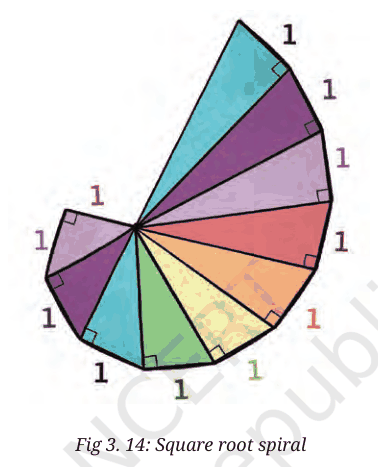
Find the lengths of the hypotenuses of all the right triangles in the square root spiral (Fig. 3.14).
Answer
The first triangle has both legs 1, so its hypotenuse is √(1 + 1) = √2. Each next triangle uses the previous hypotenuse and a new unit leg: √((√2)² + 1) = √3, then √4 = 2, and so on. The spiral in the figure has 10 triangles, so the hypotenuses are:
√2, √3, √4 = 2, √5, √6, √7, √8 = 2√2, √9 = 3, √10, √11
Extra Practice Questions
1. Is the product of two irrational numbers always irrational? No: √2 × √2 = 2 (rational), but √2 × √3 = √6 (irrational).
2. Express 0.47 as p/q. 47/99.
3. Which of 3/8, 7/30, 11/64 have terminating decimals? 3/8 = 0.375 and 11/64 = 0.171875 terminate; 7/30 (denominator has 3) repeats.